Feeds:
Posts
Comments

Gora Tax-Evasion

When I asked our new driver where we could buy cheap plants for the apartment, I wasn’t expecting the place we ended up.

We drove into Santacruz, a few miles north of Bandra. Once off the highway and down a long road, we started slowing down.

“Ok, here ma’am,” the driver said.
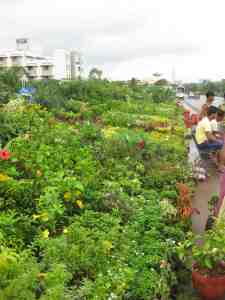
The side of the road plant market
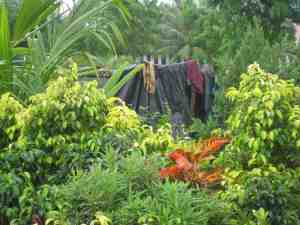
The houses behind the plant market

I looked out my window as he pulled over and stopped. I hadn’t noticed as we’d been driving, but the entire roadside was lined with plants. Plants up and down as far as the eye could see – trees, bushes, flowering plants, everything . And behind the rows and rows of flowers and trees were small slum houses. It was a jarring sight – colorful luscious plants hiding the homes of the people selling them. And the many sellers were out, watching us emerge from the car.

We immediately got a sales pitch: “What you looking for? What you want? I have good plants, very good trees. Or flower you like? This one tree is 300 rupee,” one seller said, pointing at a large tree.

“Teen-saw rupiya? Neh, neh” I replied, indicating that 300 rupees was too much. In reality 300 rupees is only $6 and change. It’s hard to see a five-foot tall tree for the price of a large ice cream in New York as a bad deal. But you can’t think like that here – if you constantly convert in your head you’ll allow yourself to be overcharged over and over again. You have to bargain for what is fair.

As it’s been with most locals, the seller found even my very very limited Hindi quite surprising. No one expects me to know anything, so the most basic phrases and numbers get me far. I kept walking, with the hopes of now being taken more seriously.

For shopping, this tactic has generally been working for me now that I’ve learned the basic numbers. And once I’ve confused people with my little bits of Hindi, I use a foolproof phrase that makes them like me as well (or at least gets them to laugh at me enough to like me a little bit more than they would normally). I had realized the power of this phrase a few days previously while negotiating with a man selling me bananas.

“Kitna huah?” I’d asked (How much?).
“40 rupees ma’am”
“Chalees rupiya?” He looked at me, surprised that I knew the word in Hindi for 40.
“Yes,” he laughed, “Chalees rupiya. That is the price.”
“Neh, neh.” I said, knowing full well that a dozen bananas should be closer to 20 or 30 rupees. But I knew my white face was stopping him from treating me fairly.

“Kyoo gora tax?” I asked

The banana seller laughed. I had asked him why he gave me a white person tax. He found this very amusing and immediately changed the price. With some price knowledge attached to a bit of humor I could at least escape some of price gauging that came with my race.

So I asked the flower seller the same thing: “Kyoo gora tax?”

Nisha started laughing immediately while the seller just looked at me. He started chuckling, clearly amused. He walked over to his fellow sellers and began to talk animatedly. He was telling them what I said and they all were looking over and smiling. I’d won them over – I was willing to make fun of myself and so now we could begin to bargain with real prices.

potting the plants

We picked out one large tree and four medium flowering plants. After my cajoling and Nisha’s instance, all the plants together were priced at a more realistic 345 rupees. The young boys who’d been watching the negotiations intently were now instructed to begin potting the plants. They sat down on the wet ground, dug up mud, tenderly picked away old dirt from the roots, and placed my new plants in their containers.

I’m not used to slums yet. It’s still hard for me to negotiate with a man when I can see that his house is barely standing and that he has no toilet or running water. But for this time at least I felt like everyone had gotten a fair shake – and perhaps a little amusement.

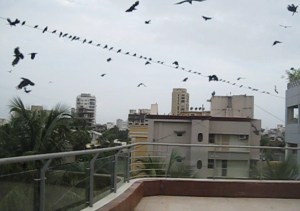
Crow-cophony

I know this is going to make me sound like a crazy bird lady, but the crows outside my windows drive me nuts.

Mumbai has all sorts of creatures roaming around (I would like to be politically correct and say this is mostly due to the tropical climate, but in all honesty the plethora of animals may also stick around because of the trash layer that permeates a majority of the city). There are lizards of every shape and size crawling outside our walls and occasionally inside. We saw a rat the size of Phoebe on our porch the other night. Cows live on the streets. On our block alone at least ten street dogs have claimed the territory.

My new favorite toy AKA the mosquito racket

And the mosquitoes are so ubiquitous that we had to buy ‘mosquito rackets’ — electric tennis rackets that kill bugs on impact (When I say ‘we had to buy’ I really mean ‘I thought it would be fun’).

I don’t mind most of these things. Nisha is scared to death of lizards, but Daniel and I are ok with just sweeping them away. The rat so far seems to be a one-time thing that only came out due to heavy monsooning. The dogs leave you alone and the cows are normally tied up. And the mosquitoes now offer a chance to watch uncoordinated people try to chase a fast-moving insect around an apartment with a racket (i.e., me).

But the crows are inescapable. They’re inescapable and — dare I say it — a little bit psycho? When I first got here I thought they were like bigger and more tropical looking pigeons. But I was wrong.

Crows are everywhere

The insanity starts every morning as the sun comes up. They fly around, sit on telephone wires and chatter about their mornings. As the day continues they migrate to the rails of my porch. They sit, molt, do their business and look at me as though thinking, “What are you going to do about it?”

But recently, the crazy crows got even weirder. When the monsoon is imminent it would seem normal for animals to act a bit off. But for these crazy birds, ‘off’ is an understatement. The other day heavy rain was on the horizon. So the birds decided to have an angry convention on my terrace. They flew in droves in circles above my head. They didn’t stop – they just circled and circled with a madcap intensity. Dozens gathered to sway on the telephone wires and watch the circling. And the noise was deafening. You would have thought the end of the world was coming (If you need evidence, I’ve embedded a video to give you an idea). I have no idea what started it, but only the torrential downpour of the monsoon could (literally) drown them out.

But it never stops for long. Even as I sit here writing, the birds are crowing. They’re saying goodnight as the sun goes down. I usually get a bit of peace and quiet until morning. Yet even as I write about how obtrusive they are I can’t help smiling – they’re insane and impossible, but even when I want to complain about them they’ve become such a part of my surroundings that I can’t help but feel a bit protective. They’re lunatics, but they’re the lunatics who reside on my porch.

Only a crazy bird lady would say that.

Language Barriers

“Sahth, sarth and satr?” I asked. “Don’t those all sound very similar?”

“Oh yes,” Nisha replied. “Sometimes I can’t tell sahth and sarth apart. When people speak quickly you don’t know the difference.”

“But doesn’t that confuse people with numbers? You can’t make seven and sixty sound exactly the same. What if I asked how much something was and you said sixty but I thought seven – I might get really excited by how cheap it was!”

Nisha just laughed as she continued to sort mint leaves from their stalk. I was sitting on the counter and she on her stool – we were both drinking our usual cups of chai and she was (attempting) to teach me how to count.

We’d gotten into a good pattern with our learning. She would teach me a few Hindi words a day and I would practice reading with her. It was a good trade. We’d spent the previous part of the morning trying to go over why certain words in English needed an E on the end.

“It sounds like ‘bloo’.” I said.

“But why is there an E? Why isn’t it B L U?”

“I don’t know. It just isn’t”

“How would I know that that word doesn’t sound like bloo-ee?”

I thought about it for a moment. I really am a terrible reading teacher. I’ve gained a new-found respect for primary school educators– how can you possibly explain the English language when it doesn’t make logical sense?

I’d started with packaging. That was the easiest place to find simple words. On this particular day we were reading the label on a box of flour, and the company’s name was ‘Blue Bird’. Nisha knew all the letters from the beginning, so that had made the task easier. But now we just had to try and learn what each one sounded like in the context of a word.

I looked at ‘bird’. Nisha was sounding it out, “Buh…. Ih… rrrr… duh… Byrrduh…Beard…. Bird?”

“yes!” I said.

“yes?” She smiled at me and then looked at Phoebe. She cupped Phoebe’s face in her hands. “Phoebe, that says bird. You can’t tell because you’re a dog.”

We both laughed. Poor Phoebe was used to staring at us – she sat there hoping a morsel of food would come her way, but instead she had to watch as we repeated words over and over again.

But then it had been my turn. And just as quickly as I had been annoyed with how silly English writing was I soon turned on Hindi.

In English, our multiples of ten are simple. Twenty, thirty, fourty, fifty, sixty… It made sense. But in Hindi? Seven and sixty sounded practically the same, but six and sixty don’t even start with the same letter. Why was two ‘do’ and twenty ‘bees’? Why is eight ‘ought’ and eighty ‘asi’? My mind swam with numbers. I just tried reciting.

“Ek, do, teen, char, panch,” I said over and over, counting to five. Nisha chuckled at my pronunciation. Hindi words don’t have hard endings – so while I might say teen with an emphasis on the N, in Hindi it barely registers. At least my pronunciation gives any Hindi speaker listening a good laugh.

And slowly but surely, we’re both coming along. While I can’t pronounce the Hindi words and Nisha can’t understand why English isn’t logical (we had the most trouble with the word ‘onion’. Can anyone explain to me why it is spelled that way?) it’s the small progress that counts. And that’s all anyone can hope for. At least we both have each other to laugh a little bit along the way towards bettering ourselves one day at a time.

Contradictory Nights

Everyone is always telling me that India is full of contradictions – the modern city of Mumbai can quickly morph into the old hierarchical maddening Bombay.  Nothing displays the contradictions in a more quirky way then the city’s nightlife.   From the outfits to the hierarchy to the cost to the location, it’s a completely different side to the city altogether.

The first thing that struck me was that many of Mumbai’s ‘trendiest’ bars are situated in hotels (I have to put trendy in quotations because it seems like nothing stays trendy for long – places that open here one month can be declared ‘over’ by the next. But of course, how would I ever know?).  Last night, for example, we found ourselves driving into a suburban Hyatt, near the domestic airport. It was corporate on the outside and seemingly the last place you’d find young people gathering to spend their evening.

Our car drove up and was stopped. As is standard at every hotel here, the trunk was opened and mirrors on long poles were placed under the car in order to confirm that we were safe to enter.  A petite woman in a security guard uniform with a bindi on her forehead searched through my purse as I made my way through a metal detector.  Even in our suburban enclaves there’s no escaping the realities that Mumbai has faced in recent years.

We walked into an empty bright lobby. We could have been in any generic Western-styled hotel in any part of the world. The vibrant, dirty, humid air of Mumbai had been replaced by a contradictory sterile interior accented by a few Indian-style paintings and pieces of furniture.

We went downstairs to find a line of thirty people trying to get into the bar.  There was no method to the madness, just various people in all kinds of outfits trying to jostle their way to the front of the pack. We moved to the side but soon found ourselves the center of attention for the bouncers, who were eager to let us pay and come in.

I looked back at the sea of faces that didn’t seem fazed or bothered.  No one but me had apparently noticed (or at least reacted to) the white people who were allowed in first.

This particular bar is called China House, and I’d heard quite varying descriptions before we showed up:

“Oh, that place is really fun if you want to dance.” (White expats who are new to the city)

“It’s a cool bar if you want to go out in Bandra and not have to drive all the way to South Bombay” (Indians who grew up in the US but now live in Bandra)

“I hear that a lot of hookers go there since it’s expensive to get into” (South Bombay Indians who dislike anything in the north)

Yes, these are the multitude of testimonies you’ll hear about almost any bar in Bombay – places come and go so quickly that it’s impossible to ever know what to expect. But since I’m not usually a late night person anyway, my expectations are low. As such, I’ve just been open to trying everything new.

And this certainly was new – not only am I clearly not used to being ushered into bars based on the whiteness of my face, but its also always jarring to experience the difference between “inside and ‘outside” – the difference in what people wear.

It’s bizarre to watch  — While you certainly see a variety of clothing on the street (from saris to kurtas to jeans and t-shirts), there’s nothing like what you’ll see INSIDE a bar. Women come into clubs initially covered up  (a scarf will be strategically wrapped around clothes when outside), but once they come in it’s a free for all.  Designer dresses, mini-skirts and tight-fitting clothing surround you – you could quickly forget you’re in Bombay and wonder whether you had somehow wound up in Miami.  And the men fit the bill as well – guys with gelled back hair wear Armani exchange tops underneath blazers while sipping on their overpriced martinis and glasses of scotch.

I stood and watched throughout the night. The crowd and danced cheered when the DJ played Justin Bieber or Usher while others tried to have conversations over the music. But when we finally left we were spit back out into Mumbai. The rain poured down, all the drivers ran red lights, and a Bollywood tune overtook the pop music still running in my head.

Our shipment has arrived

I couldn’t believe I had to stand here and watch another heated discussion over cardboard.

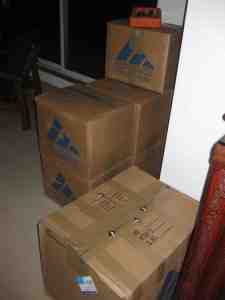
Our security guard and the man from our moving company were going ten rounds over which of them got to keep the boxes after all of our belongings had been removed.  I watched, bemused, but nothing could keep me from the happiness of seeing my own items slowly emerge from their lucrative cardboard containers.

We have been in our apartment since June 30th. We had been told our shipment (clothes, kitchenware, some furniture – everything) would arrive the next day, on July 1st. Of course, as with most things here, it took quite a bit longer. Our shipment couldn’t be scheduled to come into India because the monsoon and overbooking had backed up flights. The monsoon?! As though they didn’t know a monsoon was coming and couldn’t have planned for it.  Then the airline left half our shipment behind on the layover in Qatar. Then it had to get through customs.

But here it was, 15 days late, and I still couldn’t get unpacked because somehow cardboard needs to be a recurring theme in my life. Daniel finally stepped in.

“What is the problem?”

“Sir, your security guard says he helped unload so he should get boxes in return.”

“So… again, what’s the problem?”

“Well sir, these boxes belong to our company.”

“No, they belong to me. Don’t they?”

“Well… yes sir. I guess sir.”

“Ok. So lets give him some boxes and you take the rest of the boxes.”

There he was, my mediating hero, solving the second great cardboard dilemma of 2010. Our security guard went downstairs, triumphant at his (partial) victory, while the movers continued to unpack.

As each item came out, our apartment felt more like home. But I was also struck by how many items we’d brought that we wouldn’t need. Every cotton polo shirt or light spring cardigan now appears to me as heavy as winter clothing. I’ve gotten so used to wearing light kurtas and thin cotton leggings or flimsy nylon t-shirts and linen capris.

While we packed most of our winter clothes, we were still foolish to think that we could just fully pack up our old apartment and transfer it uniformly to the opposite side of the world. A good percentage of our stuff is going to be shoved to the backs of closets, never to see the Indian light of day and only re-emerging into the New York air.

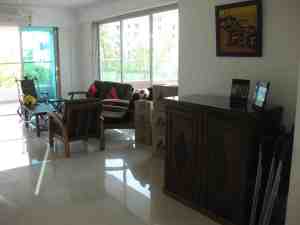
The (almost) finished apartment

But it’s ok because we’ve already been preparing ourselves for some of these replacements. Nisha has bought pans for roti’s and a pressure cooker for rice – our wok will probably just get a year off. I’ve already stocked up on free-flowing lightweight clothing and so the out-of-place elements in my closet will just seem new again in a year. Even our kettle will get a breather, since Indian chai needs a pot to boil both water and milk (used in the same proportion).

But while some items are replaced, for the most part it’s a merging of the two worlds – our kitchenware sits in a cupboard next to one of the ubiquitous gas cylinders everyone has here.  Photos of family and friends now intermingle with our new bar and rocking chair.  We can watch our DVDs while looking out the window to see huge Indian crows staring back. It’s a new kind of home — but with our belongings arriving late on Indian time, we’d at least been given a couple weeks to prepare.

Another view of the apartment

Starting from Scratch

I have finally begun what I hope will be a long-term effort during my time here in Bombay.

Everyone has been asking me since I arrived: What are you hoping to do here? And the answer to that question ranges from vague to very specific. It’s either: “I’m hoping to take a step back from my hectic life and do something valuable.” or, the more honest and blunt, “I have no actual plan.”

I knew one thing: I wanted to use the skills I’ve learned over the last few years to be truly valuable somewhere in a way others couldn’t. The only question was, what on earth would that entail?

Luckily I was put in contact with a woman who certainly understood my vantage point. She is a former journalist who tired of the profession and started her own non-profit that aims to give underprivileged women a voice through the use of media and communications.  After listening to my story and hearing what I was hoping to do, she suggested a seemingly great solution: I could go to the various NGO’s her organization partnered with and document their stories. They could use it for their websites, or presentations or fund-raising — wherever it would be helpful.

We decided to start with an organization that works with domestic violence victims in Dharavi, one of the world’s largest slums.

It’s hard for me to explain Dharavi in any knowledgeable context, since my first visit was very short and contained. But just the statistics alone can bring some perspective. It’s estimated that at least a million people live in Dharavi — an area that’s less than one square mile. Or, to use a National Geographic estimate, there’s 18,000 people living on every acre. Rents can be as low as $4 a month. And you won’t have trouble finding it – Dharavi is a 15-minute drive across the highway from Bandra. This prime real estate has led to some controversial re-development proposals in recent years (although none seem to be quite able to get off the ground, from what I have been told).  Most people in the West became familiar with Dharavi (even if they don’t know it) because the childhood scenes in the film Slumdog Millionaire were shot there.

With all that in mind I drove into Dharavi to discuss the work that I would be doing.

I didn’t see a lot – the organization is based in a public hospital on one of the main roads, so I have yet to experience the teeming mazelike interior of the slum. But even just driving down the road you can understand why there are two very different mindsets about this place.

The obvious negative descriptions are apparent – Most of the structures appeared to be built with sheets of materials cobbled together, often rusting and filled with holes. One building’s owners had tied ladders horizontally in-between wall materials in order to create an open window. Dirt was everywhere, casting a dark pall on the haphazard structures. The bright bursts of color that exist everywhere else in Mumbai were only visible on the saris of women walking through the street.

But it was clear from the outset why this place is also known for a sense of community. Those sari-clad women chatted animatedly as they walked together down the street.  Down the road, a man tried to lift something into a truck and another man crossed over the street and offered to help. The main road was lined with every kind of shop imaginable – grocery markets, restaurants, clothing stores. You can understand why residents have been so vocally against development — they have created a life here and their neighbors and families own businesses. It is a city unto itself.

I went into the hospital, up to the small area cordoned off for the domestic violence center. The woman accompanying me told me that the public hospitals are often empty because the doctors who are appointed to work there just don’t show up. Since they are political appointees, no one higher up notices (or chooses to notice) the absences that take place throughout the system.

But the center itself was full of life – the women who worked there were in full motion — holding meetings, typing away at computers, and discussing work over chai.

I took a glass of chai when it was offered and began speaking with the center’s director about what might be useful. What she wanted was to be able to tell the story of their work to the outside world as well as to the organizations that give them funding.  We agreed that I should begin by spending a few days with the women before filming in order to gain a bit of trust and goodwill before jumping in. I could then start filming the women’s daily life in Dharavi as well as the work of the center.

We shook hands and agreed to touch base next week after she’d run the plan by her board. As I got up to leave she announced to the office, “This is Ali. She’s going to do some work with us.” I was immediately inundated with various women coming over to shake my hand and welcome me.

Even in that first meeting, I got the sense that this was a place where I could bring some value. And I hope in the next weeks and months I will be able to.

What Are You Doing Here?

“What are you doing here?” the woman asked me as she openly stared at me. She looked at me from top to bottom — from my white face, to my green and gold kurta, to the waterproof crocs on my feet.

“You mean, in this frame shop?” I responded. I had come to this store to buy frames for the Batik’s we had purchased in Indonesia.

“Nahee, nahee. Here in Bombay. What are you doing here?”

The question wasn’t meant as rude. In fact, I get it quite often because here, I am an oddity. I stand out.  Because of this, it’s perfectly acceptable for people to stare at me as long as they want and to verbalize whatever questions their inquiring minds are bursting to ask.

In India, these questions are normal: Where are you going? What are you doing? Are you here with your husband? Do you HAVE a husband? Where are you living?  Everyone wants to know. And so the solution is very simple –they just ask.

“I live here. I’m living here in Bandra.”
“Ah. Ok.” She then turned her honey colored eyes towards my paintings. “Where are those paintings from?”

Before I could answer, another younger woman decided to pipe up, “Did you paint them? What is this kind of painting? What is this material?

“No,” I responded. “I bought them in Indonesia. It’s wax on cotton and the type of painting is called Batik.”

The women wiggled their heads in affirmation that I had given them the answers they were looking for. Everything was ok now. Their curiosity was satisfied and I was deemed acceptable because I had willingly answered all of their questions, like a good foreigner living here should.

I said thank you to the man who had taken my order (who seemed very glad that I had answered all the questions he had probably been wondering) and went home.

I walked into the apartment and plopped down with a cup of tea, happy that in at least one place I wasn’t strange.  But as I sat reading the paper, the doorbell rang.

I opened the door to an elderly woman in a long colorful sari. She smiled at me.

“Namste,” she said. I replied, “Namaste.” I, of course, didn’t know what to say in Hindi past hello. I made a mental note to ask Nisha how to say, “How can I help you?”

Nisha heard that I was stuck and walked over. She started speaking to the woman in Hindi.  This wasn’t unusual — we’d had people at the door practically ever day. Do you have any papers or cardboard to pick up? Do you need bottled water? Do you want to buy vegetables? Do you need someone to help clean the house?  None of these people ever spoke English, so I was happy Nisha could always politely say “no thank you.”

I listened to the conversation in Hindi, hoping to pick up a few phrases. I, of course, could only really understand the words that were in English. To me, the Hindi conversation sounded like:

“Hindi, hindi, more hindi, lots of hindi, English, a bit more hindi, way more hindi, macaroni, hindi, hindi, concluding hindi.”

The woman said thanks and left.  I turned to Nisha.

“Did you tell her we were English and therefore only ate macaroni?” It was my only guess based on the two words I had known.

She laughed.  “Yes, she was coming here trying to sell vegetable. She wouldn’t hear no, so I told her that you didn’t like Indian food and only ate macaroni every day.”

I couldn’t stop laughing. Here I was, once again, the crazy foreigner.  it’s so funny that to people here, the idea that white people could eat only macaroni all the time seems plausible.

Why wouldn’t we eat macaroni all the time? We look different. We dress different. We speak English in a way that’s hard for people to understand even if they DO speak English.  Why wouldn’t it seem completely normal that we might eat only strange food all the time?  It was a very good excuse that Nisha had created, because now that woman wouldn’t bother us again. So what’s the harm in saying I eat only macaroni?

I am an oddity. And for now, that’s ok.

Expatriate Yourself

I found myself out dancing last night. Head bopping to Shakira, I looked around the setting. What city were we in? We could have been anywhere. A DJ was at front while the Germany-Uruguay game played behind him. Neon green lights darted across the room, hitting a sleek white bar in the back packed with late night revelers.

I was dancing with new friends, friends of Daniel’s, friends of friends from home, and some people I hadn’t even been properly introduced to yet. It was expat night at the Blue Frog and while we were surrounded by a sea of Indians (dressed very differently on the inside than perhaps many would on the outside) but a little enclave of outsiders had formed in the middle. Here I was, someone who normally hated clubs (even if I love dancing – the two don’t usually get to go together due to the massive crowds in New York clubs) and I was having a great time.  It was my first real night out and I’d been able to wade through it with a little help from the community I now belong to.

While I live in Mumbai and I’m trying to experience it to the fullest, I can’t deny that I live in a second world as well – I’m an expat. The expat community of Mumbai lives in the same city as the native Mumbaikers and the millions of Indians who come from all over the country. Yet they have their own way of flowing through the city while still creating their own space in a crowded metropolis.

Expats are like a venn diagram. Every circle interacts with the Indian circle in its own way – on the street, through their jobs or volunteer work, through slowly learned Hindi – but there’s always going to be a portion of an expat circle that stands alone. And so, they all stick together – giving each other advice, living in the same few locations, and crowding certain bars and restaurants. They establish outposts in the city.

Living in Scotland for four years in college never felt like this – I was part of the University community, I belonged. And I was proud that I tried my hardest to make friends primarily with British people (and not corner myself off into an American clique). That felt important to me then – what was the point of going abroad if you only wanted to hang out with people from home?

In a non-University context and in a culture clearly much more different than that of our neighbors across the pond, I think it’s okay to admit that the situation here is different. Here I’m more of a fish out of water – and while it’s admirable to hope that I can immerse myself into Mumbai and it’s people, it would be naive to think I didn’t need the comfort of the built-in community in front of me.  You can make friends on both sides of the aisle here – but as an expat it would be hard to fight the natural inclination to befriend people who a) understand you but b) also are always happy to have and accept new friends, since theirs are always coming and going.  Young expats here are transient. Most come for months or at most years, so being a new person is part of the natural expat life cycle.

Luckily for me, it’s been hilarious realizing that most of the young expats in Bandra are all connected.  A girl I was put in touch with through an Andover connection happened to be living with one of Daniel’s old friends who was in Mumbai. They invited me out last night with a guy who I’d already been put in touch with through another friend from home. And a friend of Daniel’s from work who is also living here is now temporarily living with a girl who turned out be someone Daniel had known in high school. Just when I thought I didn’t know anyone, everyone I COULD know already knows each other.

It really puts the phrase “It’s a small world”, into a funny context.

The friends issue been one of my larger fears moving here – how can I leave my great life with my great friends to go move somewhere where I don’t know a soul? But it’s the expat openness that makes those fears start to recede, even in these early stages where I’m still pretty much on my own (with Daniel of course).

Listening to American pop music in a bar with my own enclave, even for a night, makes it seem like even when the whole world is in front of me, I’ve got pieces of home standing squarely behind me.

Love’s Labour’s Cost

There are a lot of things here that take some getting used to – but none more so than adjusting my expectations when it comes to the cost of labor.

In New York, if I ordered a dozen cupcakes from one of the many, many bakeries I frequented the order might cost $30 (don’t get me started on the cost of cupcakes in New York. That’s another tale of adjusting expectations). But to get them delivered usually costs around $15 – increasing my cost by 50%. But you can’t blame the bakery – the cost of a delivery guy loading the cupcakes, getting to my apartment, ringing my doorbell, delivering the cupcakes and getting back to the bakery might actually cost $15.

In India, $15 might be the cost of hiring a person for an entire week. Americans are uniquely aware of this arbitrage – because we’ve all  seen outsourcing in action by this point.  Yet when you COME here with an American frame of reference, the rationality of this understanding is constantly replaced by the sheer amazement at the low cost of anything that needs a human touch.

I bring this all up because today we went furniture shopping. We’d done our basic shop at Hometown, as previously mentioned, but we had been waiting to buy a few nicer items that we could keep forever.  We had been told to go to Bhaghem Bombay – it’s a store you won’t find in any guidebook, but rave reviewers had assured us that this was the place where you’d get a fair price on some of the most amazing furniture you could imagine.

As with anything here, I kept a healthy dose of skepticism with me as we went into the store. How great could it be?

Harry, the man we’d been told to ask for, greeted us with the enthusiasm of a salesman who knows he has what you want and will make you want even the things you didn’t think you wanted. We were taken into the showroom and I knew we’d been steered in the right direction – beautiful intricately designed hand-carved tables, dressers, trunks and chairs surrounded us. We had come with an idea of what kind of items we were looking for — one big table or storage unit for our living room, perhaps a small side table — but we were immediately drawn to the bar.

Close up of one small section of carving

At the back of the room stood a tall teak bar unit. On the top, on the paneling and even on the back, intricate patterns had been delicately whittled into the surface. We could use it as the storage unit for our living room and, of course, it’s intended use as a bar.  When Harry saw my eye move towards it he immediately sprung to life.

“This one of my favorite pieces. It took artisan three solid months to make. Here, you open–”  he opened the front cabinet to reveal wine racks and drawers and leafs that expanded the size of the piece — “This one of a kind. You not find something like this very often.”

I agreed. I had never seen anything like it. But of course, there was that one nagging question. “What is the price of this one of a kind, artisan carved, very large piece of furniture?”

“Because you recommended to me by a friend, it’s 28,000 rupee. Roughly $600.”

Now, I’ll pause the story here for a minute to put this in perspective. I’m clearly not going to argue that $600 of anyone’s money is a small amount. But when Daniel and I moved to New York and bought our furniture from Ikea- the cheapest store imaginable – our ‘Malm’ dressers (which combined used about as much wood as this bar) cost $300 each. They are the worst made pieces of crap (pardon my French) that you could imagine made from the cheapest wood (and plastic). And we still had to put them together with our own bare hands. A bar made with beautiful teak wood that has three months of carving work and an amazingly complex interior has the value of my two dressers that are barely acceptable in a dorm room.

All our new furniture

We decided we would buy it. How could we not? We can ship our items back at the end of the year by sea freight, and this is an item we literally would keep for the rest of our lives. I also got sucked into getting the most comfortable and beautiful wood and wrought iron rocking chair and we additionally purchased two small tables. Again, for perspective, the small table’s base is carved all the way around. The top of the table has inlaid designs. It cost roughly $50.

The flashes of guilt I’d felt early on in my stay tried to crawl back in (how can they pay skilled artists so little for their life’s work?). But my rationality repeated itself: this is what it costs here. This is the price they are asking for.

We walked out with a handshake from Harry and a promised Tuesday delivery once the items were polished. I also walked out with a new Indian frame of reference — one that meant I might just never be able to walk into a Pottery Barn again.

The Price is Right

I have learned a very important phrase in Hindi, one whose usage can have a grave impact on your wallet. Kitanā?, I can ask. And by saying this in Hindi I can be sure to reduce the cost of any item, even if the cost will still remain in the range of ‘white person price.’ The biggest problem, of course, if that I’m not far enough along in my Hindi to know what the responses to this question mean.

Kitanā, as you may have guessed, means ‘How much?’. In my phrase-a-day approach to learning Hindi, this has been one of the more useful ones. People may get a kick out of me saying ‘Mujhē bhindi achee leh gee’ (I like okra very much) or ‘Tora, tora Hindi bolteh’ (I speak little, little Hindi), but it doesn’t have quite the disarming effect as showing a seller that you’re perhaps a bit wise to their games. Or at least wise enough to have learned the phrase, if not yet the numbers they respond with.

But it’s still, of course, not enough to get a fair price. I think even a lifetime worth of Hindi and the long kurta’s I’ve been wearing wouldn’t get the price as low as if I just looked like I belonged.

Luckily Daniel and I had Nisha along for a day of shopping for household basics, and she had given us strict instructions:

“Don’t let them see us together. Walk in front of me and touch the things you like. I’ll go by a few minutes later and get the real price. Then we can decide if we want to buy.”

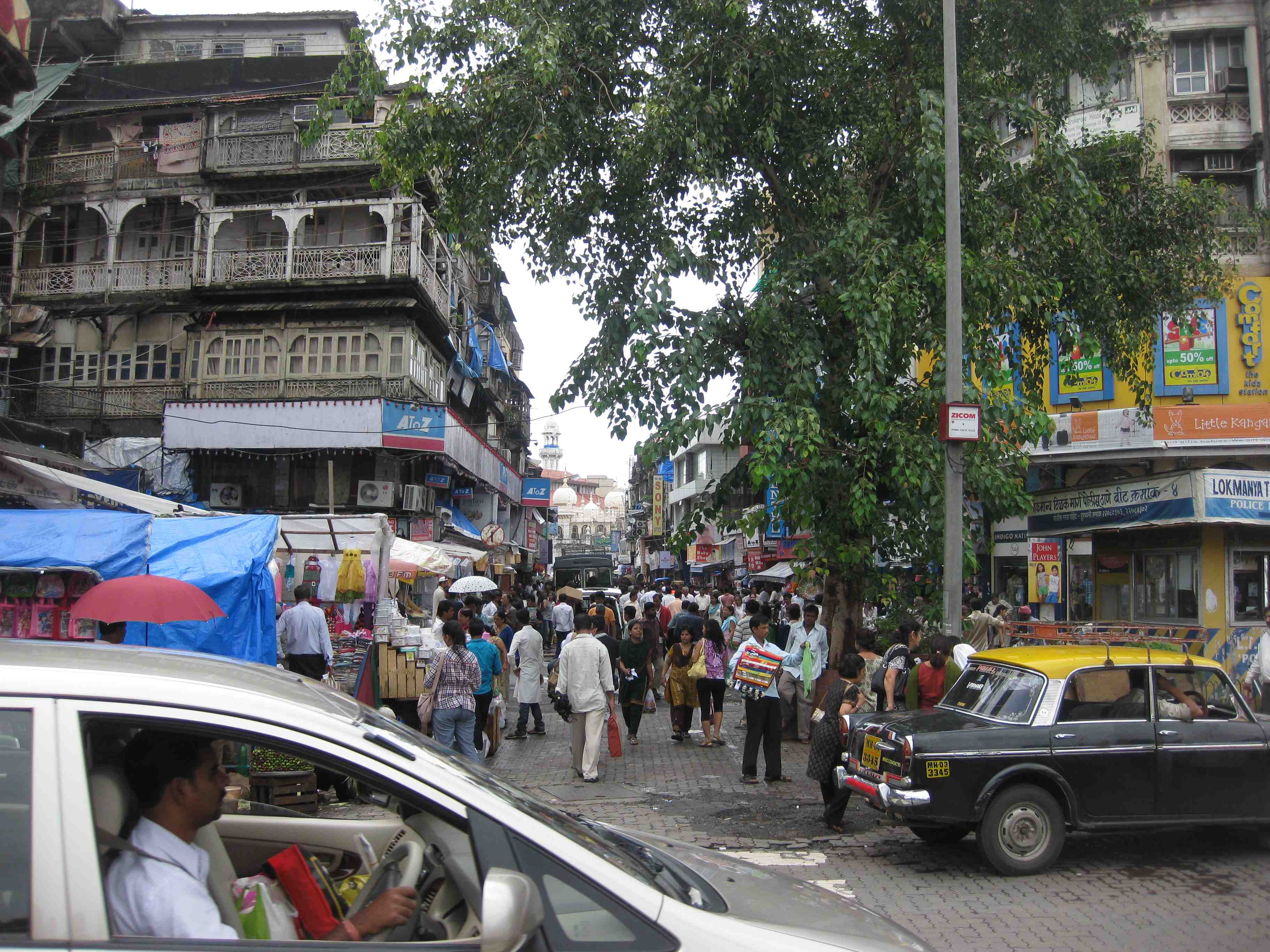
Side streets in Crawford Market

We went to the famed Crawford Market in South Bombay. It’s a building, its a neighborhood, it’s a conglomeration of shops and stands and street-hawkers.  Everyone has something to sell no matter the size or shape of their stall or storefront; and every seller is ready to make a deal. It’s a tourist attraction and local haunt that’s known for its cheap wares and myriad inventory.

We started out testing our pricing system with drying racks. I looked at a few and touched on the ones that we liked. We asked how much. It was 1,500 rupee (about $32). We scoffed and walked away.

A few minutes later Nisha came back.  800 rupee was the new price. But when we went back together to pay, the price suddenly increased to 1,250. We knew we’d have to try and get most of what we were looking for at one place – where they’d have too much to lose if we walked away from all the items.

While Nisha was searching for a singular place to purchase, I wandered over to a lighting store to look at standing lamps.

“How much?” I asked.

“4,400 rupees,” the man said, clearly under the impression that $94 for his most basic cheap standing lamp was a reasonable price to offer a gora.

“Nahee, Kitanā?” I asked (“No, how much”).

“Ah. 2,500,” he replied, still ripping me off but with a little bit more realistic intentions.

I walked out shaking my head at my own stupidity for even trying to negotiate in a place where people would never give me a reasonable rate.  And as I walked, lost in thought, I stepped into one of the monsoon’s ubiquitous puddles, splashing mud into my waterproof shoes and covering my legs. I sighed in frustration.

Many, many shops

But a man in a nearby shop shouted my way and pointed at a bucket of water next to him with a ladle. I said “Shukriyaa” in thanks and began pouring the water down my legs. Here was a man who probably would have tried to screw me if I’d come into his store looking to buy something. But he saw me in distress and immediately wanted to help.

It’s funny – the price structure isn’t personal here. It’s not malicious. It’s just everyone trying to make as much as they can off of the small sales they make.  And for every moment that I get exasperated with India, the people here never fail to make me love them an instant later. It’s just the way it is.

Nisha called me in to the shop she had selected and I thanked the man again for his help. I went in and she handed me a pre-written price list with all the items we needed. The owners weren’t going to haggle with me – they knew we’d walk away if they tried to change so many already agreed upon prices. We had found success.

We spent the other portion of our shopping day in the opposite setting to Crawford Market. We pulled up to the Phoenix Mall and went into a store called Big Bazaar, which is like a dingier Bed Bath and Beyond with a grocery store thrown in the back. We picked up the items we couldn’t get at Crawford Market.

Big Bazaar's rice and lentils

But even at a mall that housed a Zara, Marks and Spencers, Burberry and McDonalds under one roof, you couldn’t stereotype it into a completely Western context. Upstairs in Big Bazaar you can go look at saris and kurtas. And when you walk into the grocery section you run smack into big tubs of rice and lentils, surrounded by prospective shoppers putting their hands in to test the quality. The two men in charge just scoop out bags and bags of the staples as customers flock to their most important section.  It’s a comforting piece of an Indian market sitting in a grocery aisle lit by florescent lights and decorated with signs showing happy families in polo shirts and jeans.

When we came back to our apartment, purchases in hand, we felt victory was ours. We’d gotten the basics we needed and we’d added some Indian cookware and flatware to our repertoire. But of course, when we tried to take it all upstairs the elevator had stopped working – and haggling and Hindi couldn’t buy us out of this one. Never a dull moment here – and never a time when we’re allowed to forget that we’re always going to have to try a little bit harder to make it all work.