Feeds:
Posts
Comments

Archive for July, 2010

I have finally begun what I hope will be a long-term effort during my time here in Bombay.

Everyone has been asking me since I arrived: What are you hoping to do here? And the answer to that question ranges from vague to very specific. It’s either: “I’m hoping to take a step back from my hectic life and do something valuable.” or, the more honest and blunt, “I have no actual plan.”

I knew one thing: I wanted to use the skills I’ve learned over the last few years to be truly valuable somewhere in a way others couldn’t. The only question was, what on earth would that entail?

Luckily I was put in contact with a woman who certainly understood my vantage point. She is a former journalist who tired of the profession and started her own non-profit that aims to give underprivileged women a voice through the use of media and communications.  After listening to my story and hearing what I was hoping to do, she suggested a seemingly great solution: I could go to the various NGO’s her organization partnered with and document their stories. They could use it for their websites, or presentations or fund-raising — wherever it would be helpful.

We decided to start with an organization that works with domestic violence victims in Dharavi, one of the world’s largest slums.

It’s hard for me to explain Dharavi in any knowledgeable context, since my first visit was very short and contained. But just the statistics alone can bring some perspective. It’s estimated that at least a million people live in Dharavi — an area that’s less than one square mile. Or, to use a National Geographic estimate, there’s 18,000 people living on every acre. Rents can be as low as $4 a month. And you won’t have trouble finding it – Dharavi is a 15-minute drive across the highway from Bandra. This prime real estate has led to some controversial re-development proposals in recent years (although none seem to be quite able to get off the ground, from what I have been told).  Most people in the West became familiar with Dharavi (even if they don’t know it) because the childhood scenes in the film Slumdog Millionaire were shot there.

With all that in mind I drove into Dharavi to discuss the work that I would be doing.

I didn’t see a lot – the organization is based in a public hospital on one of the main roads, so I have yet to experience the teeming mazelike interior of the slum. But even just driving down the road you can understand why there are two very different mindsets about this place.

The obvious negative descriptions are apparent – Most of the structures appeared to be built with sheets of materials cobbled together, often rusting and filled with holes. One building’s owners had tied ladders horizontally in-between wall materials in order to create an open window. Dirt was everywhere, casting a dark pall on the haphazard structures. The bright bursts of color that exist everywhere else in Mumbai were only visible on the saris of women walking through the street.

But it was clear from the outset why this place is also known for a sense of community. Those sari-clad women chatted animatedly as they walked together down the street.  Down the road, a man tried to lift something into a truck and another man crossed over the street and offered to help. The main road was lined with every kind of shop imaginable – grocery markets, restaurants, clothing stores. You can understand why residents have been so vocally against development — they have created a life here and their neighbors and families own businesses. It is a city unto itself.

I went into the hospital, up to the small area cordoned off for the domestic violence center. The woman accompanying me told me that the public hospitals are often empty because the doctors who are appointed to work there just don’t show up. Since they are political appointees, no one higher up notices (or chooses to notice) the absences that take place throughout the system.

But the center itself was full of life – the women who worked there were in full motion — holding meetings, typing away at computers, and discussing work over chai.

I took a glass of chai when it was offered and began speaking with the center’s director about what might be useful. What she wanted was to be able to tell the story of their work to the outside world as well as to the organizations that give them funding.  We agreed that I should begin by spending a few days with the women before filming in order to gain a bit of trust and goodwill before jumping in. I could then start filming the women’s daily life in Dharavi as well as the work of the center.

We shook hands and agreed to touch base next week after she’d run the plan by her board. As I got up to leave she announced to the office, “This is Ali. She’s going to do some work with us.” I was immediately inundated with various women coming over to shake my hand and welcome me.

Even in that first meeting, I got the sense that this was a place where I could bring some value. And I hope in the next weeks and months I will be able to.

Read Full Post »

“What are you doing here?” the woman asked me as she openly stared at me. She looked at me from top to bottom — from my white face, to my green and gold kurta, to the waterproof crocs on my feet.

“You mean, in this frame shop?” I responded. I had come to this store to buy frames for the Batik’s we had purchased in Indonesia.

“Nahee, nahee. Here in Bombay. What are you doing here?”

The question wasn’t meant as rude. In fact, I get it quite often because here, I am an oddity. I stand out.  Because of this, it’s perfectly acceptable for people to stare at me as long as they want and to verbalize whatever questions their inquiring minds are bursting to ask.

In India, these questions are normal: Where are you going? What are you doing? Are you here with your husband? Do you HAVE a husband? Where are you living?  Everyone wants to know. And so the solution is very simple –they just ask.

“I live here. I’m living here in Bandra.”
“Ah. Ok.” She then turned her honey colored eyes towards my paintings. “Where are those paintings from?”

Before I could answer, another younger woman decided to pipe up, “Did you paint them? What is this kind of painting? What is this material?

“No,” I responded. “I bought them in Indonesia. It’s wax on cotton and the type of painting is called Batik.”

The women wiggled their heads in affirmation that I had given them the answers they were looking for. Everything was ok now. Their curiosity was satisfied and I was deemed acceptable because I had willingly answered all of their questions, like a good foreigner living here should.

I said thank you to the man who had taken my order (who seemed very glad that I had answered all the questions he had probably been wondering) and went home.

I walked into the apartment and plopped down with a cup of tea, happy that in at least one place I wasn’t strange.  But as I sat reading the paper, the doorbell rang.

I opened the door to an elderly woman in a long colorful sari. She smiled at me.

“Namste,” she said. I replied, “Namaste.” I, of course, didn’t know what to say in Hindi past hello. I made a mental note to ask Nisha how to say, “How can I help you?”

Nisha heard that I was stuck and walked over. She started speaking to the woman in Hindi.  This wasn’t unusual — we’d had people at the door practically ever day. Do you have any papers or cardboard to pick up? Do you need bottled water? Do you want to buy vegetables? Do you need someone to help clean the house?  None of these people ever spoke English, so I was happy Nisha could always politely say “no thank you.”

I listened to the conversation in Hindi, hoping to pick up a few phrases. I, of course, could only really understand the words that were in English. To me, the Hindi conversation sounded like:

“Hindi, hindi, more hindi, lots of hindi, English, a bit more hindi, way more hindi, macaroni, hindi, hindi, concluding hindi.”

The woman said thanks and left.  I turned to Nisha.

“Did you tell her we were English and therefore only ate macaroni?” It was my only guess based on the two words I had known.

She laughed.  “Yes, she was coming here trying to sell vegetable. She wouldn’t hear no, so I told her that you didn’t like Indian food and only ate macaroni every day.”

I couldn’t stop laughing. Here I was, once again, the crazy foreigner.  it’s so funny that to people here, the idea that white people could eat only macaroni all the time seems plausible.

Why wouldn’t we eat macaroni all the time? We look different. We dress different. We speak English in a way that’s hard for people to understand even if they DO speak English.  Why wouldn’t it seem completely normal that we might eat only strange food all the time?  It was a very good excuse that Nisha had created, because now that woman wouldn’t bother us again. So what’s the harm in saying I eat only macaroni?

I am an oddity. And for now, that’s ok.

Read Full Post »

I found myself out dancing last night. Head bopping to Shakira, I looked around the setting. What city were we in? We could have been anywhere. A DJ was at front while the Germany-Uruguay game played behind him. Neon green lights darted across the room, hitting a sleek white bar in the back packed with late night revelers.

I was dancing with new friends, friends of Daniel’s, friends of friends from home, and some people I hadn’t even been properly introduced to yet. It was expat night at the Blue Frog and while we were surrounded by a sea of Indians (dressed very differently on the inside than perhaps many would on the outside) but a little enclave of outsiders had formed in the middle. Here I was, someone who normally hated clubs (even if I love dancing – the two don’t usually get to go together due to the massive crowds in New York clubs) and I was having a great time.  It was my first real night out and I’d been able to wade through it with a little help from the community I now belong to.

While I live in Mumbai and I’m trying to experience it to the fullest, I can’t deny that I live in a second world as well – I’m an expat. The expat community of Mumbai lives in the same city as the native Mumbaikers and the millions of Indians who come from all over the country. Yet they have their own way of flowing through the city while still creating their own space in a crowded metropolis.

Expats are like a venn diagram. Every circle interacts with the Indian circle in its own way – on the street, through their jobs or volunteer work, through slowly learned Hindi – but there’s always going to be a portion of an expat circle that stands alone. And so, they all stick together – giving each other advice, living in the same few locations, and crowding certain bars and restaurants. They establish outposts in the city.

Living in Scotland for four years in college never felt like this – I was part of the University community, I belonged. And I was proud that I tried my hardest to make friends primarily with British people (and not corner myself off into an American clique). That felt important to me then – what was the point of going abroad if you only wanted to hang out with people from home?

In a non-University context and in a culture clearly much more different than that of our neighbors across the pond, I think it’s okay to admit that the situation here is different. Here I’m more of a fish out of water – and while it’s admirable to hope that I can immerse myself into Mumbai and it’s people, it would be naive to think I didn’t need the comfort of the built-in community in front of me.  You can make friends on both sides of the aisle here – but as an expat it would be hard to fight the natural inclination to befriend people who a) understand you but b) also are always happy to have and accept new friends, since theirs are always coming and going.  Young expats here are transient. Most come for months or at most years, so being a new person is part of the natural expat life cycle.

Luckily for me, it’s been hilarious realizing that most of the young expats in Bandra are all connected.  A girl I was put in touch with through an Andover connection happened to be living with one of Daniel’s old friends who was in Mumbai. They invited me out last night with a guy who I’d already been put in touch with through another friend from home. And a friend of Daniel’s from work who is also living here is now temporarily living with a girl who turned out be someone Daniel had known in high school. Just when I thought I didn’t know anyone, everyone I COULD know already knows each other.

It really puts the phrase “It’s a small world”, into a funny context.

The friends issue been one of my larger fears moving here – how can I leave my great life with my great friends to go move somewhere where I don’t know a soul? But it’s the expat openness that makes those fears start to recede, even in these early stages where I’m still pretty much on my own (with Daniel of course).

Listening to American pop music in a bar with my own enclave, even for a night, makes it seem like even when the whole world is in front of me, I’ve got pieces of home standing squarely behind me.

Read Full Post »

There are a lot of things here that take some getting used to – but none more so than adjusting my expectations when it comes to the cost of labor.

In New York, if I ordered a dozen cupcakes from one of the many, many bakeries I frequented the order might cost $30 (don’t get me started on the cost of cupcakes in New York. That’s another tale of adjusting expectations). But to get them delivered usually costs around $15 – increasing my cost by 50%. But you can’t blame the bakery – the cost of a delivery guy loading the cupcakes, getting to my apartment, ringing my doorbell, delivering the cupcakes and getting back to the bakery might actually cost $15.

In India, $15 might be the cost of hiring a person for an entire week. Americans are uniquely aware of this arbitrage – because we’ve all  seen outsourcing in action by this point.  Yet when you COME here with an American frame of reference, the rationality of this understanding is constantly replaced by the sheer amazement at the low cost of anything that needs a human touch.

I bring this all up because today we went furniture shopping. We’d done our basic shop at Hometown, as previously mentioned, but we had been waiting to buy a few nicer items that we could keep forever.  We had been told to go to Bhaghem Bombay – it’s a store you won’t find in any guidebook, but rave reviewers had assured us that this was the place where you’d get a fair price on some of the most amazing furniture you could imagine.

As with anything here, I kept a healthy dose of skepticism with me as we went into the store. How great could it be?

Harry, the man we’d been told to ask for, greeted us with the enthusiasm of a salesman who knows he has what you want and will make you want even the things you didn’t think you wanted. We were taken into the showroom and I knew we’d been steered in the right direction – beautiful intricately designed hand-carved tables, dressers, trunks and chairs surrounded us. We had come with an idea of what kind of items we were looking for — one big table or storage unit for our living room, perhaps a small side table — but we were immediately drawn to the bar.

Close up of one small section of carving

At the back of the room stood a tall teak bar unit. On the top, on the paneling and even on the back, intricate patterns had been delicately whittled into the surface. We could use it as the storage unit for our living room and, of course, it’s intended use as a bar.  When Harry saw my eye move towards it he immediately sprung to life.

“This one of my favorite pieces. It took artisan three solid months to make. Here, you open–”  he opened the front cabinet to reveal wine racks and drawers and leafs that expanded the size of the piece — “This one of a kind. You not find something like this very often.”

I agreed. I had never seen anything like it. But of course, there was that one nagging question. “What is the price of this one of a kind, artisan carved, very large piece of furniture?”

“Because you recommended to me by a friend, it’s 28,000 rupee. Roughly $600.”

Now, I’ll pause the story here for a minute to put this in perspective. I’m clearly not going to argue that $600 of anyone’s money is a small amount. But when Daniel and I moved to New York and bought our furniture from Ikea- the cheapest store imaginable – our ‘Malm’ dressers (which combined used about as much wood as this bar) cost $300 each. They are the worst made pieces of crap (pardon my French) that you could imagine made from the cheapest wood (and plastic). And we still had to put them together with our own bare hands. A bar made with beautiful teak wood that has three months of carving work and an amazingly complex interior has the value of my two dressers that are barely acceptable in a dorm room.

All our new furniture

We decided we would buy it. How could we not? We can ship our items back at the end of the year by sea freight, and this is an item we literally would keep for the rest of our lives. I also got sucked into getting the most comfortable and beautiful wood and wrought iron rocking chair and we additionally purchased two small tables. Again, for perspective, the small table’s base is carved all the way around. The top of the table has inlaid designs. It cost roughly $50.

The flashes of guilt I’d felt early on in my stay tried to crawl back in (how can they pay skilled artists so little for their life’s work?). But my rationality repeated itself: this is what it costs here. This is the price they are asking for.

We walked out with a handshake from Harry and a promised Tuesday delivery once the items were polished. I also walked out with a new Indian frame of reference — one that meant I might just never be able to walk into a Pottery Barn again.

Read Full Post »

I have learned a very important phrase in Hindi, one whose usage can have a grave impact on your wallet. Kitanā?, I can ask. And by saying this in Hindi I can be sure to reduce the cost of any item, even if the cost will still remain in the range of ‘white person price.’ The biggest problem, of course, if that I’m not far enough along in my Hindi to know what the responses to this question mean.

Kitanā, as you may have guessed, means ‘How much?’. In my phrase-a-day approach to learning Hindi, this has been one of the more useful ones. People may get a kick out of me saying ‘Mujhē bhindi achee leh gee’ (I like okra very much) or ‘Tora, tora Hindi bolteh’ (I speak little, little Hindi), but it doesn’t have quite the disarming effect as showing a seller that you’re perhaps a bit wise to their games. Or at least wise enough to have learned the phrase, if not yet the numbers they respond with.

But it’s still, of course, not enough to get a fair price. I think even a lifetime worth of Hindi and the long kurta’s I’ve been wearing wouldn’t get the price as low as if I just looked like I belonged.

Luckily Daniel and I had Nisha along for a day of shopping for household basics, and she had given us strict instructions:

“Don’t let them see us together. Walk in front of me and touch the things you like. I’ll go by a few minutes later and get the real price. Then we can decide if we want to buy.”

Side streets in Crawford Market

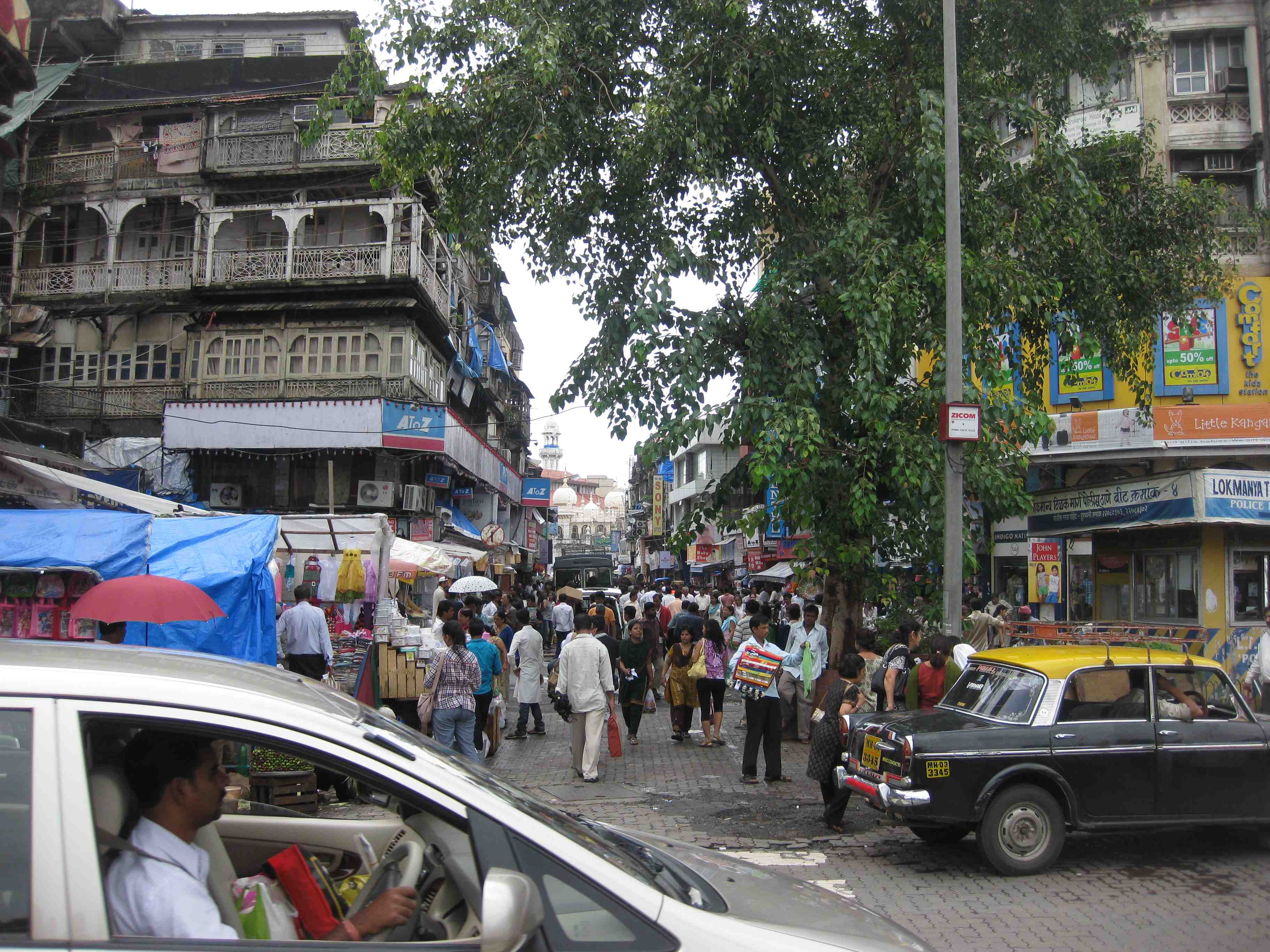
We went to the famed Crawford Market in South Bombay. It’s a building, its a neighborhood, it’s a conglomeration of shops and stands and street-hawkers.  Everyone has something to sell no matter the size or shape of their stall or storefront; and every seller is ready to make a deal. It’s a tourist attraction and local haunt that’s known for its cheap wares and myriad inventory.

We started out testing our pricing system with drying racks. I looked at a few and touched on the ones that we liked. We asked how much. It was 1,500 rupee (about $32). We scoffed and walked away.

A few minutes later Nisha came back.  800 rupee was the new price. But when we went back together to pay, the price suddenly increased to 1,250. We knew we’d have to try and get most of what we were looking for at one place – where they’d have too much to lose if we walked away from all the items.

While Nisha was searching for a singular place to purchase, I wandered over to a lighting store to look at standing lamps.

“How much?” I asked.

“4,400 rupees,” the man said, clearly under the impression that $94 for his most basic cheap standing lamp was a reasonable price to offer a gora.

“Nahee, Kitanā?” I asked (“No, how much”).

“Ah. 2,500,” he replied, still ripping me off but with a little bit more realistic intentions.

I walked out shaking my head at my own stupidity for even trying to negotiate in a place where people would never give me a reasonable rate.  And as I walked, lost in thought, I stepped into one of the monsoon’s ubiquitous puddles, splashing mud into my waterproof shoes and covering my legs. I sighed in frustration.

Many, many shops

But a man in a nearby shop shouted my way and pointed at a bucket of water next to him with a ladle. I said “Shukriyaa” in thanks and began pouring the water down my legs. Here was a man who probably would have tried to screw me if I’d come into his store looking to buy something. But he saw me in distress and immediately wanted to help.

It’s funny – the price structure isn’t personal here. It’s not malicious. It’s just everyone trying to make as much as they can off of the small sales they make.  And for every moment that I get exasperated with India, the people here never fail to make me love them an instant later. It’s just the way it is.

Nisha called me in to the shop she had selected and I thanked the man again for his help. I went in and she handed me a pre-written price list with all the items we needed. The owners weren’t going to haggle with me – they knew we’d walk away if they tried to change so many already agreed upon prices. We had found success.

We spent the other portion of our shopping day in the opposite setting to Crawford Market. We pulled up to the Phoenix Mall and went into a store called Big Bazaar, which is like a dingier Bed Bath and Beyond with a grocery store thrown in the back. We picked up the items we couldn’t get at Crawford Market.

Big Bazaar's rice and lentils

But even at a mall that housed a Zara, Marks and Spencers, Burberry and McDonalds under one roof, you couldn’t stereotype it into a completely Western context. Upstairs in Big Bazaar you can go look at saris and kurtas. And when you walk into the grocery section you run smack into big tubs of rice and lentils, surrounded by prospective shoppers putting their hands in to test the quality. The two men in charge just scoop out bags and bags of the staples as customers flock to their most important section.  It’s a comforting piece of an Indian market sitting in a grocery aisle lit by florescent lights and decorated with signs showing happy families in polo shirts and jeans.

When we came back to our apartment, purchases in hand, we felt victory was ours. We’d gotten the basics we needed and we’d added some Indian cookware and flatware to our repertoire. But of course, when we tried to take it all upstairs the elevator had stopped working – and haggling and Hindi couldn’t buy us out of this one. Never a dull moment here – and never a time when we’re allowed to forget that we’re always going to have to try a little bit harder to make it all work.

Read Full Post »

I made 200 rupees today.  That may sound impressive. And perhaps it is. But you should know that 200 rupees equal a whopping 4 dollars and 28 cents. But I made it from selling something that I formerly considered trash.

Our apparently valuble cardboard boxes

I’ll start at the beginning. Yesterday I said to Nisha and Ray (the manager of all the work going on in our apartment, who today fixed a broken light, our broken toilet and a broken doorbell. There seems to be always something new!) that I needed to find a way to throw out the many furniture boxes we had sitting around. I couldn’t put them outside because of the monsoon but they were just taking up space in the spare bedroom.

“Throw out?” they both responded, looking at me like I had three heads.

I stared back. “Well, we have to get them out of the house eventually,” I said a bit sheepishly. I didn’t know what I’d said that was incorrect but clearly I was in the wrong somehow and I might as well be preemptively embarrassed for my own stupidity.

“No, you get these guys,” Nisha explained in the manner of someone talking to a very nice but very slow child, “they come around every day. They buy cardboard and newspaper from you. You can get money for it.”

“I tell guy at gate if they come by to send them up,” Ray said, as he walked out of the apartment, clearly on a mission to inform my doorman (or “guy at gate”, apparently) to send strangers into my house foraging for heavy-duty paper products.

And as promised, they arrived the next morning. They came in and sternly began evaluating my ‘goods’. They spoke in quick, sharp Hindi to Nisha. She turned to me and said, “They’re offering you 150 rupee. I don’t think that’s enough.”

“Well, tell them that it doesn’t bother me if they sit in the extra room for a few more days.”

“Yes,” she said, “Good. We’ll get them to 200.”  She talked animatedly to the man in charge, clearly rejecting his initial offer. He moved away from her and started to look at the boxes more closely. I wondered what on earth he was trying to find. It clearly was part of his negotiating strategy.

She leaned over to me as he looked away. “Say to me loudly that you don’t need the boxes to go away yet if they don’t give a fair price.”

I just looked at her. “They don’t speak English, I could say anything and they wouldn’t know the difference.”

To make the point, I said some make-believe gibberish about pigs flying in my most stern voice to see if I could get Nisha to laugh. She did, but with her back turned to the men all they heard was my insistence. Clearly I was VERY serious about pigs flying.

But it worked and we had a deal. The men agreed to 200 rupee and began to collapse and take away the boxes. Nisha took the plastic wrapping off some of the boxes.

“Is ok if I take these? My roof is leaking from monsoon and this will help.” I wanted to cry. I wanted to go over to her house and single-handedly fix her roof (as though I could do that without breaking her roof and/or killing myself). I wanted, though, to not embarrass her.

“Yeah of course. Take whatever you need!” I said, as though my enthusiasm for plastic somehow made it all better.  But it’s only ME who is embarrassed. She seems to feel this is a normal question that shouldn’t faze me as it is clearly not fazing her.

It’s a funny thing, the American guilt. It’s clearly one sided and not even recognized here. She’s not upset; she just wants some plastic.  It’s me who is embarrassed, not her.  It’s me who has to get over it because she was never in it or under it. She folded up the plastic without noticing my own pathetic internal Greek tragedy.  And the boxes continued to be collapsed and taken away.

Victory! The newly earned 200 rupee

A moment later, once they finished, I opened my hand and two crisp 100 rupee notes were pressed into it.  Success. It was my very own trash into treasure story, but clearly I could take no credit for the victory.  It marveled in the uniqueness of that experience.

“Some things are very different here,” I said to Nisha.
“Like what?”
“Well, I never knew you could sell cardboard to men who came to your house.”

Just then the monsoon started up again and the noise took over the room.  “And this constant rain is different,” I said.

“You don’t have rain in New York?”
“Well, we have rain, but we have it in short spurts all year.”
“You have rain all year?”
“Yes, but it’s not like this all year. It rains for a day or two then it doesn’t rain for a few weeks. Then it rains some more and then no rain for a bit.”
“Even in winter? Or spring?”  She was clearly shocked at the idea of rain in November or March.

That question, that kind of moment, is when I’m reminded that there’s a whole world whose experience with even the most basic parts of humanity – such as rain – is completely different to my own.  There’s no right or wrong – just a whole new way to see the world.

I had spent a larger portion of my day at a coffee with the American Women’s Club than I did with the boxes or the conversations about rain. But the interaction with the day-to-day life of India stuck with me more than the attempt to find remnants of home here (even if it was nice to be around a bevy of American accents for 2 hours and I will definitely be happy to have those coffee respites while I’m in Mumbai).

What a world of learning I’ve entered into. Today: rain and cardboard. Tomorrow, who knows what’s next.

Read Full Post »

I woke up with a start at the sound of something hitting the roof so hard it seemed the ceiling could collapse.  I squinted at the time. It was 6:30am. The sun was just starting to peak out from behind the buildings – but it was covered by a full heavy sheet of rain, the source of the pounding. No thunder or lightning accompanied it. The volume of the rain itself made enough sound to wake me, and it seemed like there was no chance it was waning anytime soon.   With that in mind, I got out of bed and began to get ready for the day.

It was meant to be a full day of apartment finishings – the gas needed to be connected, furniture assembled, internet installed, cable dish secured to the roof and curtains hung. I groggily got up, preparing myself for the day ahead, and went into the bathroom. 

Our lovely broken toilet

For all the steps forward we would have that day, I was about to get one severe step back: As soon as I sat on the toilet I heard a crack. A moment later my left side gave out and I was tumbling sideways. The toilet had cracked off the wall and water was spilling out.

I stood there, watching and marveling at the distinctly poor engineering and installation that must have occurred for my small frame to have broken this large instrument. I started laughing. I couldn’t help it. Of COURSE the toilet fell off the wall. In our brand new gleaming apartment we still couldn’t escape something breaking even as we were already working to get other things fixed.

The water soon stopped spilling and I stopped laughing.  I pulled myself together because the day needed to move forward. Nisha arrived and was soon managing all the various workers who had come over. At the same time she was washing and preparing vegetables.

She was like my own personal godsend – translating everything into Hindi and back, constantly asking if I was hungry and giving Phoebe a pat every time she walked by. How did I ever manage without this woman?  I loved the smell our apartment took on as she unraveled a cilantro-esque herb from its twine wrapping.  And I loved hearing her firm voice with every worker who she felt wasn’t doing their job properly. She was looking out for me and I truly needed the help. My earlier discomfort was being replaced with sincere appreciation for her presence.

She asked later if we could call her old employer – the woman wanted to speak with Daniel and I to make sure WE were good enough for Nisha. We gladly obliged and got further confirmation that we’d struck a pot of lucky by finding our new member of the family.

Throughout the day she and I watched over the goings-on in the apartment while we chatted about life and homes and our pasts. The only English that would trip her up were idioms, like when I mentioned, “I stick out like a sore thumb” or “that toy of Phoebe’s has seen better days.”   She would look at me with a blank expression and I knew I was failing her. I caught myself later as I used the phrase “good cop, bad cop,” and realized I would really need to be more cognizant of this if I didn’t want to suddenly sound like I was speaking gibberish.

I still felt pangs of my initial guilt. As I took an orange out of the refrigerator to peel Nisha came over and said “give it to me.” I thought maybe she needed it for something else but as I stood there I watched as she started peeling it for me.

“You don’t have to peel my orange for me,” I said, trying to still sound nice and appreciative while getting the point across. It didn’t work.

“Don’t be silly” she said, with a finality that made me think I shouldn’t fight her on it.

Phoebe waiting for all the work to be done!

“Ok. Shukriya,” I said, meaning thank you. I’d asked her to teach me one Hindi phrase ever day and that had been her first.  My phrase of this day was “Chai penge,” or, “Do you want tea?” She laughed at my pronunciations but I was glad to be learning.  And I used that original phrase over and over to every person who was helping complete all the tasks that had to be done throughout the day – gas was connected. Tv mounted on the wall. Furniture assembled.  Progress!

Nisha left at 7pm after having cooked a meal of roti and bindi (also known as flatbreads that she made from scratch and an okra based vegetable dish).  I waited for Daniel to come home before eating. We both took bites and looked at each other – it was amazing. Sorry to every cook in the south whose okra I’ve ever loved, but THIS was certainly an okra revelation.

The toilet in our room still remained in pieces on the floor. But I couldn’t seem to think of that while bindi and roti sat on my plate. The morning’s small step back was dwarfed by the meal in front of me and the thought of all the day’s steps forward.

Revalatory okra

Read Full Post »

As our dinner wound down we were warned, “Make sure you leave before midnight. That’s when the bandh will start and you don’t know what kind of protests there will be.”

We’d been lucky enough to be invited to the home of a friend who lives with her family in South Bombay. Being in a home around a family made Mumbai feel like my own safe home. But we had to escape the previously safe roads before the city turned into the proverbial pumpkin at midnight.

No one knew what the scale of the bandh would be – but we didn’t want to be out and about to find out.

A bandh, as I had learned earlier, is the Indian version of a strike. This one was called by the opposition parties over rising fuel prices and the end to some fuel subsidies.

Unlike any strike we see in the US, this bandh was stopping a billion people from working, shopping, going to school or safely traversing their streets. And even more unlike the US, while the opposition parties sponsor the bandh, it doesn’t just effect the supporters who decide to come out and rally– it shuts the whole country down. It would be as if the Republican Party declared a strike against the health care bill and every person across every state in the nation stayed home for an entire day.

It doesn’t mean that the whole country was necessarily in agreement with the bandh or that every part of India was massively affected. Some cities saw much more active protests and riots. Other cities didn’t appear to participate on any large scale. And even on a more individual level, most of the people we spoke to here in Mumbai were closing shop or staying home more out of a fear for safety than a sign of solidarity with the protesters.

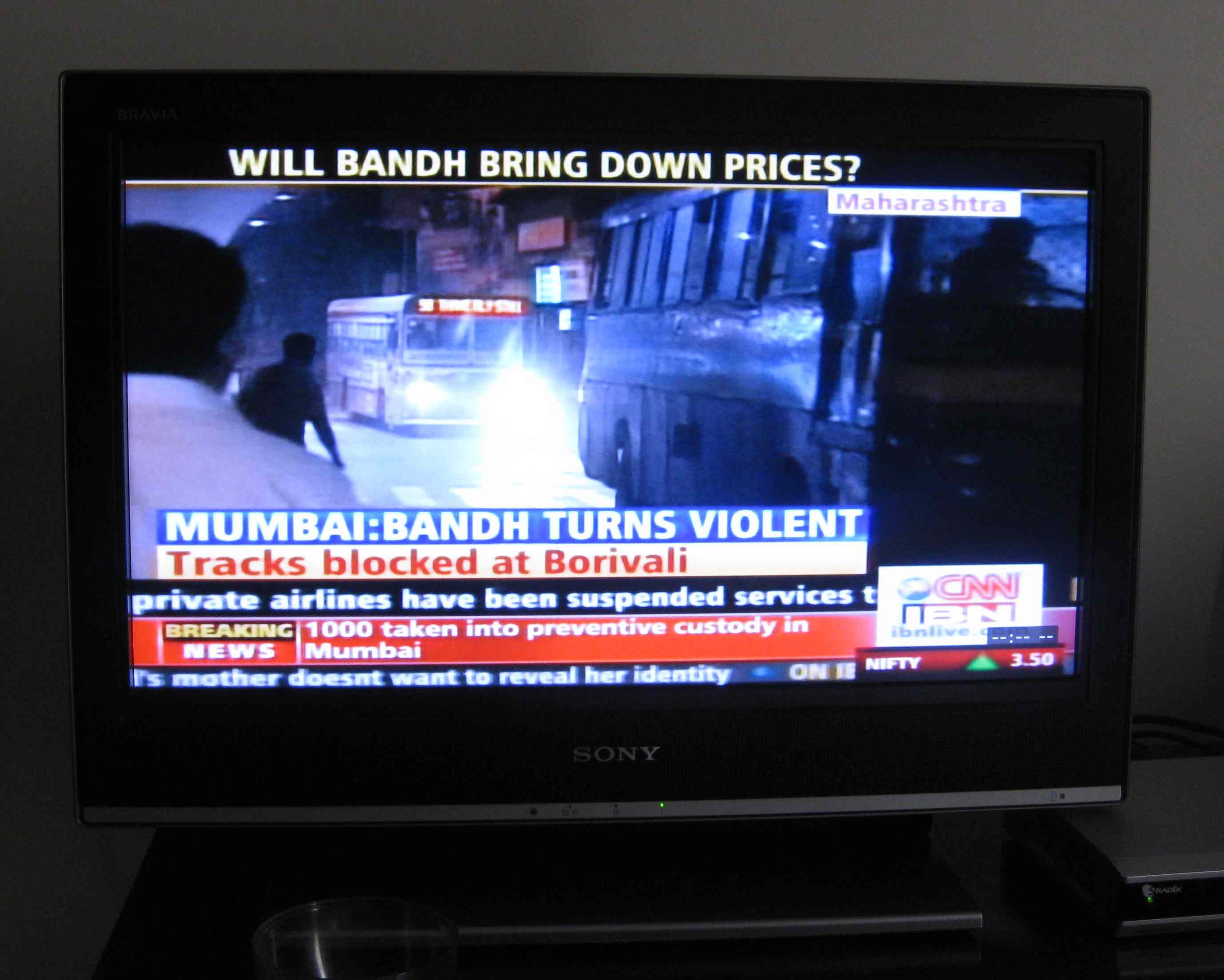
News coverage of the bandh in Mumbai

Then again, there were reports of protests turning violent even in Mumbai, so there clearly was anger over the issue for some segments of the population.

We’d been warned that if we did go out, we should wait until the afternoon, since the protests usually were more active in the morning in order to catch the news cycle and get coverage (some things NEVER change wherever you are).

Last night was our final evening in the guesthouse, since our furniture had arrived and we could officially move in – so our plan was to head over to the apartment in the morning. We figured since we live in suburban Bandra (and most of the municipal buildings and transport centers are in South Bombay) the likelihood of the protesters reaching us seemed slim. But as we watched news coverage in the morning of some of the protests across the country and in Mumbai we decided to heed the warning of the native Mumbaikers we’d spoken to and wait until the afternoon to gather our suitcases and make the short 5 minute drive to our apartment.

An empty Turner Rd - one of the main streets near us

When we left the guesthouse, the street was as empty as if it were 3am – but the sunny skies turned the scene upside-down. Shops were closed and very few cars drove in the streets. The frenetic soul of Mumbai seemed to have vanished and all that was left was the city’s shell.

But the emptiness didn’t seem fearful. Our gut instinct about our portion of Bandra not being a target appeared correct, and we made it easily over to our apartment (so much easier than normal, in fact, since we had no insane traffic to contend with).
We lived out the rest of the bandh in our own oblivious unpacking mode. By the evening both the traffic and the monsoon had returned – all was back to normal. It’s yet to be seen whether the bandh has any political impact. But whatever the outcome, I have to admit that I, at least, was impressed by the massive feat of stopping approximately one out of every six people in the world in their tracks for a day.

Read Full Post »

I am beginning to understand the root of “Indian Time” a little bit better. It’s not (as my Indian friends at home would have me believe) just an Indian way of life where they are allowed to be late to things because its inherent to Indians.

I think in actuality it’s related to something much simpler. Indians are late to everything because, at least here in Mumbai, there are NO STREET ADDRESSES.

That’s right. Street addresses do not exist. In fact, street names are barely recognized. Instead, there’s a system, that doesn’t work, of just telling someone what ‘landmark’ you’re near, and then hoping for the best. But when they say landmark, they just mean another place or business. So when we give someone directions to our apartment, it goes something like this:

“It’s La Paloma, it’s on St Cyril Road across from St Anthony’s road. Do you know it? Ok, well do you know where Turner Road is? It’s off Turner Road, towards St Andrews College. No? Do you know where Holy Family Hospital is? How about the American Express bakery? Yes? You want me to meet you there and then show you? Ok. I’ll meet you at the bakery.”

This is really how it has to be done. Because you can’t just say “Oh when you get to the bakery go straight, turn right on St Dominic and then left on St Cyril because NONE of these roads would have a sign indicating that that is actually the name of the street.

Not to mention that the main road, Turner Road, actually (if you look at a map) technically changes into Gurunanak Marg right before our house – but no one knows that. To them it’s still just Turner Road. Even after it THEN turns into Perry Rd.

And you’d think you could solve this problem with a driver, but you can’t. Today I wanted to go a store to buy some Indian style clothes. The store is well known and its called FabIndia (I could delve into the awesomeness of that name, but I won’t now). And when you look it up online the address is: Navroze Building, Next To HDFC Bank, Pali Hill (Yes, that is the actual full address). So you’d think you could find it easily – but you would be wrong.

When we went to Pali Hill (an area in Bandra), near the market there is an HDFC Bank but no FabIndia. We drove around, asked around, looked around. Nothing. We finally called FabIndia and solved the mystery. We were meant to know its next to the OTHER HDFC bank in Pali Hill. Up Zigzag road. Not by the market. Obviously.

This applies to any address. For example, one of my personal favorites is the address for Phoebe’s groomer. It is (and I mean this is the actual mailing address):

Tail Waggers Pet Salon
Near Hotel Mini Punjab
Pali Village Behind Hawaiian Shack
16th Road
Bandra West, Mumbai 400050

It’s hilarious, completely Indian and yet an all encompassing theory to explain the Indian loose relationship with time. It’s inherently frustrating but you can’t help but love a city where people find their way around SOLELY based on trusting everyone’s local knowledge.

So if you want to come visit me, just remember: La Paloma doesn’t exist. Just go to the tree in the middle of the road in St Anthonys Rd next to the hospital, next to Lemongrass Restaurant, next to CitiBank, next to Crosswords bookshop. Then ask someone where to go. And don’t worry if you’re late- we’re all on ‘Indian Time’ here.

Read Full Post »

My stomach churned and it stopped me in my tracks. No! I’m not ready to get sick, I thought. I’d avoided feeling ill for my entire time here so far. I’d heard everyone tell me that it was inevitable, but I wasn’t buying. Yet here I was with my stomach doing somersaults and I was armed with only Pepto Bismol.

I felt the thick pink liquid going down my throat like troops on their way to fight the war in my stomach. I ignored the jolting momentary pangs of pains and instead I got dressed and went outside with Daniel to go to a bar to watch the World Cup. My stomach is just a minor hiccup, I told myself.  I hadn’t even eaten anything questionable that I could think of.  I rationalized and justified the situation, thinking that my mind could ignore the true matters in front of me.

But as we drove along the bumpy Bandra roads I had to concede defeat. The somersaults had turned into full-on routines. It was official. My first night in the grips of India’s notorious stomachaches had begun. I told Daniel to stay out while I slinked home, disappointed that just the mere will to stay healthy hadn’t cured me.

It was lucky though – in the annals of illness history this one wouldn’t go down as painfully memorable. Instead it was a warning shot. Just know what we can do to you, India was telling me. Don’t let yourself forget that you’ll always be on guard here. It’s not truly your home. I curled up with Phoebe, willing myself to sleep.

And I did. I woke up the next morning and the sound of a jumping stomach had been replaced by pounding rain outside. The monsoon was back – India’s second reminder in 24 hours that it could make trouble for us whenever we got too comfortable.  And the trouble remained all day.

Monsoon soaked happy Phoebe

Just as I had tried to tell my stomach no, I thought I could say no to my fear of the rain. I could model myself after all the Mumbaikers I saw wandering the streets while they got instantly soaked. I took Phoebe out for a walk on our new street umbrella in hand (can’t throw TOO much caution to the wind). But India once again laughed at me. The elevated pavement did nothing to shield us from the soaking power of passing cars. Phoebe looked up at me like I was a traitor in the ranks. She kept trying to pull me back to our apartment building. Why are you doing this to me, her eyes pleaded. She was soaked completely after just a minute. Indians in rickshaws slowed down as they drove by to watch the crazy white lady walking her tiny dog in the morning’s downpour.

But the sun came out in the form of that tiny dog. Phoebe was the strong one in the face of the chaos. The same dog who had curled up next to me the night before in solidarity came inside from the rains, shook herself off and seemed utterly unfazed. She was happy – she ran across the floor, sliding in the water coming off her own body, completely happy just to be back inside even if she was soaked head to paw. If Phoebe can let the rain roll off her back, figuratively and metaphorically, then so can I.

Bolstered, Daniel and I took to our errands in the rain. We drove a few blocks that had only taken 2 minutes the day before, but now it took 10. The streets were crowded, flooded, and the traffic knew no rules. Everyone was trying to get somewhere and the urgency only crowded and slowed the streets more. We stepped out of the car to go into a store. A car immediately splashed us. We took off our shoes and went inside, soaked. On the way out I went to put my shoes back on only to see that a long worm had coiled its way through my waterproof shoes.

Illness. Rain. India had thrown it all at me today trying to see if I would crack. But I haven’t.  Because today, I stood in my still mostly empty apartment and unloaded groceries that Daniel and Nisha had gone to buy and it started to feel a bit more like home. And Phoebe kept smiling at me.  Bit by bit I’m saying to my new city, “Bring it on”. I just hope that that audacity doesn’t earn me another case of illness.

Read Full Post »

« Newer Posts - Older Posts »