Feeds:
Posts
Comments

On the Inside

I have to be perfectly blunt and say that I can’t possibly fathom what it is like to live in a 10-foot by 10-foot room with one window and one stove and no bathroom with my entire family.

In fact, I don’t really know how to realistically process and respond to my first foray into residential Dharavi without falling into the trap of minimizing, dramatizing or romanticizing the experience.

All I can really say is that now I have seen with my own eyes the living standards that I have heard so much about since moving to Mumbai. And there are a lot of impressions and thoughts that came with my first visit.

I went back to the hospital to meet up with the supervisor who I had been shadowing. He informed me that today, instead of a group meeting, he and his field workers were going out into the community to distribute information about hygiene. This monsoon is the worst in five years and there has been a serious outbreak of malaria and dengue.

I tried to ask in the most polite way, as I had every day, what this had to do with curtailing domestic violence (since that, ostensibly, is their main mission).

“It has nothing to do with violence. But we give information, which is good. Then some people will come to meetings about health care, which they are interested in. Then, once they are involved, we can talk about ending violence. If we start with violence, nobody cares.”

I followed him out of the hospital wondering how he and his field workers get the energy to go out every day when they can’t even raise the topic that they are interested in. It just seemed so daunting.

He informed me that we had to drive to the area we were going to (Dharavi is, after all, very large. At least a million people live here). As we drove he tried to warn me.

“Just… be aware of your feet.”

“My feet?”

“Yes, your feet. They will get dirty. I hope that’s ok.” He didn’t elaborate, but I got the general gist.

We pulled over once we’d gone as far as we could go – I very quickly realized that walking was going to be difficult, let alone driving.

The method for the day was to go “door to door” (I put that phrase in quotes because most of the homes did not have physical doors beyond a makeshift bed sheet).  We walked in from the street and it immediately felt like we’d entered a maze.
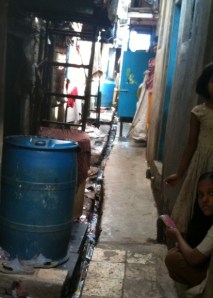
They path between houses

Walking into a residential section of Dharavi is actually kind of reminiscent of walking through the tightest alleyways some small European town – if the town were made of poorly constructed cement structures and if you’d been transported back to a time with little plumbing and amenities.

Each home is directly connected to the home next to it, and you maneuver through the area with only a small 2-foot wide pathway serving as your sidewalk. In the middle of this pathway is a hole running the entire length that serves as both a place to lay small pipes and as a moat of sewage.  This is the part that really gets to you if you’re not used to it – there’s a constant pervasive smell of garbage and sewage, which is only exacerbated by the lack of fresh air making its way in. The lanes are so narrow much of it is covered with tarp, so the smells and the heat combine together throughout.

This also creates a trap for the heat– so even though I hadn’t been too hot before we entered the slum, once I was inside the narrow pathways the stale air, confined quarters and number of people surrounding me ensured that I existed in a permanent sweaty state.  But, on the other hand, it started making me cognizant of the small victories: every time a breeze came through I felt it was the coolest moment of my life. I quickly appreciated every wisp of the wind in a way I never had before.

The scene that was laid out in front of me at each turn of the corner was similar– every home had one room, the structure was made of some combination of cement, brick and wood, the roofs appeared to be made of a kind of sheet metal.  Inside every room there was usually a stove, some mats for beds, and a few personal items. A good number of the rooms had televisions – one of the many contradictions that existed in the slum. When at one point I found myself standing at a vantage point where I could see above the structures, I noticed that every third home appeared to have a television dish.  And for every person watching television there were five more staring down at his or her mobile phone.

Color along another path between houses

There was also color everywhere – walls were painted in bright hues, varying clothes dried on the outside of every single house, and children in school uniforms were always running through, brightening the alleys. I don’t know whether it was purposeful or not, but the constant explosion of color gave the slum a vibrancy that seemed to defy the darkness that pervaded in each of the individual rooms.

I mostly just watched as the field workers approached each home and handed out pamphlets  (which had words and text depicting healthy bathing habits, proper garbage disposal and boiling water properly). Some people would only politely accept the handouts without any discussion. Others would take more time and ask questions.

I asked the supervisor what sorts of questions were most common. He said that some people couldn’t read the pamphlet and so they needed to understand the content. Others wanted to know more about the organization. It was in these instances that the field workers could try to encourage the residents to come to a meeting (and they were going to hold one directly following their leaflet distribution). It was their first stage in getting people involved.

Sometimes the discussions took longer – a few people wanted to share their difficulties with the field workers and they would stop to listen and encourage. One woman got angry. She started yelling and talking very animatedly. I had to ask again what was happening.

“She thinks we are useless,” the supervisor said matter-of-factly, “She says if we really wanted to help we would bring medication and other supplies. She says no one will help her and her family.”

“How do you answer that?” I asked.

“Well, we gave her information on clinics that she could go to and places that do give out medication. I understand why she is angry though.”

I didn’t respond. It was still hard for me to shake my previous thought: how could these people be strong enough and motivated enough to do this work every day? These community workers were standing there being yelled at, and instead of being frustrated they were sympathetic of where the anger came from.  I was constantly struck by their enormous patience.

I felt pretty useless in the whole endeavor, but the women kept nudging me along and helping me find my way. They still seemed to accept me, and I felt sort of flattered that they’d actually let me come along for the task. The Dharavi residents themselves mostly just stared at me. Since the pamphlets we were handing out were from Unicef most asked if that was where I was from. It usually started with pointing towards me and then I’d heard the words “gora” and “unicef” thrown in until the field workers responded with “Ali” and “film”. I could usually tell once the conversation had ended because they’d all stop paying attention to me.
The only people who never stopped staring were the children. Every single one, from toddlers to teenagers, looked at me for however long I was standing in their doorway. At many points children would just appear, clearly after having heard that a white person was in their midst. The ones who were learning English wanted to practice. They’d ask to shake my hand and they all wanted to know my name.   When I tried to respond to them in Hindi (saying what my name was or letting them know that I spoke only a little Hindi) they laughed and tried to repeat what I had said in my clearly very foreign accent. But their laughter filled up the constricted alleyways and brought it to life.

The only difficult point for me came when I almost fell headfirst into the narrow sewage stream in the middle of the pathway. Every time I walked I had to focus on putting one foot in front of the other – the pathways were certainly not paved in any standard way and there were often steps or cracked tile or a steep inclines. One turn that looked like a path ended up being mud and I started to slip. But I quickly had at least 10 pairs of hands on me – every field worker and every woman they were talking to had reached out instantly to stop my fall. When I didn’t fall in they all smiled and patted me on the back.

I don’t want to extrapolate too much from one isolated incident, but it certainly made me feel the sense of community that existed there. Maybe that’s my outsider desire to see the good in a dire situation, but it appeared to me that everyone’s instinct was to protect even the visitors. It’s a difficult life and it seems like everyone has accepted that they all need to come together to co-exist.  And maybe it’s from there that the field workers keep the momentum to do the difficult work that they do.

I don’t know if any of these instincts are right. But I’m certainly looking forward to delving in further and trying to tell these women’s stories.   Watching the number of people who showed up for the post-distribution meeting I certainly started to feel more empowered. I sat in a schoolhouse – one room with a broken fan with one chalkboard and no chairs – as the field workers gave an in-depth discussion of disease prevention to the fifteen women who’d showed up. It’s slow work, but little by little they are enacting changes in their community.

Watch and Learn

Try to imagine sitting in a meeting where you don’t understand the language that the meeting is being conducted in. You’ll either be really bored or you’ll start to notice the details of a conversation in a way you never could if you were just focused on the words. Perhaps it’ll be a little bit of both.

This is the scenario I found myself in on my second day of observing in Dharavi. I wanted to sit in on one of the afternoon group meetings. The supervisor who was leading the meeting spoke perfect English so he said he could translate the basic agenda throughout the afternoon. Of course I should have guessed that the person leading the group wouldn’t have a lot of time to lean over and translate.

While we walked from the hospital to the field office I asked what today’s meeting was about.

“Today the meeting will be about lots of things. The women who come will get information from us and then they can spread that back among their community. So we’re talking about senior citizen benefits and rations and health care during the monsoon.”

I tried to keep up with him as we walked. I was attempting to maneuver through the streets without stepping in garbage or getting run over while still maintaining a conversation. After sidestepping a tethered sheep, I endeavored to get more clarity, “But what does that have to do with domestic violence?” I asked.

“Nothing today. But we always try to bring it up a little bit and then build trust and stay in their minds as a resource. But today is just about spreading information for daily life.”

I nodded while falling back to accommodate a bus coming by. We turned the corner into the field office and I was relieved to be off the street. I took my shoes off (today I had more wisely chosen waterproof footwear) and walked in among a much larger group than I had seen the previous day. About 30 women of all ages had come to the meeting. I sat down at the front with the supervisor while they all stared at me.

He started talking and gesturing towards me. I could make out a few words- Ali, filming, etc – so I knew he was explaining who this white person was and why she was here. As he talked everyone started nodding and smiling towards me. And with that, the meeting began.

Every once in a while I would get the basics translated (“Now we’re talking about how to set up the benefits if you are a senior citizen” or “Now we are answering questions about taxes”) but mostly I just listened as the words went in one ear and musically drifted out the other without meaning. Every minute or so I’d pick up on a phrase or a number I knew. Or I’d hear a word or phrase in English (for example, Senior Citizen Benefits is just referred to as Senior Citizen Benefits. I suppose they use terms like that when they are the official government term, since the government of India’s official language is English).

So I just watched. And even without understanding the content I got the distinct sense that this was a group of women who wanted to gain every piece of knowledge they could. They hung onto all the words that I couldn’t understand. When a question was posed calling for a show of hands, the hands shot up enthusiastically. All eyes were on the speaker as every woman sat on the ground for over two hours in a hot room with nothing but fans to keep them cool. They all had questions – and when they were called on they spoke animatedly and excitably, as though the entire world depended on the question’s answer.  They clearly were there to better their communities and to use the resource that had been placed in front of them. You don’t need to know the language to feel like you understand the sense of the urgency each person is feeling.

And it was apparently acceptable to them that I was just sitting in. Every time one of them would catch me watching, they didn’t look away – they always smiled and looked me right in the eyes. One child came over to give me a closer look (as one might imagine, the children here have no hesitation to overtly staring at a white person) and when I looked at the mother to see if it was ok, she gave me an approving nod. The child sat down in my lap and took a nap. No one seemed to notice. I guess if I wanted to come be a part of their community no one was going to give me a second thought — even if I couldn’t communicate beyond the most rudimentary basics.

At the end of the meeting a number of women stood around to continue to share their ideas and questions with the supervisor and the field workers. I walked out with the last group and everyone waved and said goodbye to me. I hadn’t understood the words, but I was glad I had come.  I think sometimes its important to see the work and see the excitement. And then perhaps, sometime soon, the translations will come a little bit more quickly.

Back to Dharavi

We marched out of the Dharavi hospital with a sense of purpose. I’d come back to begin my project here with the domestic violence prevention center. I’m going to be documenting the work they do and so I’m starting by shadowing for a few days.  I’d met up with the supervisor in the main office, but he was taking me to the field office, in the heart of the slum.

We had to go single file – there are no sidewalks in Dharavi that I’ve seen. We were walking along 60 Foot Road, which is named quite literally for the width of the street.  It’s a bustling thoroughfare with shops on either side and then trucks, cars, motorbikes, people, stray animals, and trash all crowding the road.  Because of the monsoon everything is wet and mud sticks onto my feet and legs within the first steps. At times I had to breathe through my mouth when passing a particularly garbage-filled (or excrement laden) area.

I tried mostly to concentrate on putting one foot in front of the other and following my leader. I kept one eye on his black shirt in front of me and one eye on the ground so I didn’t fall or step on anything that could hinder me. We maneuvered through large good carrier vehicles parked on one side of the road while cars and motorbikes went around us on the other side. It’s like an elaborate game of Frogger getting through the Dharavi streets, and you can’t stop paying attention for more than a moment.

But when I could steal away moments of attention, I tried to take in the energy of the place. It’s like it’s own small city in the middle of a metropolis. The commotion has a pattern and every shop and stand is bustling with the breath of the community. It’s colorful and chaotic and exciting – even while you’re trying not to get run over.

By the time we got to the office my sandals were soaked through and the bottom of my blue kurta was splattered with mud and dust and who knows what else. The office is mostly just an empty room with no windows and no formal door – paint cracked on walls that were entirely empty except one team photo. Everyone sat on the floor, paying no attention to the one piece of furniture in the room, a desk with an unused old computer. But the circle of women that occupied the space filled the room with their vibrancy.

I took my shoes off and sat with the women, who were diligently writing in notebooks on wooden trays perched on their laps. One volunteer, who had been brought along to translate for me, alerted the group to my presence. In Hindi she explained who I was and why I was there. Everyone looked up and smiled at me – without words I knew I was welcome.

Through slow translations I began asking questions. The most vocal of the group, a woman of approximately 30 in a blue kurta with her hair pulled into a tight bun, started by explaining their day to day activities. In the morning they document the previous day’s work (hence the writing when I walked in) and do office activities. In the afternoon they hold sessions.  The sessions consist of groups of women from the community who want to talk about any issue that’s bothering them, whether it be sanitation concerns, food rationing, or safety. The field workers try to use these sessions to solve community issues as well as raise the problems of domestic violence.  Even though all of this was being said to me in Hindi, the woman speaking looked straight at me as she talked, as though she wanted to make sure the message was coming through.

I asked why the subject of domestic violence had to be addressed in such a roundabout way. A quiet woman in an orange sari with a slew of bangles and earrings responded animatedly once my question was raised. She said it’s an impossible topic in Dharavi. No one would come to their group sessions if they were just speaking primarily about domestic violence. Most of the time, if a woman raises the issue, she begins by saying she has a cousin or a neighbor who is experiencing violence in the home. Then the workers have to approach her later to find out if it is really she who is in need of help or counseling.

We talked for over an hour through translations about the various work they do beyond the group sessions – outreach campaigns and talks and films, youth groups and now even a men’s group. They have an upcoming campaign August 15th for Indian Independence day where they will try to recruit new members. They’re also now training more active members in how to deal with domestic violence throughout the community beyond the group sessions.

The women truly lit up when I asked why each of them had decided to make a career out of community work. All the field workers are originally from Dharavi and all the ones I spoke to had originally gotten involved through the groups they now lead. Most of them originally didn’t even know you could have a job where your duties were just helping others. But as every one went around the circle and told their individual stories it was clear that each had been inspired by the small changes they could create and now all were devoting their life to it.

We took a break for lunch before they went out into the community for their afternoon work. I sat, hesitant. I certainly didn’t want to get sick from eating street food in Dharavi. But even before the Hindi was translated I could see that they all wanted to share their food with me. They all now had questions for me and it was my time to share. As they pulled out their rotis and various vegetables they started quickly asking questions to my translator while motioning for me to eat.

I didn’t want to be rude. I couldn’t be rude – they had answered every question I had and had welcomed me in without hesitation.  And now they wanted to share with me.  So I took a roti, said a little internal prayer hoping to not get sick, and ate. As I ate I answered all their questions – why was I here in India? What country did I come from? Did I like being in Mumbai? Did I miss home? Did I like Indian food? Through the translation they all laughed and smiled and kept asking more and more questions.

And when lunch was over and they were off for their afternoon work I said goodbye and made my way back through the crazy streets of Dharavi. I’d be back the next day to see the group sessions and I already felt truly lucky to be able to watch them work in this place they loved so much.

Sick of it

I started missing Western hospitals right around the moment that I was standing in a thin hospital gown with my face against an X-ray machine while a small man steadied my head so that my nose was touching the right spot on the panel.

This adventure had begun about an hour and a half earlier. My ‘birthday’ sickness hadn’t gone away, and a full week later I had started to wonder whether it was time to finally let a professional have a look. I’m usually a wait-and-see kind of person – if it sounds like a cold and feels like a cold, I usually assume it’s just a cold. But I’d had a low-grade fever every day for 8 days and my coughing was starting to scare small children, so I ventured out to a hospital.

We were lucky that a colleague of Daniel’s had recommended a doctor at Lilavati Hospital, one of the supposedly better hospitals here in Bandra.  We made an appointment for today (shocking) by talking to the actual doctor (also shocking) and we were on our way.

All my payment paperwork

Right off the bat we learned that the most interesting difference between an American hospital and an Indian hospital is that in India (or, at least, at Lilavati hospital) you pay up front.  There’s no “We’ll bill you later” and there’s certainly no chance to see the doctor and then pay.  You go to a desk, tell them what you’re there for, they give you a plastic card that’s wired with your information, and then ask for your credit card.  It’s also shocking that to see the doctor only costs about $17.

We waited for about half an hour. I sat and watched the crowd as everyone sat there patiently. There were men and women of all ages – some were dressed in modern clothes like button down shirts and jeans and others in full-length saris.  But the one commonality was that everyone turned their heads sharply to stare at me every time I coughed.

When we went in to see the doctor he went through the basic procedures – although the light to look at my throat was an actual flashlight. He had a desk that he sat in when he wasn’t examining me. There was nothing on the walls and no windows – it was an odd room to spend your entire day in with people coughing and sick all around you.

When he was done looking he immediately diagnosed me with a chest infection – the doctor said it’s been going around in the monsoon and he’s seen a lot of people with it. Apparently it mostly just manifests itself as the bad cough and cold I’d been experiencing. He assured me that some antibiotics should do the trick, but he also wanted me to get some blood drawn and take a chest x-ray just to be safe.

I had to go back to the front to pay for my new procedures before I could continue. It was 840 rupee combined for my x-ray and my blood tests (Divvied up that meant my blood test cost about $5 and each of my two x-rays would be about $6). I took my payment slips and walked over to the blood lab – it was in and out, very efficient. It certainly seemed like this private hospital had found a good system for getting everyone from one treatment to the next.

A jarring sign...

I went and waited for my x-ray. I sat next to a woman in a burqa on one side and an entire family surrounding one seemingly sick person on the other. It was two microcosms of India in one waiting area.

I looked around at the signs on the wall to occupy myself while I waited. One stuck out to me: “Determination of the Sex of the foetus is not permitted in this hospital. It is legally prohibited.” Apparently there’s been a problem with sex-selective abortions in India, and this is the only way to curb it. People told me later that it got to be such a huge problem here that they just outlawed allowing people to know. It’s signs and notices like that that sometimes jar me into remembering how stark the cultural differences can be here. While I was sitting around marveling at how modern and Western-seeming the hospital is, that sign was a poke in the arm telling me not to get too comfortable.

But as I was getting lost in that thought, the x-ray technician beckoned me in. I changed into a hospital gown and he led me over to the standing x-ray. He carefully pushed my face up against the machine, seeming very concerned that my nose press up against an X in the middle. When the x-rays had been taken he handed me over my very own copy. Apparently I’m as entitled to one here as my doctor.

I picked up my prescriptions and went home – the whole ordeal had taken less than 2 hours and cost me only a bit more than $30.

Many many medications

Of course the funniest part came when I realized quite how many prescriptions I’d been given. Maybe my new doctor believed in the ‘better safe than sorry’ approach, or maybe he just wanted to be extra cautious with the white people, but I walked away as the proud new owner of a large stash of medications. He’d given me two separate antibiotics (why?), a pro-biotic prescription supplement, an anti-inflammatory normally reserved for ulcers, an antiseptic ‘germicide gargle’ (basically just iodine and alcohol with mint flavoring), and a cough suppressant with codeine.

At least he wasn’t taking any chances?  I decided to self-diagnose that I wouldn’t need both antibiotics and that the anti-inflammatory and codeine-ridden cough suppressant could be put aside.   I was going to get better and I was going to take my new Indian doctor’s advice, but I was still keeping a bit of my American sensibilities.

I’m still sort of proud that I haven’t gotten sick from food (knock on wood), and experienced the true ‘India’ sickness. But now I’ve at least been initiated into monsoon sickness and had my first dose of Indian health care – as well as my new ‘germicide gargle.’

Monsoon Excuses

One of the most interesting effects of the monsoon is how it can stop anything in an instant. And in a city as vibrant and full of life as Bombay, that truly is something.

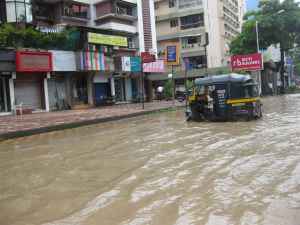
Rickshaw in water

You can be driving along a road at a normal speed in normal traffic when suddenly the rain comes out of nowhere. It only takes a moment sometimes; clear-looking skies and dry weather are overtaken first by small drops, then persistent rain, then a heavy downpour, then rain so thick you can’t see your hand in front of you. And that whole shift can take place in a matter of seconds.

In that instant, the traffic snarls to a halt. Windshield wipers are practically useless in the deluge. Hazard lights are turned on just so that each car will know where the cars around them are basically located. A trip that could take 30 minutes suddenly takes two hours.

You can always spot a few victims once the rain lets up enough to let you see out. Usually in heavily flooded areas you’ll see abandoned rickshaws, not strong enough to get out of a flooded area.  Parts of roads will remain flooded for hours afterwards, since the water has nowhere to drain.

I’ve gotten sort of used to living this daily rainy existence – there’s never a full day respite, but some days aren’t so heavy or often it’s just a light drizzle. And I know what to expect once heavy rains start to fall.

But the one thing I can’t get used to is our internet connection.

Our high-tech cable running from our roof to our neighbor's roof

It was installed as soon as we moved in, and the process itself was humorous. A cable was run from a few buildings over – over and around and up the side of our apartment building the cable went. It’s not underground, it’s not through a wall, it’s just across some buildings and drilled neatly into our wall.  But it’s a cable and it seemed simple enough. We bought a wireless router and thought that that would be that.

However, nothing is so simple. It stops working at best for an hour a day. Sometimes, like now, it stops working for a few days at a time. And every time Daniel calls up the company they say “nothing works right in the monsoon.”  If the power goes out in one of the buildings along our one cable line, no one has internet (At least, this is what they say. I don’t know if I actually believe that this is the real reason).

Now, I understand why our cable dish doesn’t always work in the monsoon. We get a message on our tv saying something is wrong and I think of the small dish trying to get a signal through the deluge. But a cable? What could be so wrong with this cable every day? How can the monsoon be an excuse for constant failure of an entire product?

Our television during heavy monsoon...

Yet it’s everyone’s excuse here – our carpenter was late because of the monsoon (what exactly about the monsoon, we don’t know), people are always late to dinners and meetings because of the monsoon, our shipment was late, items can’t be delivered because of the monsoon. Doesn’t this happen every year? Don’t you think by now people could have figured out how to work around it? It’s a bad rain, but its just rain.   It apparently is also a great excuse.

So today I am only connected to the wider world via a wireless card Daniel can plug into his computer. It’s slow but it’s a useful backup – after all, there’s still another month of monsoon. Who knows when our internet will come back on again.

How Much Do You Want?

Before I left New York I tried to stock up on Malarone, an anti-malarial mediation. Our doctor had advised us to take it every day, and despite a lot of other people telling us it wasn’t necessary, we figured it was better to be safe than sorry.

However, the pharmacists in New York thought I was part of some anti-malaria stockpile conspiracy and they refused to give me more than a one-month supply.

I had tried to argue my way out of it, but there was no chance. Rules were rules and I just was going to have to get more Malarone once we got to India.

I mention this now, because my experience with Indian pharmacies has been dramatically different.

In order to find Malarone in the first place I’ve had to call around. As is customary here with almost any store, if they decide they don’t want to talk to you, they just hang up or hand the phone to someone else. So my conversations have sounded mostly like this:

Me: Hello? Is this the chemist?
Them: Hello?
Me: Hi. Chemist?
Them: Hi.
Me: Hi, are you the chemist?
Them. Hi. Yes.
Me: Ok, do you have Malarone?
Them: What?
Me: Malarone? It’s a preventive malaria drug.
Them: What?
Me: Malarone.
Them: Hold on

(Pause here anywhere from three to ten minutes while they ignore you or pass you off to another person)

Them: Hello?
Me: Hi. Did you find it?
Them: What?
Me: Malarone?
Them: What is Malarone?
Me: I talked to someone earlier about whether you have Malarone, it’s an anti-malarial daily pill
Them: We don’t have.

Now is the part where you hear the dial tone because they hung up.

Exciting, isn’t it?

But once you’ve found the drug you’re looking for you’ll have no problem actually getting your hands on it.

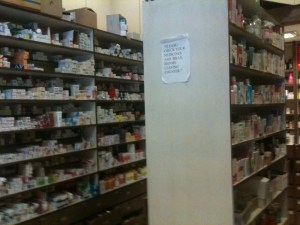
Indian pharmacy's array of medicines

I finally found a pharmacy that confirmed the existence of Malarone. I walked in and was greeted by a small woman in a lab coat over a yellow salwar kameez.

“How can I help you ma’am?”
“Hi. I called earlier about Malarone –“
“Ah yes,” she said as she turned to go looking for it. I looked at the prescription sitting neatly in my hand, waiting to be passed over. She hadn’t asked for anything. Here I was apparently not a criminal for wanting extra Malarone – on the contrary, it seems I could’ve asked for a multiple-month supply without giving any reason at all.

I stood waiting and eavesdropped on the conversation taking place next to me, between a gangly pharmacist and an older gentleman peering up at him from round spectacles.

“It’s an imported medicine,” the older man was saying,
“Ah, do you know if it’s legally imported? Because we might have it either way, but if it’s legally imported then we’re more likely to be able to get it in,” the pharmacist replied earnestly.

I turned away – I didn’t want them to see that I was listening. But soon my pharmacist came back.

“How much do you want?” she asked.

I took a three-month supply. Why not?  I’ll never know whether the older gentleman got his medicine – legally or illegally imported – but I suppose, like me, he can get whatever he wants. Just perhaps not over the phone.

Nice to Meet You

I am starting to feel some pressure to beef up my Hindi.  After all, if a person tells you that your language skills give them a sense of national pride, you need to try as hard as possible.

This all started with a trip to purchase a phone – Nisha’s phone broke so we went on an expedition for a new one.

While we’re out, Nisha and I have gotten into the habit of prodding each other – I’ll make her read signs and she’ll make me repeat numbers back to her in Hindi.  I’ve needed the extra help with the numbers, because learning them in practice is tricky – even if you can say them all fast in a row, it doesn’t necessarily mean you can remember a specific number off the bat (I.e. you might count to ten in succession, but do you remember which one means eight?).

This has proven even harder for large numbers. If something cost 1,260 rupees, you have to remember how to say one, a thousand, two, a hundred AND sixty. It looks like one number on the page when in reality you’re remembering five numbers and putting them together.

The reason I used this number as an example is because when we got to the phone store, we were told that the basic phone cost 1,260 rupees. And as the store clerk announced this, I chirped back at him “Ek hazaar doe saw sarth” (or 1,260 in Hindi). I looked to Nisha, as I always do, to make sure this was right. But once I saw her nod I turned around and noticed that every one of the seven people helping us was staring at me in amusement.

“You know Hindi?” one of them said.
“Tora, tora Hindi boltay,” I said, (roughly translates to “I speak little, little Hindi”). They clapped their hands with delight.

“Where did you learn Hindi?”  I nodded towards Nisha but their curiosity wasn’t satisfied, “Why you learn Hindi? Where are you from?”

“Well,” I started, “I’m from America. And I only know very very little Hindi. But I’m learning it because I think it’s important to know the basics while I’m living in India.”

They all looked at each other and nodded. One man who had been silent up until that point suddenly came to the front of the counter and looked me dead in the eyes.

“You have no idea what this is to us,” he said. “If people like you want to come here and speak in our language it means something great for India.”

“We are very happy to hear you speaking Hindi,” another man said. “Yes,” another concurred, “It gives national pride.”

I didn’t really know how to respond to this. My basic Hindi gives these people national pride? That I can recite numbers (extremely slowly) in Hindi? How could I possibly believe that?

The many helping hands in the phone store- new phones and new sims

Here I was, surrounded by more than half a dozen young Indian men who spoke perfect English and yet they wanted to praise me for the rudimentary Hindi words I had picked up.

I tried to explain that I hadn’t learned very much yet, but they would hear none of it. They spoke in quick Hindi to Nisha trying to find out more information about me.

I wasn’t going to protest. After all, this was why I’d wanted to learn Hindi, right? I wanted to be politically correct and culturally sensitive and all of that. But it’s one thing to think that you should try hard to respect the culture you’ve moved into; It’s quite another to have someone tell you that it’s meaningful to them that you’re trying.  It made me feel like I should be trying harder.

And this certainly wasn’t the first time my terrible Hindi has received a shocked reception. Everywhere I go – at bars, in rickshaws, at markets and now at the phone store – most Indians seem bemused that I’m at least trying to speak their language.  No one expects white people to try at all (since English is the co-national language here), so even the basics in Hindi are congratulated.

And I’m sure that for most people, half the fun is in watching this foreign person struggle with a bad accent at their language. But every time my bad Hindi makes someone laugh, or whenever they ask me to repeat my words again for their friends, I’m getting the sense that it’s the most crucial way for me to adapt. It’s an immediate signal that I’m trying, ever so slowly, to fit into Indian culture instead of trying to make it adapt to me. And that seems to be appreciated.

As we left the store I waved and said, “Muje apsay milnee acha laga”.
“It’s nice to meet you too, ma’am!” they replied, before talking animatedly amongst themselves while continuously looking back at Nisha and me as we walked away

It’s hard to face a birthday in a foreign country where you have few friends and most of your loved ones are thousands of miles (and many hours time difference) away from you.

It’s even harder when you wake up with a severe cold.

I’ve been really lucky since I’ve been here. Other than one night of feeling a bit off, I have not been ‘India’ sick at all (aka food poisoning). All the horror stories of inevitable sickness in the first few weeks had scared me into being very careful – and so far (knock on wood) it’s paid off.

But the monsoon also attracts another, more basic, illness: the common cold. It’s been going around like wildfire here. Friends have had it. Nisha had it. Then Daniel had it. I was doomed to get it. No amount of safe drinking water and properly cooked food could help me avoid the sickness lingering in the air.

I just really didn’t want it on this day.

I’m usually pretty into birthdays (anyone who knows me is laughing at this point, since this is an understatement). I love anyone’s birthday – who can say no to celebrations, cake and giving/receiving fun gifts and cards? But I’d been thinking that this year I would avoid my birthday a bit – how could I celebrate when most of the people I love are far away? I guess my low-key birthday plan had evolved, unbeknownst to me, to include the extra joy of a fever and cold.

When I woke up, it was still the previous day in the US – so no messages were waiting and I couldn’t expect any phone calls for a few hours. Instead I took my temperature – 99.8. I took some Tylenol Cold to try and get back to normal and then I opened some birthday cards my parents and a friend had sent. I figured that would make me feel better, and it did for a moment (they were hilarious). But when I picked up the phone to call and thank everyone, I realized I couldn’t. It was too late on the east coast.

I groggily sat up with my headache pounding. So this was it, huh? Daniel was at work (to be fair, he had arranged for me to get a massage in the afternoon and had planned a great dinner, so Daniel gets bonus birthday points) so I was just in my house alone with a minor fever, a major cough and some birthday cards from people too far away to share the joy with. I must have looked pretty pathetic.

And it figured – the previous day Nisha had explained that my birthday was cursed anyway. To Mumbaikers, July 26 is a very bad day. On July 26 2005 Mumbai saw some if it’s heaviest flooding ever – over a thousand people died, countless lost homes and many people were without power and transportation for days or even weeks.

Nisha explained, “When you say ’26 July’ to someone, it is understood you’re talking about that very bad day. I personally couldn’t get home for 3 days. When I finally made it back, my whole house was flooded and all our gas cylinders were burst”

So who was I to complain about anything mildly bad that happened to me on the 26th of July?

I was determined to turn my day around – a cold was no reason to let the day get ruined. And then, as if right on cue, Nisha came in the door with a huge bag.

Birthday flowers in a bundle!

“What is that?” I asked.
“Birthday present!” she said, pulling out a dozen pink roses. But then there were more. Like multi-colored performers jumping out of a clown car, she pulled one bouquet after another out of the bag until the whole counter was covered.

“You didn’t have to do this!” I said, shocked at the amount of flowers taking over my apartment. I had never received so many flowers in one moment in all my life.

“Oh, I got a good deal,” she shrugged, “And my sons told me I wasn’t buying enough! I figured this would work though.”

I smiled. It definitely would work. It brightened my whole morning. It shook me out of my silly funk and reminded me that I was here, in India. I had chosen to come here; I had known I would be far away. And I was trading the comforts of home for one year so that I could have new experiences and meet new people.

flowers in vases

And I was reminded of that again as Daniel and I were coming back from dinner – I had spent most of the day trying to ignore my sickness, enjoy my flowers and enjoy a day of relaxing. I’d dressed up to go out to dinner so that even if I felt gross on the inside I could fake it ’till I made it on the outside. However, I was tired, and the day had been my first real cold reminder of how far away I was from my regular life.

My amaaazing birthday cake

But, as that thought was sinking in, I got a phone call – two of my new friends here had baked me a cake and wanted to know if I was well enough for them to bring it over. I said of course (sickness never trumps cake).

I soon answered the door and was handed an incredible vanilla cake with a pear/mango/deliciousness filling. I made some lemongrass tea and we sat around and talked for a few hours. I didn’t feel sick and I certainly didn’t feel alone.

I’d made it past my first real day of feeling actual-sick and homesick, and I’d made it past pretty well. This July 26th wasn’t a disaster by any stretch of the imagination. In fact, I think it’ll be a very good year.

P.S. If that cake looks good to you (and it should, because it was awesome) the recipe for it will be posted tomorrow on http://bobosbakery.wordpress.com. Not only do I have a new friend who bakes, she also shares her recipes. How great is that?

Made to Measure

I had watched carefully as the carpenter measured out the space for our bookshelves. He was a small man – no taller than five feet – but he had no trouble imagining our bookshelves as six feet high.

I showed him some images on my computer of bookshelves and tv stands that I’d found online.  He nodded, talked to Nisha in Hindi a bit and we agreed he would come back in one week. I asked him how much it would be. He calculated out each item – two bookshelves, one tv stand, and one entry table with shelves.

“Six thousand?” he said.  This was less than $130 for four pieces of custom made furniture.  I still couldn’t get over it- I keep getting shocked by the low cost of anything custom-made.

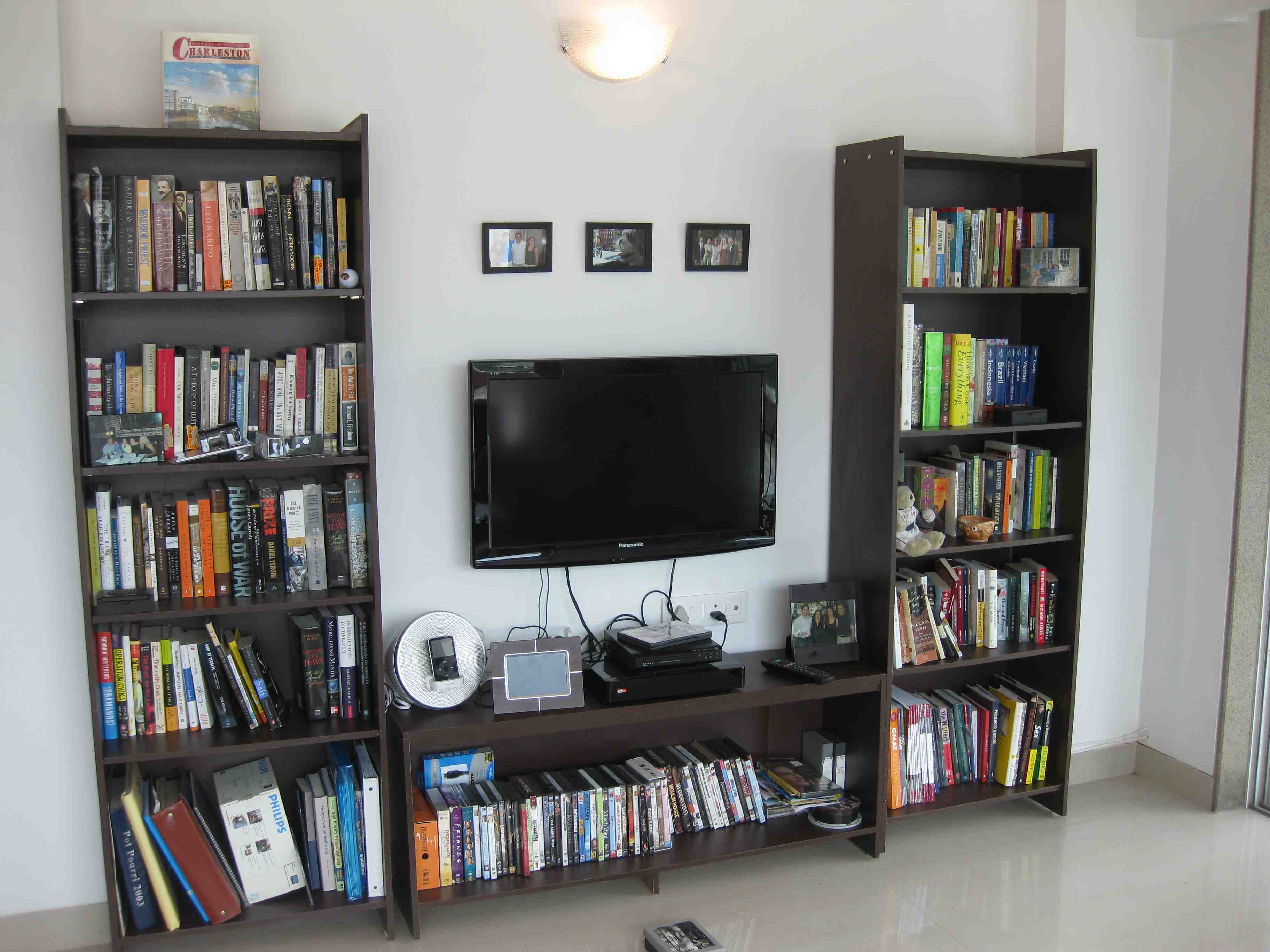
Our new bookshelves

Of course, he worked on Indian time and the bookshelves actually took two weeks to make. And he tried to apply a ‘gora tax’, attemping to raise the price to 8,000 rupees for no particular reason (we still paid him 6,000).  But now, here they are — our bookshelves and tv stand made to the exact dimension of our space.

Yet while I marvel over my new bookshelves, I’m starting to realize that my love of all things ‘custom-made’ sets me apart from everyone else around me.  Indians themselves place no premium on an item being custom-made. It’s a clear-cut case of ‘the grass is always greener’. Western people love custom-made items because they are exclusive – it implies that your item is special and probably more expensive. Indians, though, can have anything custom made. What they love is an imported item, or a well known brand (I’m going to pause here and say that I know this is a gross generalization. But it’s what I have observed for the most part).

I had initially found it interesting that most Indians suggested furniture stores for our bookshelves instead of using a carpenter.  Every single suggested store carried expensive imported furniture. All we wanted was something cheap, since we’re only here for a year. But no one could fathom that we would rather have something custom made, even if it was cheaper. Nisha finally put us in touch with the carpenter she knew, but it was only after we’d driven around to various furniture stores.

And this attitude pervades into other items as well. When Daniel asked around his office about getting suits made, most people were shocked. Why would he want a custom made suit when he is from New York and can go to Bloomingdales or Macys? Why wouldn’t he want the brand? It was a shocking response to Americans who wish they could have a suit custom made to their exact measurements.

It’s also the same for women’s clothes. Expats run around looking for a great tailor to copy designs they see in magazines. Locals like to go to the chic Indian designer boutiques or the overpriced Western clothes in malls (although they will all get each item fixed by their tailor eventually).

It makes sense – you always want what you can’t have (or what other people can’t have). In my case, I’m just glad we’ve got our bookshelves. They may not be imported, but they surely fit right into our space.

Sharing the Holidays

If you’re ever hoping to sound stupid in front of an Indian person, try explaining Halloween.

It’s easy to forget that some of the most ingrained elements of American or Western life have no corollary here.  Most basics like food and clothing can be compared to Indian food or clothing. But some concepts just don’t translate.

On this occasion, it all started with my pirate peeler.

My pirate peeler with its 'pumpkin' peels

My pirate peeler is one of  my favorite possessions – it’s a basic peeler painted to look like a pirate. Nisha used it to peel pumpkin (or what she called pumpkin – it looked to me like a long green squash, but who am I to argue) and thought it was very funny.

“What is this supposed to be?” she asked.
“It’s a pirate!” I replied, not realizing how dumb I probably sounded.
“What?”
“You know? Pirates? Did you ever see Pirates of the Caribbean?” I lamely exclaimed, hoping that those movies had perhaps made their way here.

“Yeah, I know,” she nodded.

“Well, at University my roommates and I liked pirates and we dressed up like pirates for Halloween and so for Christmas one year one of them got me the pirate peeler.”

Nisha stared at me like I was speaking gibberish. And to her, I was. Here I was telling her that I dressed like a pirate while supposedly studying at University.

“I assume there’s no Halloween here?” I said.  Nisha looked at me blankly. Then I started digging the hole:

“Well, it’s this holiday. I think it originally came from a holiday called All Hallows Eve where spirits and ghosts could come out. Then somehow… it became a holiday where children dress up in costumes and go door to door asking for candy.”

“Why candy?”
“I don’t know.”
“Is it religious?”
“No.”
“What kind of costumes?”

I was starting to feel like the whole thing sounded ridiculous to someone who had never seen it. And it is a little ridiculous. But it’s an accepted part of our lives so I’ve never questioned it.

Culture is a funny thing – to most of the world, unique traditions probably can look incredibly stupid.  Many evolve over time to the point where they’re impossible to rationally explain. Why DO we give candy and dress up on Halloween? Why is the birth of Jesus celebrated most often with presents and Santa?  Why do most Americans (of Irish-descent or not) take St Patricks day as an excuse to wear green and drink?

I’m sure there are reasons – but the average person couldn’t explain why. We just go along with it because its something we’ve always done and its fun.

But, right as I was feeling like I could never explain Halloween, I was reminded that ridiculous cultural traditions may each be unique- but everyone has them.

“My favorite festival in Mumbai is Ganesh Chaturthi,” Nisha said. “All the Hindus take statues of Ganesh and bring them into the sea. That probably is as crazy as Halloween.”

And just like that, I didn’t need to explain myself.