Feeds:
Posts
Comments

Rain and Cardboard

I made 200 rupees today.  That may sound impressive. And perhaps it is. But you should know that 200 rupees equal a whopping 4 dollars and 28 cents. But I made it from selling something that I formerly considered trash.

Our apparently valuble cardboard boxes

I’ll start at the beginning. Yesterday I said to Nisha and Ray (the manager of all the work going on in our apartment, who today fixed a broken light, our broken toilet and a broken doorbell. There seems to be always something new!) that I needed to find a way to throw out the many furniture boxes we had sitting around. I couldn’t put them outside because of the monsoon but they were just taking up space in the spare bedroom.

“Throw out?” they both responded, looking at me like I had three heads.

I stared back. “Well, we have to get them out of the house eventually,” I said a bit sheepishly. I didn’t know what I’d said that was incorrect but clearly I was in the wrong somehow and I might as well be preemptively embarrassed for my own stupidity.

“No, you get these guys,” Nisha explained in the manner of someone talking to a very nice but very slow child, “they come around every day. They buy cardboard and newspaper from you. You can get money for it.”

“I tell guy at gate if they come by to send them up,” Ray said, as he walked out of the apartment, clearly on a mission to inform my doorman (or “guy at gate”, apparently) to send strangers into my house foraging for heavy-duty paper products.

And as promised, they arrived the next morning. They came in and sternly began evaluating my ‘goods’. They spoke in quick, sharp Hindi to Nisha. She turned to me and said, “They’re offering you 150 rupee. I don’t think that’s enough.”

“Well, tell them that it doesn’t bother me if they sit in the extra room for a few more days.”

“Yes,” she said, “Good. We’ll get them to 200.”  She talked animatedly to the man in charge, clearly rejecting his initial offer. He moved away from her and started to look at the boxes more closely. I wondered what on earth he was trying to find. It clearly was part of his negotiating strategy.

She leaned over to me as he looked away. “Say to me loudly that you don’t need the boxes to go away yet if they don’t give a fair price.”

I just looked at her. “They don’t speak English, I could say anything and they wouldn’t know the difference.”

To make the point, I said some make-believe gibberish about pigs flying in my most stern voice to see if I could get Nisha to laugh. She did, but with her back turned to the men all they heard was my insistence. Clearly I was VERY serious about pigs flying.

But it worked and we had a deal. The men agreed to 200 rupee and began to collapse and take away the boxes. Nisha took the plastic wrapping off some of the boxes.

“Is ok if I take these? My roof is leaking from monsoon and this will help.” I wanted to cry. I wanted to go over to her house and single-handedly fix her roof (as though I could do that without breaking her roof and/or killing myself). I wanted, though, to not embarrass her.

“Yeah of course. Take whatever you need!” I said, as though my enthusiasm for plastic somehow made it all better.  But it’s only ME who is embarrassed. She seems to feel this is a normal question that shouldn’t faze me as it is clearly not fazing her.

It’s a funny thing, the American guilt. It’s clearly one sided and not even recognized here. She’s not upset; she just wants some plastic.  It’s me who is embarrassed, not her.  It’s me who has to get over it because she was never in it or under it. She folded up the plastic without noticing my own pathetic internal Greek tragedy.  And the boxes continued to be collapsed and taken away.
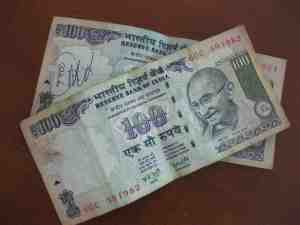
Victory! The newly earned 200 rupee

A moment later, once they finished, I opened my hand and two crisp 100 rupee notes were pressed into it.  Success. It was my very own trash into treasure story, but clearly I could take no credit for the victory.  It marveled in the uniqueness of that experience.

“Some things are very different here,” I said to Nisha.
“Like what?”
“Well, I never knew you could sell cardboard to men who came to your house.”

Just then the monsoon started up again and the noise took over the room.  “And this constant rain is different,” I said.

“You don’t have rain in New York?”
“Well, we have rain, but we have it in short spurts all year.”
“You have rain all year?”
“Yes, but it’s not like this all year. It rains for a day or two then it doesn’t rain for a few weeks. Then it rains some more and then no rain for a bit.”
“Even in winter? Or spring?”  She was clearly shocked at the idea of rain in November or March.

That question, that kind of moment, is when I’m reminded that there’s a whole world whose experience with even the most basic parts of humanity – such as rain – is completely different to my own.  There’s no right or wrong – just a whole new way to see the world.

I had spent a larger portion of my day at a coffee with the American Women’s Club than I did with the boxes or the conversations about rain. But the interaction with the day-to-day life of India stuck with me more than the attempt to find remnants of home here (even if it was nice to be around a bevy of American accents for 2 hours and I will definitely be happy to have those coffee respites while I’m in Mumbai).

What a world of learning I’ve entered into. Today: rain and cardboard. Tomorrow, who knows what’s next.

I woke up with a start at the sound of something hitting the roof so hard it seemed the ceiling could collapse.  I squinted at the time. It was 6:30am. The sun was just starting to peak out from behind the buildings – but it was covered by a full heavy sheet of rain, the source of the pounding. No thunder or lightning accompanied it. The volume of the rain itself made enough sound to wake me, and it seemed like there was no chance it was waning anytime soon.   With that in mind, I got out of bed and began to get ready for the day.

It was meant to be a full day of apartment finishings – the gas needed to be connected, furniture assembled, internet installed, cable dish secured to the roof and curtains hung. I groggily got up, preparing myself for the day ahead, and went into the bathroom. 

Our lovely broken toilet

For all the steps forward we would have that day, I was about to get one severe step back: As soon as I sat on the toilet I heard a crack. A moment later my left side gave out and I was tumbling sideways. The toilet had cracked off the wall and water was spilling out.

I stood there, watching and marveling at the distinctly poor engineering and installation that must have occurred for my small frame to have broken this large instrument. I started laughing. I couldn’t help it. Of COURSE the toilet fell off the wall. In our brand new gleaming apartment we still couldn’t escape something breaking even as we were already working to get other things fixed.

The water soon stopped spilling and I stopped laughing.  I pulled myself together because the day needed to move forward. Nisha arrived and was soon managing all the various workers who had come over. At the same time she was washing and preparing vegetables.

She was like my own personal godsend – translating everything into Hindi and back, constantly asking if I was hungry and giving Phoebe a pat every time she walked by. How did I ever manage without this woman?  I loved the smell our apartment took on as she unraveled a cilantro-esque herb from its twine wrapping.  And I loved hearing her firm voice with every worker who she felt wasn’t doing their job properly. She was looking out for me and I truly needed the help. My earlier discomfort was being replaced with sincere appreciation for her presence.

She asked later if we could call her old employer – the woman wanted to speak with Daniel and I to make sure WE were good enough for Nisha. We gladly obliged and got further confirmation that we’d struck a pot of lucky by finding our new member of the family.

Throughout the day she and I watched over the goings-on in the apartment while we chatted about life and homes and our pasts. The only English that would trip her up were idioms, like when I mentioned, “I stick out like a sore thumb” or “that toy of Phoebe’s has seen better days.”   She would look at me with a blank expression and I knew I was failing her. I caught myself later as I used the phrase “good cop, bad cop,” and realized I would really need to be more cognizant of this if I didn’t want to suddenly sound like I was speaking gibberish.

I still felt pangs of my initial guilt. As I took an orange out of the refrigerator to peel Nisha came over and said “give it to me.” I thought maybe she needed it for something else but as I stood there I watched as she started peeling it for me.

“You don’t have to peel my orange for me,” I said, trying to still sound nice and appreciative while getting the point across. It didn’t work.

“Don’t be silly” she said, with a finality that made me think I shouldn’t fight her on it.

Phoebe waiting for all the work to be done!

“Ok. Shukriya,” I said, meaning thank you. I’d asked her to teach me one Hindi phrase ever day and that had been her first.  My phrase of this day was “Chai penge,” or, “Do you want tea?” She laughed at my pronunciations but I was glad to be learning.  And I used that original phrase over and over to every person who was helping complete all the tasks that had to be done throughout the day – gas was connected. Tv mounted on the wall. Furniture assembled.  Progress!

Nisha left at 7pm after having cooked a meal of roti and bindi (also known as flatbreads that she made from scratch and an okra based vegetable dish).  I waited for Daniel to come home before eating. We both took bites and looked at each other – it was amazing. Sorry to every cook in the south whose okra I’ve ever loved, but THIS was certainly an okra revelation.

The toilet in our room still remained in pieces on the floor. But I couldn’t seem to think of that while bindi and roti sat on my plate. The morning’s small step back was dwarfed by the meal in front of me and the thought of all the day’s steps forward.

Revalatory okra

Bandh Together

As our dinner wound down we were warned, “Make sure you leave before midnight. That’s when the bandh will start and you don’t know what kind of protests there will be.”

We’d been lucky enough to be invited to the home of a friend who lives with her family in South Bombay. Being in a home around a family made Mumbai feel like my own safe home. But we had to escape the previously safe roads before the city turned into the proverbial pumpkin at midnight.

No one knew what the scale of the bandh would be – but we didn’t want to be out and about to find out.

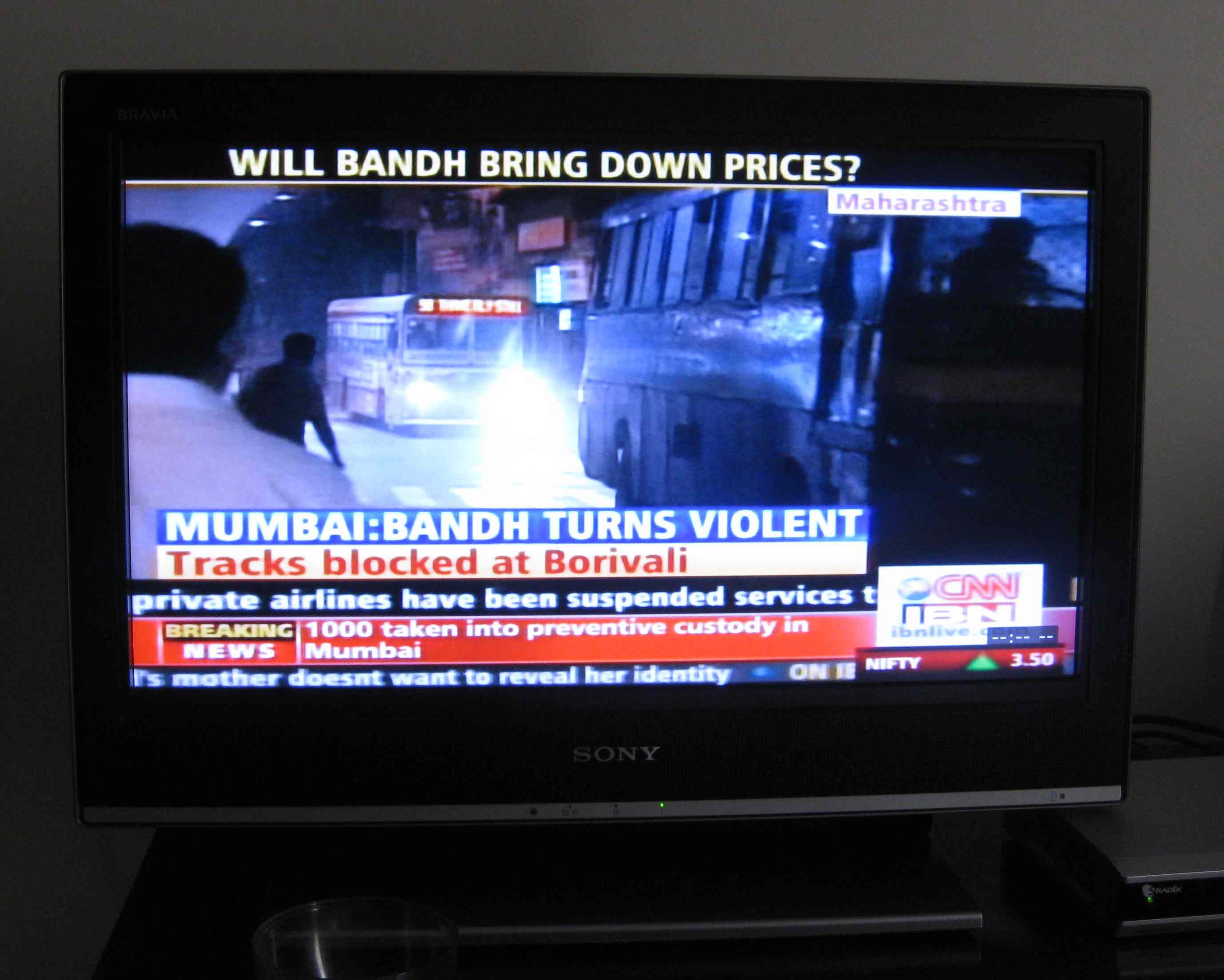
A bandh, as I had learned earlier, is the Indian version of a strike. This one was called by the opposition parties over rising fuel prices and the end to some fuel subsidies.

Unlike any strike we see in the US, this bandh was stopping a billion people from working, shopping, going to school or safely traversing their streets. And even more unlike the US, while the opposition parties sponsor the bandh, it doesn’t just effect the supporters who decide to come out and rally– it shuts the whole country down. It would be as if the Republican Party declared a strike against the health care bill and every person across every state in the nation stayed home for an entire day.

It doesn’t mean that the whole country was necessarily in agreement with the bandh or that every part of India was massively affected. Some cities saw much more active protests and riots. Other cities didn’t appear to participate on any large scale. And even on a more individual level, most of the people we spoke to here in Mumbai were closing shop or staying home more out of a fear for safety than a sign of solidarity with the protesters.

News coverage of the bandh in Mumbai

Then again, there were reports of protests turning violent even in Mumbai, so there clearly was anger over the issue for some segments of the population.

We’d been warned that if we did go out, we should wait until the afternoon, since the protests usually were more active in the morning in order to catch the news cycle and get coverage (some things NEVER change wherever you are).

Last night was our final evening in the guesthouse, since our furniture had arrived and we could officially move in – so our plan was to head over to the apartment in the morning. We figured since we live in suburban Bandra (and most of the municipal buildings and transport centers are in South Bombay) the likelihood of the protesters reaching us seemed slim. But as we watched news coverage in the morning of some of the protests across the country and in Mumbai we decided to heed the warning of the native Mumbaikers we’d spoken to and wait until the afternoon to gather our suitcases and make the short 5 minute drive to our apartment.

An empty Turner Rd - one of the main streets near us

When we left the guesthouse, the street was as empty as if it were 3am – but the sunny skies turned the scene upside-down. Shops were closed and very few cars drove in the streets. The frenetic soul of Mumbai seemed to have vanished and all that was left was the city’s shell.

But the emptiness didn’t seem fearful. Our gut instinct about our portion of Bandra not being a target appeared correct, and we made it easily over to our apartment (so much easier than normal, in fact, since we had no insane traffic to contend with).
We lived out the rest of the bandh in our own oblivious unpacking mode. By the evening both the traffic and the monsoon had returned – all was back to normal. It’s yet to be seen whether the bandh has any political impact. But whatever the outcome, I have to admit that I, at least, was impressed by the massive feat of stopping approximately one out of every six people in the world in their tracks for a day.

Where are You Going?

I am beginning to understand the root of “Indian Time” a little bit better. It’s not (as my Indian friends at home would have me believe) just an Indian way of life where they are allowed to be late to things because its inherent to Indians.

I think in actuality it’s related to something much simpler. Indians are late to everything because, at least here in Mumbai, there are NO STREET ADDRESSES.

That’s right. Street addresses do not exist. In fact, street names are barely recognized. Instead, there’s a system, that doesn’t work, of just telling someone what ‘landmark’ you’re near, and then hoping for the best. But when they say landmark, they just mean another place or business. So when we give someone directions to our apartment, it goes something like this:

“It’s La Paloma, it’s on St Cyril Road across from St Anthony’s road. Do you know it? Ok, well do you know where Turner Road is? It’s off Turner Road, towards St Andrews College. No? Do you know where Holy Family Hospital is? How about the American Express bakery? Yes? You want me to meet you there and then show you? Ok. I’ll meet you at the bakery.”

This is really how it has to be done. Because you can’t just say “Oh when you get to the bakery go straight, turn right on St Dominic and then left on St Cyril because NONE of these roads would have a sign indicating that that is actually the name of the street.

Not to mention that the main road, Turner Road, actually (if you look at a map) technically changes into Gurunanak Marg right before our house – but no one knows that. To them it’s still just Turner Road. Even after it THEN turns into Perry Rd.

And you’d think you could solve this problem with a driver, but you can’t. Today I wanted to go a store to buy some Indian style clothes. The store is well known and its called FabIndia (I could delve into the awesomeness of that name, but I won’t now). And when you look it up online the address is: Navroze Building, Next To HDFC Bank, Pali Hill (Yes, that is the actual full address). So you’d think you could find it easily – but you would be wrong.

When we went to Pali Hill (an area in Bandra), near the market there is an HDFC Bank but no FabIndia. We drove around, asked around, looked around. Nothing. We finally called FabIndia and solved the mystery. We were meant to know its next to the OTHER HDFC bank in Pali Hill. Up Zigzag road. Not by the market. Obviously.

This applies to any address. For example, one of my personal favorites is the address for Phoebe’s groomer. It is (and I mean this is the actual mailing address):

Tail Waggers Pet Salon
Near Hotel Mini Punjab
Pali Village Behind Hawaiian Shack
16th Road
Bandra West, Mumbai 400050

It’s hilarious, completely Indian and yet an all encompassing theory to explain the Indian loose relationship with time. It’s inherently frustrating but you can’t help but love a city where people find their way around SOLELY based on trusting everyone’s local knowledge.

So if you want to come visit me, just remember: La Paloma doesn’t exist. Just go to the tree in the middle of the road in St Anthonys Rd next to the hospital, next to Lemongrass Restaurant, next to CitiBank, next to Crosswords bookshop. Then ask someone where to go. And don’t worry if you’re late- we’re all on ‘Indian Time’ here.

The Wisdom of Phoebe

My stomach churned and it stopped me in my tracks. No! I’m not ready to get sick, I thought. I’d avoided feeling ill for my entire time here so far. I’d heard everyone tell me that it was inevitable, but I wasn’t buying. Yet here I was with my stomach doing somersaults and I was armed with only Pepto Bismol.

I felt the thick pink liquid going down my throat like troops on their way to fight the war in my stomach. I ignored the jolting momentary pangs of pains and instead I got dressed and went outside with Daniel to go to a bar to watch the World Cup. My stomach is just a minor hiccup, I told myself.  I hadn’t even eaten anything questionable that I could think of.  I rationalized and justified the situation, thinking that my mind could ignore the true matters in front of me.

But as we drove along the bumpy Bandra roads I had to concede defeat. The somersaults had turned into full-on routines. It was official. My first night in the grips of India’s notorious stomachaches had begun. I told Daniel to stay out while I slinked home, disappointed that just the mere will to stay healthy hadn’t cured me.

It was lucky though – in the annals of illness history this one wouldn’t go down as painfully memorable. Instead it was a warning shot. Just know what we can do to you, India was telling me. Don’t let yourself forget that you’ll always be on guard here. It’s not truly your home. I curled up with Phoebe, willing myself to sleep.

And I did. I woke up the next morning and the sound of a jumping stomach had been replaced by pounding rain outside. The monsoon was back – India’s second reminder in 24 hours that it could make trouble for us whenever we got too comfortable.  And the trouble remained all day.

Monsoon soaked happy Phoebe

Just as I had tried to tell my stomach no, I thought I could say no to my fear of the rain. I could model myself after all the Mumbaikers I saw wandering the streets while they got instantly soaked. I took Phoebe out for a walk on our new street umbrella in hand (can’t throw TOO much caution to the wind). But India once again laughed at me. The elevated pavement did nothing to shield us from the soaking power of passing cars. Phoebe looked up at me like I was a traitor in the ranks. She kept trying to pull me back to our apartment building. Why are you doing this to me, her eyes pleaded. She was soaked completely after just a minute. Indians in rickshaws slowed down as they drove by to watch the crazy white lady walking her tiny dog in the morning’s downpour.

But the sun came out in the form of that tiny dog. Phoebe was the strong one in the face of the chaos. The same dog who had curled up next to me the night before in solidarity came inside from the rains, shook herself off and seemed utterly unfazed. She was happy – she ran across the floor, sliding in the water coming off her own body, completely happy just to be back inside even if she was soaked head to paw. If Phoebe can let the rain roll off her back, figuratively and metaphorically, then so can I.

Bolstered, Daniel and I took to our errands in the rain. We drove a few blocks that had only taken 2 minutes the day before, but now it took 10. The streets were crowded, flooded, and the traffic knew no rules. Everyone was trying to get somewhere and the urgency only crowded and slowed the streets more. We stepped out of the car to go into a store. A car immediately splashed us. We took off our shoes and went inside, soaked. On the way out I went to put my shoes back on only to see that a long worm had coiled its way through my waterproof shoes.

Illness. Rain. India had thrown it all at me today trying to see if I would crack. But I haven’t.  Because today, I stood in my still mostly empty apartment and unloaded groceries that Daniel and Nisha had gone to buy and it started to feel a bit more like home. And Phoebe kept smiling at me.  Bit by bit I’m saying to my new city, “Bring it on”. I just hope that that audacity doesn’t earn me another case of illness.

En Route to Home Town

It was a moment I’ve been oddly dreading.

At 10am this morning we left our guesthouse and went over to the empty apartment. Waiting for us was Nisha, our new housekeeper, arriving for her first day. She’d been recommended to us through an expat group and we were relieved to have found someone so quickly and someone who didn’t want to live with us (often a requirement here).

I’ve been of two minds about having a housekeeper. One side says: it’s a job for this person, they’re making a fair wage, it’s not that much work compared to larger families. But the other side, the side that has this weird American anti-colonialist guilt keeps saying: how can I pay someone the low amount that they’re asking for? It’s criminal. She’s almost twice your age – she’s supposed to pick up after YOU?  Pick up after yourself.But rationality wins the day. We had accepted the wage she asked for, so it pushed my guilty conscience a bit to the side.

When we stepped out to meet her she took to Phoebe right away, which put me at ease. She and I decided that first up we would go shopping for some household goods.

It turns out that she had previously been working for 12 years in catering, a job that required her to get up at 3:30am every morning to travel down to South Mumbai and begin cooking very early in the morning. She’d gotten sick of it and wanted to be able to spend more time with her two sons. This job will allow her to live at home and keep more normal hours – even if her home is a full 2 hours by train from ours. Guilt for her travel time? Or happiness that a woman who wanted a more manageable job has found one?

She helped me navigate the home store – while every sign and number was in English, the people working IN the store seemed more comfortable and ready to help in Hindi. My early reluctance was beginning to fade. I need this help, I thought.  Then I came up to the register to pay for my odds and ends – cleaning supplies, a few odd dishes to tide us over, an iron – and I looked at the total. I looked at Nisha to see if she saw. She didn’t. The total was only a little bit less than what she was earning in a month. The number blinked at me from the register and I quickly moved to pay.

I met Daniel back at the apartment and I didn’t have time to dwell on the blinking number still burning in my mind.  We had to go get furniture if we ever wanted our empty apartment to turn into our home.

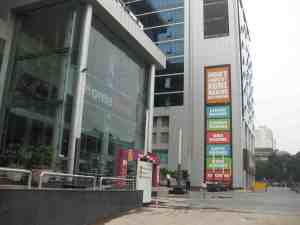
Home Town - India's "Largest Home Making Destination"

We left Nisha with Phoebe and drove out to the aptly named Home Town – an Ikea-esque store in every visible sense. But we found that there was one difference: like every other part of Mumbai, Home Town existed in India Time.

India Time refers to the fact that Indians don’t really seem to suffer from the grips of punctuality. There’s always a traffic jam, always something making everyone late or slower or arriving the next day. And no one here seems to mind because they all live in India time.

Daniel, however, does not. We started inquiring about furniture. “How long until we could have this couch delivered?”

“25 days. It’s not in stock.”
“And this one?”
“25 days as well. Also not in stock.”
“Why don’t you show us things that are IN stock.”
“Ok, this couch here is in stock. 6 days for delivery”
“Why would it take 6 days to deliver something you already have?”

And on and on it went. Our customer service representative, who’d greeted us with a badge that said “Ask me for help!”, was continuously confused by these two gora (aka white people) who didn’t seem to live in the same time zone that they did.  Why ever would we need a mattress quickly? Don’t we understand that things in Mumbai don’t just appear, even if they are in a store only a short drive from our house?

The conversation continued. Daniel asked to speak to the manager. He got them down to two days. It was consensus.

And as a bonus we were going to get voucher for a certain amount off since we bought a bed and mattress set. But the voucher was upstairs. Then it was lost. Then they needed a new one. I looked at Daniel – if he had been a cartoon character steam would have been coming out of his ears as he tried to remain calm. We had to get back to meet an electrician. It would be ok though – they’re all on Indian time too. They expected us to be late.

We came home to a happy Phoebe who looked from Nisha to us and back again. She had given her seal of approval. And as we dropped her off at the train I watched her walk away feeling like the day had gone as well as it could. This is the world we’re living in. Indian time and unfair-seeming wages and all – it was ours now. And now at least we’ll have a guide who can help try to keep us on the right track.

(Just FYI, for anyone who is concerned Nisha is not our housekeeper’s real name. I’ll be using aliases throughout this blog for anyone who specifically hasn’t mentioned that they don’t mind me using their real names)

Lock it In

I stepped off the plane from Kuala Lumpur and took in the heat and the distinct smell of Bombay. It was time to really sink my teeth into the city. I walked briskly towards immigration with my Residential Permit in hand… and like a car in the back of a traffic jam I halted abruptly.

A young Indian man — also barreling his way towards immigration — had run into an elderly man going towards a flight. The crash sound was perceptible and both men fell back, staring at each other, shocked. I waited for the scolding that the younger man seemed to richly deserve. But instead the elderly man helped his fallen foe up by grasping his elbow and patting him on the back, almost hugging. It was a gesture that said “It’s ok. We all make mistakes.” And then, just like that, they parted.

It’s those small moments that make me feel at home in India so instantly again. There’s a brotherhood and mutual understanding among kinsmen. Mumbaikers number in millions and yet for moments they seem like a small community. I walked into customs and proudly held out my residential permit. Where do I live? Here. I am a resident of Mumbai.

Phoebe in the new, empty, apartment

But by the next morning that little fantasy had been dealt a swift blow.

“We’re just going to leave the apartment unlocked and the workers can come in to finish painting. It’s not like we have anything here yet.”

We were leaving our broker and our landlord’s broker to head to lunch. We’d taken ownership of our apartment and the wheels were in motion. There was painting to be completed and odds and ends to be fixed, but in a few hours some workers would come over and finish.

“You can’t leave the apartment unlocked,” our broker said, matter of factly. “The workers can easily steal your stuff.”

Daniel and I blinked at her, still confused. Nothing had been moved in. “All that’s here is the refrigerator.” Daniel replied.

“Right. They’ll steal that.”
“In broad daylight? A fridge?”
“If you leave anything unlocked – your car, your apartment – big things and small things will be taken. The people downstairs wouldn’t care. Don’t leave anything out.”

Our landlord’s broker nodded enthusiastically. The locksmiths working on changing the locks on our door just carried on without a word. What happened to my trusting, forgiving society?

As I stood bewildered, Daniel silently handed over the box to our new lock that the locksmiths were installing. As if the universe was trying to wipe the smug enjoyment off my face from my stolen moment the previous evening, I looked at the box. Among the ‘Features’ listed (such as Patented Lockable Knob and 3 Heavy Duty Bolts) there was this:

Enables Locking of servants and thieves within your house, it said.

I tried to stifle a laugh. Really? Lock your SERVANTS and THIEVES in. Together? What will they be doing there, I wonder. Locked together the thieves and servants of India are plotting to take over our fridge? Once again, there goes my simplistic romantic view. India is, of course, so much more complex than a few days spent here in its shadows.

I went to lunch and was treated to another piece of home and my past. Catherine Tousignant, my Andover English teacher, was visiting Mumbai on what I wanted to call an “Andover Mission”. They’re working on teaching a more global perspective and as such she and a few teachers are here meeting with students and local teachers to try and find pathways of collaboration. It truly made me a little jealous of current students.

But the day was still dedicated to work. When I returned from lunch there were errands to be had. We have an apartment to fill, after all. The servants and thieves need items to be locked in with.

All the curtains waiting to be purchased

So we started with curtains. Haggling and curtain draping, more haggling and fabrics. Daniel discussed and bargained while I tried to not get in the way. I tried to furtively look the salespeople in the eye – are our prices fair? Or are we always just going to have to accept the foreign price.

“For furnishings, make sure to go to the fixed price stores. There aren’t a lot of them, but you’ll need it,” our broker had said nonchalantly. I find it hard to wrap my head around the fact that we’re going to have to keep proving over and over again that just because we’re foreign doesn’t mean we want to get ripped off.

The heat of day and the errands of the day had wiped us out. We came back to the guesthouse (where we’re still staying until we get furniture) to sit down before dinner. I started looking at emails. I looked at the date.

“Oh my goodness, Daniel”, I said after a minute.

“What?”

“It’s our 6 year anniversary today.” We both laughed. We’d talked about it a few days ago in Kuala Lumpur. But somehow the day had just gotten away from us. There’s so much Mumbai absorption that the days and weeks just ran together and took us over. Our old life is hard to keep track of here. And furniture and curtains await.  Oh well. Tomorrow maybe we can keep our heads on straight.

Malaysia

Anyone who knows me will have noticed by now that a major character in my life has been missing from this blog: Food.

Yes, my favorite thing in the world has gone unmentioned because, while I loved the sights and people and culture of Indonesia, I found that the food didn’t knock my socks off. I got into the Nasi Gorings and the Pisang Gorangs (that would be fried rice and fried banana to those of you who inexplicably do not speak Javanese) — but, as they say, it wasn’t anything to write home about. When I crossed the border into Malaysia, however, I found enlightenment.

Where did I find it? In the form of cheesy crabs.

What is a cheesy crab you might ask? Well, it’s very simple and yet while you’re eating it you can’t possibly imagine ever eating anything else again. You take crab meat out of the shell. Mix in some cheese. Put the mixture back in the shell. Then bake. Whoah nelly.

Georgetown architecture

Daniel and I began our time in Malaysia on the island of Penang, which is known as the culinary capital of Malaysia. The main town, Georgetown, has beautiful colonial architecture and is a UNESCO heritage sight. But none of that really matters while you’re eating cheesy crab.

And not just cheesy crab. We also had this dish that consisted of fresh oysters cooked (baked? fried? who knows) into an egg mixture with some herbs and a tomato sauce on top. Or, at another restaurant, we had a lemongrass prawn curry whose sauce I could have just kept eating all day. It was pure delight.

After our food binge in Penang we hopped over to the island of Langkawi. This was intended to be our 2 days of ‘beach time’. Again, anyone who knows me knows that I am not one for sitting on a beach. But Langkawi is a breathtaking combination of stunning beaches, towering mountains, and jungles that come right down to the surf. So while in Langkawi I mostly just read under a tree, looked at the ocean and enjoyed the moment of peace and calm before heading back into Mumbai (while thinking of cheesy crab).

The beach, jungles and mountains of Langkawi

I’d also found some unexpected comforts here. As I’ve been away it’s been continually hard to reconcile the distance that separates me and the people I love. There have been moments where the unfamiliarity has hit me.

But I was lucky enough to have a quick succession of little signs telling me that wherever I am in the world, home is always close by. My first day in Langkawi I was walking along the beach when I saw a sand dollar – it was smaller and more misshapen than the ones we find in South Carolina. But it was undeniably from the same family. A few moments later as I sat reading, I saw that the guy sitting in front of me had a shirt with a palmetto… and a crescent moon… and when he stood up I saw it read “Charleston, SC.” I struck up a conversation with him and it turned out that he had lived in Charleston for a few years and was from Virginia originally. A little piece of home all the way out here with me. I hope that moments like that can help relieve the pangs for home as my days in Asia turn into weeks and months.

We left Langkawi for Kuala Lampur, a complete turnaround. KL (as they call it here) is about as modern a city as you can imagine. We pulled into our hotel and across the street I saw a mall with a ‘Forever 21’ and down the road was a Starbucks. Everything is clean and sleek and anything that hasn’t been built is certainly in the process of being built.

We went to Chinatown for lunch and had another amazing meal. We had laksa, a coconut shrimp soup. We walked around the city’s Chinatown and I couldn’t stop marveling at how the old colonial architecture melded together with the shiny new. It will be an interesting juxtaposition to go back to Mumbai.

But go back we will. Tomorrow night we’ll leave Malaysia and board a plane back to our new home. With our apartment (hopefully? theoretically?) ready for moving in it’ll be round two in the adventures of setting up our life. I think after our time away we’re ready to go back. We’re once again ready to let India take us in.

Addendum:
As I was going through pictures I realized that we were constantly taking pictures of particularly funny signs. Malaysia seems to have an abundance of them. I’m going to share a few below:

Yogyakarta

The only way for me to describe Yogyakarta is to start with my vantage point from a becak.

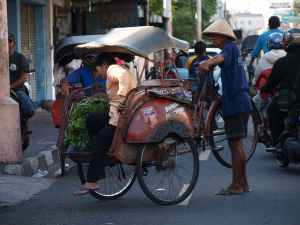
Becak

A becak is like a rickshaw where the bicycle is in the back, so as you ride around you see only the city in front of you. Imagine that you start by negotiating with a becak driver, most of whom appear to be above the age of 50. You offer someone at least twice your age to ride you across town for $2 and they laugh at when you offer this price because apparently $2 is HILARIOUSLY overpriced. You are then clearly marked as a silly tourist for thinking that a human being riding a bicycle for 20 minutes with two people attached is worth the exorbitant price of $2. You should have offered less than $1.

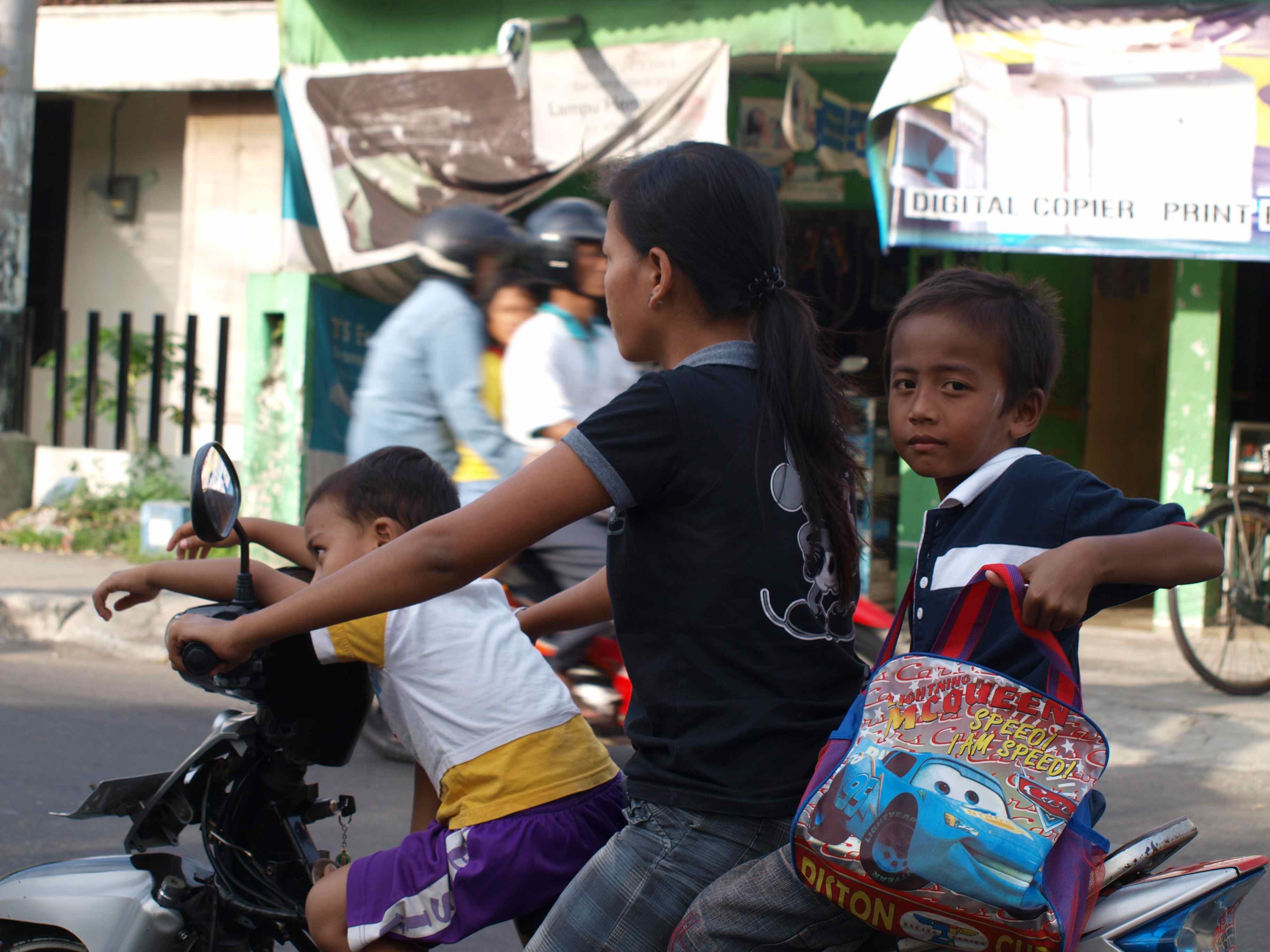
But what you see as you go through the town is that this is one of the most charming place you can imagine, pulled together by an amusing range of transportation options. While riding around you’ll see families in cars, becaks with Yogyakartans and their groceries, actual honest-to-god horse-drawn carriages, and motorbikes with 2 year old children holding the handlebars as their parents hold them. It’s a busy city and a small town all at once, bustling with the movement of all the various ways to get around.

Family on a motorbike

I’m going to pause here to explain what in the heck Yogyakarta is, because I myself didn’t know about it until Daniel told me it was a place he wanted to go. Yogya (as its called for short) is in central Java (a one hour flight from our Bali paradise) and is considered by many to be the soul of Indonesia. Art and culture permeate this domestic tourist hub. If the Westerners flock to Bali to see Indonesian paradise then Yogya is the answer for Indonesians looking for their own heritage.

And beyond the initial vantage point of the becak, what I have found here is that Yogyakartans, are kind and interesting like the Balinese, but with a sophisticated urban edge. Our first day here started with lunch and a walk. But I soon found myself in need of a restroom – and none were to be found. A man seemed to notice we were looking for something and so he asked if he could help. He told us to come on a walk with him. Along the way he told us he was the Sultan’s accountant and that we could

In the Sultan's palace

use the restroom in the Kraton, the Sultan’s palace. The Kraton is the center of Yogya and it’s public areas are only open in the morning – so we were getting to go in post-tourist time.

When I emerged from what was described as the ‘cleanest toilet around’ (really a squat toilet with no flush or toilet paper), Daniel said our friend had had to leave because he was late to meet his wife. But HIS friend also worked at the Kraton and offered to show us around. Really. I kept waiting for the catch, but there wasn’t one. Our new friend’s friend took us all around and told us the story of the city- he explained that in all of Indonesia only Yogya is governed by a Sultan. And even the Sultan sounds like a good guy – he and his wife have five daughters, meaning he has no male heir to the Sultanate. But he has dismissed previous Sultan’s methods of taking concubines because he is a believer in women’s rights. Could I love the people of Yogya any more?

Me with Slamet Riyanto (amazing Batik painter) and our new painting (the yellow one)

We tell our new friend as we’re leaving that we were hoping to buy some Batik – the traditional art form in Indonesia that is a painting made with a particular type of wax dye on cotton – and he told us the best place to go where the artists were creating original works and that wasn’t a tourist trap. Once again I waited for the catch, but there wasn’t any. Various Batik artists had pieces on display in this gallery and we were able to buy one piece there and another from a nearby artist’s studio. For prices that I’m too embarrassed to even share (because they really are incredibly cheap), you can get some incredible one of a kind art in Yogya.

Borobudur exterior

Borobudur entrance

Our second day we left Yogya to go see what everyone comes to central Java for – Borobudur. It is the country’s MOST visited tourist attraction and yet 75% of these visitors are domestic (most of the others are from Southeast Asia or Japan). Borobudur is a 9th century Buddist temple that is over 10 stories high (or about 400 feet). It is a massive circular structure with hundreds of buddhas looking out onto the mountains. It was hidden under layers of volcanic ash and jungle growth for hundreds of years until it was rediscovered in the 19th century. A huge UNESCO restoration project in the 1970’s saw the whole structure taken apart, new foundations and drainage put in, and then the entire temple was rebuilt (its actually unbelievable to see before and after photos).

But the most amusing part of Borobudur is that the structure is not the most exciting tourist attraction for visitors: we are.

Me fulfilling the role of "giant white person" aka the bule

Yes, Daniel and I are the most interesting phenomena here. After the first group of giggling teenagers asked to take a photowith us our guide explained that it was because we are ‘bule’, Indonesian slang for white people. “Most of them never seen white tall person before. So they take your picture and then they show it back in school.” Great. At every turn people asked our guide if they could have their picture taken with us. Kids. Families. Mothers with infants who cry as they look at us (I’m not kidding). Each with a dutiful photographer cradling multiple phones with cameras so that no one person misses out on the photo with the bules. But none of them minded while I shot video as well, so at least for our own amusement we have a record of this hilarious phenomena.

We spent our third day among the hidden temples across the region and the other main temple, Prambanan. It’s truly incredible the amount of history that exists here. And yet, it shouldn’t be surprising since Indonesia has 240 million people and is the 4th most populous country in the world. Somehow I didn’t know that before coming here. Indonesia had never seemed to be a particularly important place in my limited worldview, but how blind I was. I feel so incredibly lucky to have experienced the sights, culture and people of this wonderful many-island nation.

Daniel and Ali at Prambanan

We’re off next to Penang and Langkawi in Malaysia. A new country and a new adventure before we return to Mumbai!

Bali

(Side note: I’ve gotten a lot of emails asking why I haven’t been writing. I see this blog more as a place to share my experiences living in a new culture, not as much a travel blog. So while I’m travelling I won’t be writing every day, but I will be posting a few times. We’ll be back in India June 30th though!)

So…

The second time we tried, India let us go. And we arrived in Bali – a tropical mountainous volcanic paradise halfway around the world from where we started in New York.

Mount Batukaru and rice paddies

We drove an hour and a half north to Ubud, which is in the center of the island. When most people think of Bali, they do not first think of Ubud (unless you’ve read Eat Pray Love where Ubud features prominently. And at this point it seems everyone has read it). Bali to most people is beaches, partying and, unfortunately, nightclub bombings.

Daniel and a monkey side by side in the Monkey Forest

But Ubud is a thousand years away from any party central you can imagine. Ubud is an ancient city hidden among jungles and mountains. When we arrived we first went to a forest that is literally called “Monkey Forest.” It’s called this because when you walk inside you curiously find yourself walking along with hundreds of monkeys. Most are waiting for you to feed them one of the bananas you can purchase at the entrance (“Official Monkey Forest Bananas”. The only thing official about them is that they are 10 times the price of a normal banana). But these monkeys live among thousand year old temples in a forest sanctuary. Let me just say it is not something you see every day.

Daniel and Ali in Monkey Forest temple

Our first night we met a driver named Wayan, and we agreed with him that he would take us on our varying excursions over the next few days. Meeting Wayan I think was the luckiest part of our stay in Bali – but as Wayan would say, “You do good things, so you have good karma, so good things come back to you.” That is the wisdom of Wayan. He is a man who owns his own business in partnership with his friends, speaks three languages (English, Japanese and Balinese) and is devoutly Hindu. I think that the wisdom of Wayan should be written down somewhere, so I shall do it here. A sampling:

“No one feel stress as long as they don’t have target. Target means you must make more money than you make now or must get better job. But without target, you just happy living your life.”

or

“I do not understand Muslim Jihad. Why would they want to hurt people? Jihad brings very bad karma I think.”

or, after Daniel asks how the government prevents tax evasion in cash businesses like his:

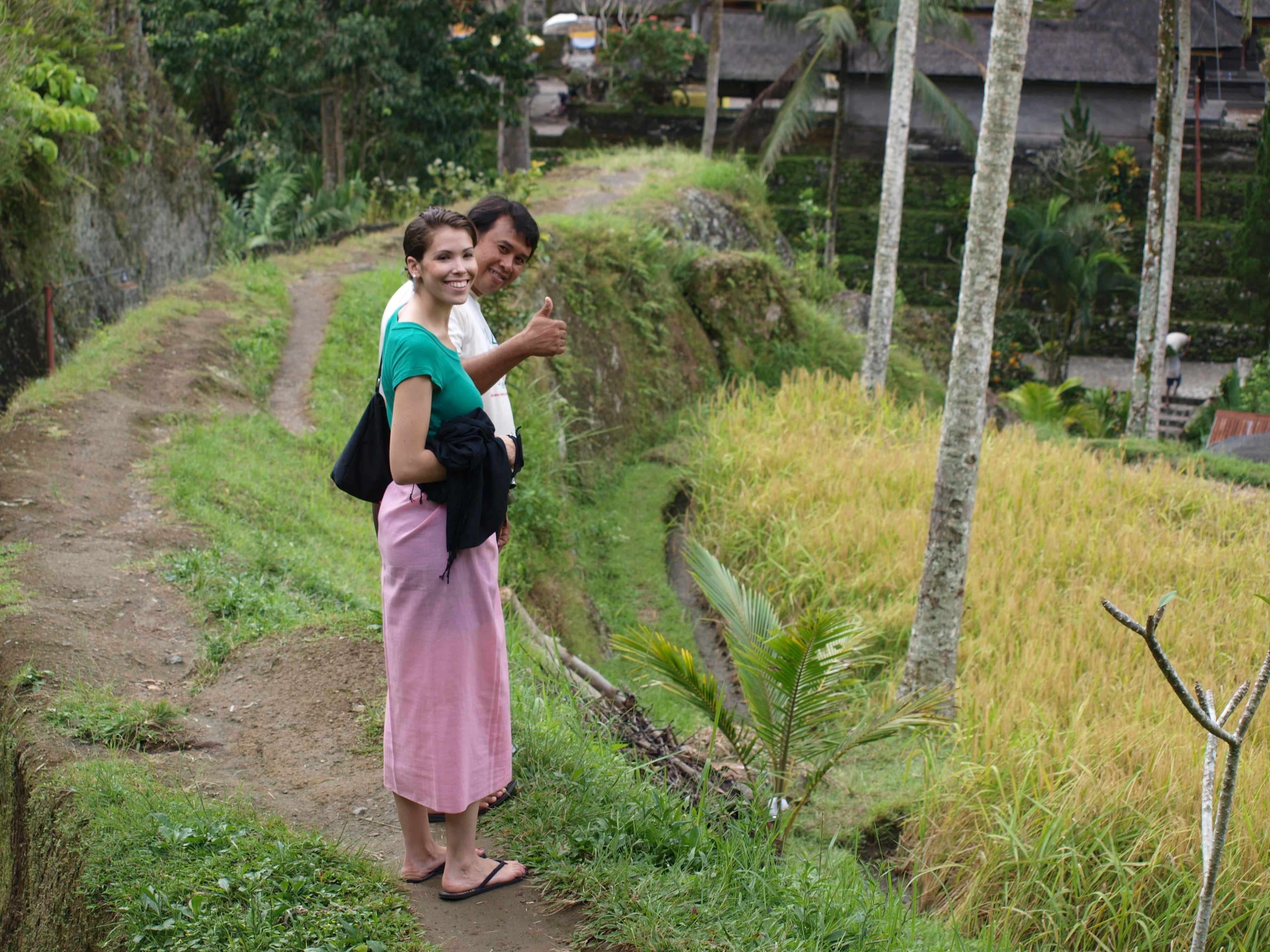
Me and Wayan on a rice paddy

“Yes, the government doesn’t know what I do. But God does. So even if I get away with it with government, I would not really get away with it. Bad karma.”

Karma. What a beautiful amazing concept. It drives Wayan and it certainly seems like a very good way to live. But, as you learn wherever you go in the world, people can lead happy successful lives but they are still only privy to the knowledge that their society affords them. And while Wayan lives by his karmic wisdom, not everyone around him does. For example, when we ask Wayan if he has a website he says he can’t have one anymore, because its too expensive. But more importantly, it’s too dangerous because the website operators in Bali will take bribes to steal emails from their site and give the emails to competitors. If they pay even a day late the operators will send viruses to their computers.

Seriously.

So Daniel very animatedly told Wayan about how you can build a website for free or even just get a domain name very cheaply. It really hit home that education and technology can do so much to even the playing field in a world where monopolizers will take what they can when they can. So, while I write this, Daniel is currently helping Wayan build his website. Wayan says this is good karma. I certainly hope so, because we need it after our initial difficulties in India.

Gunung Kawi

Prayer march at Besakih

But beyond website building we’ve also been able to explore the incredible and varied sights of Bali. On our first day with Wayan we went to a number of ancient Hindu temples, such as Besakih, which was built in the 14th century at the foot of a large volcano. You can’t imagine a more beautiful view.

Besakih

On our second day we decided to take the more scenic route and go for a hike near Munduk, in the north of Bali. Wayan took us to meet his friend Budi, whose family owns a plantation in Munduk and gives tours of the plantation and the nearby waterfalls. It turned out that Budi was no ordinary tour guide – he speaks 5 languages, has a civil engineering degree from a university in Tokyo, is an architect, and is sought after for his knowledge of coffee, specifically the rare Kopi Luwak coffee (if you’re thinking this is the world’s most expensive coffee that is made after a cat-like creature digests the beans, then you are correct).

Daniel and Budi in Munduk

And yet, when Budi was asked to speak in Denmark about his architecture (he designs and builds villas when he’s not running the plantation or showing people around the plantation. Naturally.) he didn’t enjoy it because the cold was too off-putting. Like most Balinese people he can’t really imagine why anyone would want to live anywhere else.

And when you tour the plantation with Budi you tend to agree with him.

What I’ve come away with from my trip to Bali is that for all the amazing things there are to see, the people here are very special and that whatever their station in life is, they all tend to find comfort just in being from Bali. I think that in itself describes the beauty of the island.

I know this blog is more about people than places, but for the rest of our visit the pictures truly are worth more than any thousand words I could write. I also have included a video – because things like monkeys up close, sprawling vistas, waterfalls and loud bugs that sound like the whole world is coming to an end are things you can only watch for yourself.

Gungung Agung