Feeds:
Posts
Comments

Archive for the ‘Mumbai’ Category

You are Invited

As someone who aims to write a blog that someone finds mildly interesting, it is always exciting when your friends send you emails such as this:

From: B
To: Ali
Subject: hey
I have to head to town at some point this week to go to “wedding invitation street” by chowpatty. Would you be interested in seeing that?

Obviously my immediate response was yes. Who could resist such an invitation (no pun intended)?

My friend B is getting married in March back in the US but she is trying to coordinate her wedding planning from India (very brave indeed). One benefit of this is that everything here costs less. She first started finding planning a wedding in India enjoyable when she realized she could get the beading on her dress done here for thousands of dollars less. And so with invitations the idea was that the same concept might apply. She had already talked to a few vendors and was hopeful that the reduction in cost would outweigh the headache.

So with all this in mind we set off to wedding invitation street- the hopeful bride-to-be looking to get her items made properly and the amused friend tagging along always looking for a hilarious Indian experience.

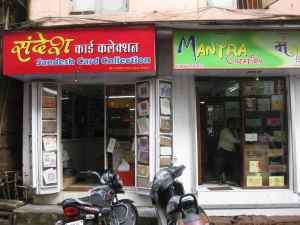
A couple stores on 'wedding invitation street'

We arrived on the street and I was taken aback with how literal it was – actually every single shop on this entire lane in the middle of Bombay was devoted entirely to invitations. Professional looking shops with dozens of examples in the windows mingled with open-air rooms that barely boasted little more than a desk and some stools. Stacks of paper samples sat out in the humidity while store employees read newspapers or looked in a mirror while combing back their hair.

I loved this part of India where people still had a craft. I love that here you can find a shoemaker and a tailor and a leather-worker all on the same row. Cheaper multi-purpose all-encompassing stores haven’t yet weeded out singular skills. I was a little bit enamored with this crazy street made just for the sole purpose of the unique art of invitations.

Closeup of Indian-style invitations

It was hard to even know where to begin – there were so many stores to choose from and, after all, no store had Western examples in their windows. They were all populated with brightly colored and loudly designed rectangle shape invitations. Drawings of elephants or intricate motifs overtook even the most modest designs.

We started with one vendor who B had spoken to earlier. But when we went in his store, of course, he wasn’t actually there. His employees dialed his number and he informed B that he would be in tomorrow. It didn’t seem odd to him that we had assumed he would be in his store on a Tuesday afternoon.

Undaunted, we continued to a few other stores.

“Hi, I’m hoping to do a Western-style invitation… do you speak English?” B would ask. We’d look at the shopkeepers to see if there was understanding beyond the immediate nodding. A few tried to help – but they didn’t have the right card stock or their examples didn’t inspire confidence. Finally one vendor (in an open-air store with just one desk and a small stool) sighed and pointed us towards a more professional looking place. We thanked him and decided to take his advice.

We walked into the new store and were met with skeptical stares. After all, how many white people are looking to get invitations made here? But after it became apparent that they were familiar with Western-style invitations and that they had good card stock, we started negotiating. We would need invitations, RSVP cards, place-cards, the wedding program and a save the date. What kind of deal could he give us?

It was hundreds upon hundreds of dollars less than even the cheapest place in the US. But, of course, B’s original vendor was cheaper. We’d have to come back another day. We’d met ‘wedding invitation street’ and we liked what we saw. But as with everything in India it might just take a little bit of time.

Read Full Post »

Grow Up

For some reason it has started to hit me more and more lately that we live here. For a long time we responded to queries about of length of time in Bombay with, “Oh we just moved here.” But it’s funny how time creeps in and you go from having been here for days to having been here for weeks to realizing it’s been more than two months since you stepped onto a plane into a new life.

You begin to notice this shift through your actions. The transition starts with allowing yourself to eat food with your hands and then eventually you let yourself brush your teeth with the tap water and then suddenly you’re responding to everything with “tikke, tikke” and doing your own version of the Indian head bob.

Phoebe before and after the haircut

This all struck me a bit today because Phoebe got her second monsoon haircut and it seemed crazy to think that enough time had passed for that to be necessary.

The first haircut came over two months ago when we had initially arrived- it was instantly apparent that she was suffering from the oppressive heat under her constant mop of long wet dirty fur.  So as one of our first activities here we took her to a groomer and afterward I posted a photo on the blog showing off our new India-ready pup.

But before we knew it, it became apparent that our India-ready monsoon-proof Phoebe had slowly been overtaken, like weeds on a vine, by the initial mop.  And if the growth of hair can be a visual representation of time passed, then she surely had become a daily reminder of the days we’d spent in India.

But, as always, time marches on and Phoebe went to the groomer. When she came out we were once again presented with a lighter, more monsoon-proof version of Phoebe, happy to be free of the confines of the heat.

For a little while with this new short hair she becomes almost like a puppy, able to jump and play without tiring quickly under the temperature.  It’s like she’s excited to move to India all over again and search and seek until the weight of her own hair becomes too much once more.

I suppose it’ll be like a bi-monthly reminder of our length of time here – a cue that every time we get comfortable we have to try and recreate our initial excitement so we don’t get too lethargic.  Like the trip to Pune, we need to be reminded that our time here will go so quickly and we have to make the most of it.  We’ll need to get our own India haircut every few months to remember that we need to keep seeing this place through new eyes.

Ideally, we should never be just settling in, but always responding that “we just moved here.”

Read Full Post »

It’s amazing how in Dharavi something as small as a mat can make you feel accepted.

This afternoon I went to the home of a woman who volunteers with the non-profit I am going to be making the film for. She had invited one of the field workers to come and talk to her neighbors about domestic violence.

Her home was approximately fifty square feet (or about seven feet by seven feet). She, her husband and three sons shared one twin-sized bunk bed. They had one stand-alone dresser, a television, a small fridge (that had a built in lock), a television, and a kitchen counter whose space was taken up by a small burner. Washing hung from lines above the bed. The walls were cement and the roof was made of aluminum siding that was held up by wooden beams. If you looked straight up at the ceiling you could see small slivers of light peeking through in various places.

But despite the small venue the home was filled with life. Photos of her parents stared down at us (unsmiling, as all Indian photographs are). Pictures of Hindu gods were interspersed with small posters for Bollywood movies and brightly colored calendars.  And despite the treacherous path filled with garbage and feces that existed outside her home (hard to ignore), you probably could have eaten a meal off the floor.

When I walked in she clapped her hands excitedly and stopped me as I tried to sit on the ground with the rest of the group. She pulled out a small mat and insisted that I sit on it.  I tried to tell her that she should sit on it, but she told me through my translator (who is a budding filmmaker and someone I am very excited to have on board) that she was so glad I was there and that she was very adamant that her guest should be comfortable.

As the women arrived it was explained to me that our host had encouraged her neighbors to come and listen. She had become involved in the non-profit through one of these meetings and she felt very strongly about preventing domestic violence. She shared that her sister’s husband was an alcoholic who had beaten her sister very badly. Ever since then she had wanted to try and affect even the smallest change in her community.

The meeting started when everyone was seated. It was a small group – five women, our host, the field worker, my translator and myself. We all sat on the floor and we could barely fit. It struck me how time consuming it must be to have these meetings in such small venues. But the field worker explained that most of these women wouldn’t come if they had to travel all the way to the non-profit’s office. While you could drive there in 10 minutes, they would have to walk, and it would take too much time out of their day. So having small meetings with the neighbors of volunteers is the only way to effectively spread their message across the crowded maze of Dharavi.

The meeting started with everyone introducing themselves and my translator started by explaining who we were and why we were there. She said her name and then started to say my name but I stopped her.

“Meera naam Ali hai,” I said to the whole group. My translator looked at me. “Its one of the few things I know how to say in Hindi – I wanted to say it myself!” I said, and we both laughed. She translated my second comment to the women who all laughed as well. It had broken the ice a bit and we were ready to start.

As with all these meetings they had to start with general issues. The field worker explained the work their organization did – she said they could help with rations (Indians below the poverty line are entitled to food rations, but the system is very corrupt and its often difficult for people to actually get a ration card), legal services, health services and other basic issues.   She also tried to entice them by saying at one recent event two Bollywood stars had shown up and given presents. My translator explained that sometimes this is the best way to get people involved – even more than free vaccinations or free classes for children.
The field worker asked if there were any questions.  One grey-haired woman in a bright blue sari spoke up – she said in her neighborhood there had been a problem with people stealing electricity, causing everyone’s bills to rise. The field worker then emphatically responded with a story about a similar situation where they had helped put in safeguards and reduce the bills. Apparently this has been a large problem across Dharavi.  She encouraged the woman to come into their office for further help.

She then started to ask about domestic violence. First, she asked, did everyone know what constitutes violence? She said there were four kinds of violence and she started with physical violence – everyone nodded their heads, acknowledging the concept. She then continued by explaining the three other kinds of violence – emotional, financial and sexual.

As she talked about each kind of violence the mood in the room shifted.  The topic of emotional violence was met with some skepticism. Everyone seemed to agree that fighting for financial independence was important. The most uncomfortable reaction came when the field worker explained that even if a couple is married, it doesn’t give a man the right to have sex with his wife whenever he wants.

The woman in the blue sari leaned over and started talking softly to the woman sitting to her right. The field worker asked her to stop talking in general, but (as my translator conveyed), she had also had to ask her to stop talking in Tamil. Apparently these women had originally come from Tamil Nadu and as such they spoke to each other in Tamil.

I tried to break the awkwardness of the moment.  “Tora, tora, Hindi boltay. Tamil, neh!” I had said that I speak only little, little Hindi but no Tamil. Everyone laughed. I can always use my terrible Hindi to amuse people.

The field worker continued. She explained that her organization helped with counseling and legal action as well as awareness. The women listened intently.

The conversation was broken up for a moment when our host’s teenage son walked in.  He stood in his crisp blue school uniform with his Liverpool football club backpack and said hi to the crowd of women taking over his small space. He put the backpack down and waved goodbye- there was nowhere for him to stay. I couldn’t stop myself from wondering what on earth it must be like to be a teenage boy and share a bunk bed and room with your parents and siblings.   Every time if I try to look at Dharavi with rose-colored glasses that notice the colorful pictures or the clean floors or the posters on the wall, I have to stop myself from the attempts to glorify. These people are doing the best they can and are trying to improve their community, but this life is incredibly hard. And just seeing the happy but resigned expression on that boy’s face reminded me that every individual in Dharavi is working with a set of cards that gives very little. The poverty here is so much more pervasive and extreme than the poverty we see in America.

I was brought back into the conversation as my translator explained that now we were talking about individual experiences. The field worker obviously had to ask, “Do you know anyone around you who has experienced violence”. By framing it this way women often feel more comfortable raising issues that are happening to them without revealing themselves. They could get questions answered about the available services without feeling embarrassed in front of their friends and neighbors.

Once all their questions had been answered and the conversation about the non-profit was finished, our host served small cups of chai and all the women turned to me. Did I have any questions for them?

I asked (through my translator of course) whether they felt the meeting was useful. The all nodded enthusiastically.

“Will you tell your neighbors about this meeting?”

All of the women started talking – they were telling me how they all gossiped and all the women would definitely share what they’d heard today. The field worker, listening, seemed relieved that they all felt this way.

“Would you feel comfortable if I came back with a camera? Would it be an invasion of the meeting?” Everyone shook their heads adamantly and started talking.

My translator laughed, “No, they say they think it is important to tell this story and speak about these issues, but they admit that they might come very dressed up if you are going to film them.”  I responded that I might have to dress up too, then.

They laughed. One of the women started talking to me and motioned towards her sari. I assumed she was asking if I had a sari.

“Sari, neh. Kurta!” I said, pointing toward the green and gold kurta I was wearing. They all laughed and started talking to each other.

“They’re saying you have to come and they’ll show you how to put on a sari. They are all inviting you to their homes.”

I felt really touched. I asked if they had any questions for me, since they had answered all of mine.

My translator asked and then said, “They say they have no questions, but they want to tell you they are really happy you came here. They are so proud that a foreign white person wants to take the time to tell their story and try to help an organization that is focused on Dharavi.”

I didn’t know what to say. I always feel a little weird that my whiteness always factors in – why should I be more welcome or more exciting just because I am white? It reeks a bit of a bizarre colonial legacy but on the other hand I think most people are just glad to see that their stories and their issues are not lost to the world at large.

Either way, I was glad that they were receptive to the work we wanted to do.  And by the time I left I was invited to four houses for a cup of chai, one Independence Day ceremony this weekend and one woman’s daughter’s wedding.  It was certainly something to feel honored by – even more than a mat to sit on.

Read Full Post »
It’s funny when my old world information sources suddenly collide right into my new world.

Last night I came across an Op-Ed article in the New York Times about slum tourism. It was written by a Kenyan who has been appalled by the growth of this cottage industry that shows mostly Western tourists what life is like in the slum. Mumbai is mentioned as a ‘hot spot’ (if there is such a thing when it comes to slum tours).  The article is now sitting in the New York Times’ most emailed list.

Living in New York, I always read articles like this one with great interest – what are the many things I am not seeing from my small island’s perspective?  We often rely on journalists and writers and filmmakers to teach us about the vast portions of the world we’ll never experience or see in our lives.  And we hope their perspective would be our perspective

So it was very strange to see my go-to paper covering an issue that doesn’t appear to be high on the radar here (in my experience, at least compared to much more pressing issues)– and claiming Mumbai as part of this horrible trend. I certainly can’t claim to know the feelings of most people here about slum tours. But I do have my own perspective – one that has changed since I came here.

I heard from various people when I arrived that you could take a slum tour. My initial reaction was the same as the author of the article – it’s exploitative, it’s degrading, you’re making people’s lives into tourist attractions.

But as I spent some time in Dharavi I started to realize that it’s not so simple to just dismiss it.  The most recognizable slum tour here is run by Reality Tours – they do not allow photography (one of the main complaints in the NYT article), they focus on showcasing Dharavi’s economy (recycling factories, leather workshops etc), 80% of their profits go to Dharavi NGO’s and they fund and run a school.  They are trying to show and improve a community, not just stare at poor people. How can this side of the story be dismissed so easily?

This particular subject has been on my mind a lot lately because obviously I’ve been spending a lot of my own time in Dharavi.  I’ve really thought a lot about how to not be intrusive, how to write in a realistic but sensitive way, how to possibly keep even a basic perspective on something I can’t possibly understand. But while all of these issues should be considered, I think the most basic fact I’ve come away with is this: the people I have encountered in my short time in Dharavi all just want to improve their community. Slum tours (that are run in a thoughtful way) raise money that provides education and services. So most people that I have met seem to not be bothered by it. A few people I have asked have actually wondered why we would think it is bad.

Again (once again with the caveats!), this is only my one experience. I’m sure plenty of people in India and Dharavi (who have lived here much much longer) hate the tours. But my own experiences changed my opinion pretty quickly.

So, with all that percolating and marinating in my mind for weeks, reading this article struck me in a strangely personal way.  I’ve only been here a very short time, but I suddenly became defensive of my perspective – how could this person who has only seen Kenya’s experience lump in Mumbai, without ever having seen it?

And I guess that is the funny thing about perspective and why it’s been so important for me to travel and experience the world: you can read every article, watch every news program and study every book, but making sure you have your own opinion in the narrative is essential.

I just feel grateful that on this subject I can even begin to have a semi-informed opinion and engage in the debate.  And so, Kennedy Odede, Op-Ed contributor in the New York Times, I respectfully disagree with your assessment because I think it ignores the good some slum tours do. But thanks for raising the subject – and I welcome any others to disagree with me.

Read Full Post »

Late last night I saw a full-fledged brawl between ten men break out in the middle of a main street. Somehow, though, this wasn’t the place where I came into contact with the Mumbai police.

The night had started promisingly. We headed down to South Bombay to go a birthday party of a friend. It was nice to escape the smoky bars of Bandra and get a change of scene.

Everyone was having a good time, but as the early evening deepened into late night, there was a knock on the door.   In walked two serious-looking men dressed in khaki from their yellow-embellished hats on their heads all the way down. They were police officers, and they were not there to join the party.

It hadn’t seemed to me like we were actually making a lot of noise – the party was just fifteen or twenty people, and while we did have music on I hadn’t noticed it being overly loud. I got the sense that we were about to be the subjects of a shakedown.

Our hosts went outside to try and talk to the officers. We had turned the music off and we were all prepared to leave, if need be. I later found out that the officers had tried to start with a game of bluff- first they wanted to take us all to jail (for what?). Then they were going to take just the host/birthday boy and his set of speakers to jail (seriously). Of course, they really just wanted a bribe.

Another friend at the party, who grew up in Bombay, tried to intervene. She thought if the cops were paid off then it just contributed to the culture of corruption. She appealed to their sense of Indian hospitality, telling them that since some of the guests at the party (ie: us) were Americans who had just moved to India, it was inhospitable to create a scene at the party. Sadly they were unmoved by this line of reasoning (although she did take down their names and vow to report them).

They were, however, moved by a payment of 2,000 rupees (about $42).

As the police left we figured it was late enough at night that we should probably leave as well. A group of us going back to Bandra hopped in the car to make our way north.

The only time in Mumbai when there is little to no traffic is in the middle of the night, so I was surprised when, only fifteen minutes into our journey, we started slowing down. I looked out the window – a huge fight was taking place.

We were on the Worli sea face on a three-lane road, but only one was moving. Parked cars and a group of men fighting one another occupied the rest. They were taking a no-holds-barred approach: a few were swinging at the others as fiercely as they could while their friends tried to hold them back. Another friend had stepped out of the fight to direct traffic (how thoughtful!). But the fighting was brutal.

I noticed, as we slowly drove by, a few brightly colored Lamborghinis and Ferraris parked at various points near the fight. I had to imagine this was a drug deal or mafia related incident (unless otherwise very wealthy people decide to stop traffic and pick fights randomly in the middle of the night).  The people fighting didn’t notice or bother any of the cars on the road driving past. They just seemed to want to pick the most dramatic place to stage their showdown.

Of course, for this incident, the police were nowhere to be found. Who are they to get involved in an underworld dispute? After all, there are important parties to break up and get paid for.

Read Full Post »

I have to be perfectly blunt and say that I can’t possibly fathom what it is like to live in a 10-foot by 10-foot room with one window and one stove and no bathroom with my entire family.

In fact, I don’t really know how to realistically process and respond to my first foray into residential Dharavi without falling into the trap of minimizing, dramatizing or romanticizing the experience.

All I can really say is that now I have seen with my own eyes the living standards that I have heard so much about since moving to Mumbai. And there are a lot of impressions and thoughts that came with my first visit.

I went back to the hospital to meet up with the supervisor who I had been shadowing. He informed me that today, instead of a group meeting, he and his field workers were going out into the community to distribute information about hygiene. This monsoon is the worst in five years and there has been a serious outbreak of malaria and dengue.

I tried to ask in the most polite way, as I had every day, what this had to do with curtailing domestic violence (since that, ostensibly, is their main mission).

“It has nothing to do with violence. But we give information, which is good. Then some people will come to meetings about health care, which they are interested in. Then, once they are involved, we can talk about ending violence. If we start with violence, nobody cares.”

I followed him out of the hospital wondering how he and his field workers get the energy to go out every day when they can’t even raise the topic that they are interested in. It just seemed so daunting.

He informed me that we had to drive to the area we were going to (Dharavi is, after all, very large. At least a million people live here). As we drove he tried to warn me.

“Just… be aware of your feet.”

“My feet?”

“Yes, your feet. They will get dirty. I hope that’s ok.” He didn’t elaborate, but I got the general gist.

We pulled over once we’d gone as far as we could go – I very quickly realized that walking was going to be difficult, let alone driving.

The method for the day was to go “door to door” (I put that phrase in quotes because most of the homes did not have physical doors beyond a makeshift bed sheet).  We walked in from the street and it immediately felt like we’d entered a maze.

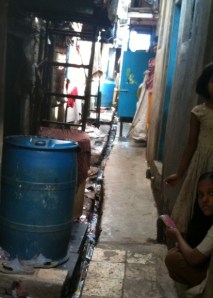
They path between houses

Walking into a residential section of Dharavi is actually kind of reminiscent of walking through the tightest alleyways some small European town – if the town were made of poorly constructed cement structures and if you’d been transported back to a time with little plumbing and amenities.

Each home is directly connected to the home next to it, and you maneuver through the area with only a small 2-foot wide pathway serving as your sidewalk. In the middle of this pathway is a hole running the entire length that serves as both a place to lay small pipes and as a moat of sewage.  This is the part that really gets to you if you’re not used to it – there’s a constant pervasive smell of garbage and sewage, which is only exacerbated by the lack of fresh air making its way in. The lanes are so narrow much of it is covered with tarp, so the smells and the heat combine together throughout.

This also creates a trap for the heat– so even though I hadn’t been too hot before we entered the slum, once I was inside the narrow pathways the stale air, confined quarters and number of people surrounding me ensured that I existed in a permanent sweaty state.  But, on the other hand, it started making me cognizant of the small victories: every time a breeze came through I felt it was the coolest moment of my life. I quickly appreciated every wisp of the wind in a way I never had before.

The scene that was laid out in front of me at each turn of the corner was similar– every home had one room, the structure was made of some combination of cement, brick and wood, the roofs appeared to be made of a kind of sheet metal.  Inside every room there was usually a stove, some mats for beds, and a few personal items. A good number of the rooms had televisions – one of the many contradictions that existed in the slum. When at one point I found myself standing at a vantage point where I could see above the structures, I noticed that every third home appeared to have a television dish.  And for every person watching television there were five more staring down at his or her mobile phone.

Color along another path between houses

There was also color everywhere – walls were painted in bright hues, varying clothes dried on the outside of every single house, and children in school uniforms were always running through, brightening the alleys. I don’t know whether it was purposeful or not, but the constant explosion of color gave the slum a vibrancy that seemed to defy the darkness that pervaded in each of the individual rooms.

I mostly just watched as the field workers approached each home and handed out pamphlets  (which had words and text depicting healthy bathing habits, proper garbage disposal and boiling water properly). Some people would only politely accept the handouts without any discussion. Others would take more time and ask questions.

I asked the supervisor what sorts of questions were most common. He said that some people couldn’t read the pamphlet and so they needed to understand the content. Others wanted to know more about the organization. It was in these instances that the field workers could try to encourage the residents to come to a meeting (and they were going to hold one directly following their leaflet distribution). It was their first stage in getting people involved.

Sometimes the discussions took longer – a few people wanted to share their difficulties with the field workers and they would stop to listen and encourage. One woman got angry. She started yelling and talking very animatedly. I had to ask again what was happening.

“She thinks we are useless,” the supervisor said matter-of-factly, “She says if we really wanted to help we would bring medication and other supplies. She says no one will help her and her family.”

“How do you answer that?” I asked.

“Well, we gave her information on clinics that she could go to and places that do give out medication. I understand why she is angry though.”

I didn’t respond. It was still hard for me to shake my previous thought: how could these people be strong enough and motivated enough to do this work every day? These community workers were standing there being yelled at, and instead of being frustrated they were sympathetic of where the anger came from.  I was constantly struck by their enormous patience.

I felt pretty useless in the whole endeavor, but the women kept nudging me along and helping me find my way. They still seemed to accept me, and I felt sort of flattered that they’d actually let me come along for the task. The Dharavi residents themselves mostly just stared at me. Since the pamphlets we were handing out were from Unicef most asked if that was where I was from. It usually started with pointing towards me and then I’d heard the words “gora” and “unicef” thrown in until the field workers responded with “Ali” and “film”. I could usually tell once the conversation had ended because they’d all stop paying attention to me.
The only people who never stopped staring were the children. Every single one, from toddlers to teenagers, looked at me for however long I was standing in their doorway. At many points children would just appear, clearly after having heard that a white person was in their midst. The ones who were learning English wanted to practice. They’d ask to shake my hand and they all wanted to know my name.   When I tried to respond to them in Hindi (saying what my name was or letting them know that I spoke only a little Hindi) they laughed and tried to repeat what I had said in my clearly very foreign accent. But their laughter filled up the constricted alleyways and brought it to life.

The only difficult point for me came when I almost fell headfirst into the narrow sewage stream in the middle of the pathway. Every time I walked I had to focus on putting one foot in front of the other – the pathways were certainly not paved in any standard way and there were often steps or cracked tile or a steep inclines. One turn that looked like a path ended up being mud and I started to slip. But I quickly had at least 10 pairs of hands on me – every field worker and every woman they were talking to had reached out instantly to stop my fall. When I didn’t fall in they all smiled and patted me on the back.

I don’t want to extrapolate too much from one isolated incident, but it certainly made me feel the sense of community that existed there. Maybe that’s my outsider desire to see the good in a dire situation, but it appeared to me that everyone’s instinct was to protect even the visitors. It’s a difficult life and it seems like everyone has accepted that they all need to come together to co-exist.  And maybe it’s from there that the field workers keep the momentum to do the difficult work that they do.

I don’t know if any of these instincts are right. But I’m certainly looking forward to delving in further and trying to tell these women’s stories.   Watching the number of people who showed up for the post-distribution meeting I certainly started to feel more empowered. I sat in a schoolhouse – one room with a broken fan with one chalkboard and no chairs – as the field workers gave an in-depth discussion of disease prevention to the fifteen women who’d showed up. It’s slow work, but little by little they are enacting changes in their community.

Read Full Post »

Try to imagine sitting in a meeting where you don’t understand the language that the meeting is being conducted in. You’ll either be really bored or you’ll start to notice the details of a conversation in a way you never could if you were just focused on the words. Perhaps it’ll be a little bit of both.

This is the scenario I found myself in on my second day of observing in Dharavi. I wanted to sit in on one of the afternoon group meetings. The supervisor who was leading the meeting spoke perfect English so he said he could translate the basic agenda throughout the afternoon. Of course I should have guessed that the person leading the group wouldn’t have a lot of time to lean over and translate.

While we walked from the hospital to the field office I asked what today’s meeting was about.

“Today the meeting will be about lots of things. The women who come will get information from us and then they can spread that back among their community. So we’re talking about senior citizen benefits and rations and health care during the monsoon.”

I tried to keep up with him as we walked. I was attempting to maneuver through the streets without stepping in garbage or getting run over while still maintaining a conversation. After sidestepping a tethered sheep, I endeavored to get more clarity, “But what does that have to do with domestic violence?” I asked.

“Nothing today. But we always try to bring it up a little bit and then build trust and stay in their minds as a resource. But today is just about spreading information for daily life.”

I nodded while falling back to accommodate a bus coming by. We turned the corner into the field office and I was relieved to be off the street. I took my shoes off (today I had more wisely chosen waterproof footwear) and walked in among a much larger group than I had seen the previous day. About 30 women of all ages had come to the meeting. I sat down at the front with the supervisor while they all stared at me.

He started talking and gesturing towards me. I could make out a few words- Ali, filming, etc – so I knew he was explaining who this white person was and why she was here. As he talked everyone started nodding and smiling towards me. And with that, the meeting began.

Every once in a while I would get the basics translated (“Now we’re talking about how to set up the benefits if you are a senior citizen” or “Now we are answering questions about taxes”) but mostly I just listened as the words went in one ear and musically drifted out the other without meaning. Every minute or so I’d pick up on a phrase or a number I knew. Or I’d hear a word or phrase in English (for example, Senior Citizen Benefits is just referred to as Senior Citizen Benefits. I suppose they use terms like that when they are the official government term, since the government of India’s official language is English).

So I just watched. And even without understanding the content I got the distinct sense that this was a group of women who wanted to gain every piece of knowledge they could. They hung onto all the words that I couldn’t understand. When a question was posed calling for a show of hands, the hands shot up enthusiastically. All eyes were on the speaker as every woman sat on the ground for over two hours in a hot room with nothing but fans to keep them cool. They all had questions – and when they were called on they spoke animatedly and excitably, as though the entire world depended on the question’s answer.  They clearly were there to better their communities and to use the resource that had been placed in front of them. You don’t need to know the language to feel like you understand the sense of the urgency each person is feeling.

And it was apparently acceptable to them that I was just sitting in. Every time one of them would catch me watching, they didn’t look away – they always smiled and looked me right in the eyes. One child came over to give me a closer look (as one might imagine, the children here have no hesitation to overtly staring at a white person) and when I looked at the mother to see if it was ok, she gave me an approving nod. The child sat down in my lap and took a nap. No one seemed to notice. I guess if I wanted to come be a part of their community no one was going to give me a second thought — even if I couldn’t communicate beyond the most rudimentary basics.

At the end of the meeting a number of women stood around to continue to share their ideas and questions with the supervisor and the field workers. I walked out with the last group and everyone waved and said goodbye to me. I hadn’t understood the words, but I was glad I had come.  I think sometimes its important to see the work and see the excitement. And then perhaps, sometime soon, the translations will come a little bit more quickly.

Read Full Post »

I started missing Western hospitals right around the moment that I was standing in a thin hospital gown with my face against an X-ray machine while a small man steadied my head so that my nose was touching the right spot on the panel.

This adventure had begun about an hour and a half earlier. My ‘birthday’ sickness hadn’t gone away, and a full week later I had started to wonder whether it was time to finally let a professional have a look. I’m usually a wait-and-see kind of person – if it sounds like a cold and feels like a cold, I usually assume it’s just a cold. But I’d had a low-grade fever every day for 8 days and my coughing was starting to scare small children, so I ventured out to a hospital.

We were lucky that a colleague of Daniel’s had recommended a doctor at Lilavati Hospital, one of the supposedly better hospitals here in Bandra.  We made an appointment for today (shocking) by talking to the actual doctor (also shocking) and we were on our way.

All my payment paperwork

Right off the bat we learned that the most interesting difference between an American hospital and an Indian hospital is that in India (or, at least, at Lilavati hospital) you pay up front.  There’s no “We’ll bill you later” and there’s certainly no chance to see the doctor and then pay.  You go to a desk, tell them what you’re there for, they give you a plastic card that’s wired with your information, and then ask for your credit card.  It’s also shocking that to see the doctor only costs about $17.

We waited for about half an hour. I sat and watched the crowd as everyone sat there patiently. There were men and women of all ages – some were dressed in modern clothes like button down shirts and jeans and others in full-length saris.  But the one commonality was that everyone turned their heads sharply to stare at me every time I coughed.

When we went in to see the doctor he went through the basic procedures – although the light to look at my throat was an actual flashlight. He had a desk that he sat in when he wasn’t examining me. There was nothing on the walls and no windows – it was an odd room to spend your entire day in with people coughing and sick all around you.

When he was done looking he immediately diagnosed me with a chest infection – the doctor said it’s been going around in the monsoon and he’s seen a lot of people with it. Apparently it mostly just manifests itself as the bad cough and cold I’d been experiencing. He assured me that some antibiotics should do the trick, but he also wanted me to get some blood drawn and take a chest x-ray just to be safe.

I had to go back to the front to pay for my new procedures before I could continue. It was 840 rupee combined for my x-ray and my blood tests (Divvied up that meant my blood test cost about $5 and each of my two x-rays would be about $6). I took my payment slips and walked over to the blood lab – it was in and out, very efficient. It certainly seemed like this private hospital had found a good system for getting everyone from one treatment to the next.

A jarring sign...

I went and waited for my x-ray. I sat next to a woman in a burqa on one side and an entire family surrounding one seemingly sick person on the other. It was two microcosms of India in one waiting area.

I looked around at the signs on the wall to occupy myself while I waited. One stuck out to me: “Determination of the Sex of the foetus is not permitted in this hospital. It is legally prohibited.” Apparently there’s been a problem with sex-selective abortions in India, and this is the only way to curb it. People told me later that it got to be such a huge problem here that they just outlawed allowing people to know. It’s signs and notices like that that sometimes jar me into remembering how stark the cultural differences can be here. While I was sitting around marveling at how modern and Western-seeming the hospital is, that sign was a poke in the arm telling me not to get too comfortable.

But as I was getting lost in that thought, the x-ray technician beckoned me in. I changed into a hospital gown and he led me over to the standing x-ray. He carefully pushed my face up against the machine, seeming very concerned that my nose press up against an X in the middle. When the x-rays had been taken he handed me over my very own copy. Apparently I’m as entitled to one here as my doctor.

I picked up my prescriptions and went home – the whole ordeal had taken less than 2 hours and cost me only a bit more than $30.

Many many medications

Of course the funniest part came when I realized quite how many prescriptions I’d been given. Maybe my new doctor believed in the ‘better safe than sorry’ approach, or maybe he just wanted to be extra cautious with the white people, but I walked away as the proud new owner of a large stash of medications. He’d given me two separate antibiotics (why?), a pro-biotic prescription supplement, an anti-inflammatory normally reserved for ulcers, an antiseptic ‘germicide gargle’ (basically just iodine and alcohol with mint flavoring), and a cough suppressant with codeine.

At least he wasn’t taking any chances?  I decided to self-diagnose that I wouldn’t need both antibiotics and that the anti-inflammatory and codeine-ridden cough suppressant could be put aside.   I was going to get better and I was going to take my new Indian doctor’s advice, but I was still keeping a bit of my American sensibilities.

I’m still sort of proud that I haven’t gotten sick from food (knock on wood), and experienced the true ‘India’ sickness. But now I’ve at least been initiated into monsoon sickness and had my first dose of Indian health care – as well as my new ‘germicide gargle.’

Read Full Post »

One of the most interesting effects of the monsoon is how it can stop anything in an instant. And in a city as vibrant and full of life as Bombay, that truly is something.

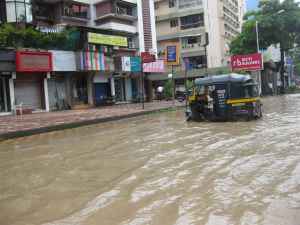
Rickshaw in water

You can be driving along a road at a normal speed in normal traffic when suddenly the rain comes out of nowhere. It only takes a moment sometimes; clear-looking skies and dry weather are overtaken first by small drops, then persistent rain, then a heavy downpour, then rain so thick you can’t see your hand in front of you. And that whole shift can take place in a matter of seconds.

In that instant, the traffic snarls to a halt. Windshield wipers are practically useless in the deluge. Hazard lights are turned on just so that each car will know where the cars around them are basically located. A trip that could take 30 minutes suddenly takes two hours.

You can always spot a few victims once the rain lets up enough to let you see out. Usually in heavily flooded areas you’ll see abandoned rickshaws, not strong enough to get out of a flooded area.  Parts of roads will remain flooded for hours afterwards, since the water has nowhere to drain.

I’ve gotten sort of used to living this daily rainy existence – there’s never a full day respite, but some days aren’t so heavy or often it’s just a light drizzle. And I know what to expect once heavy rains start to fall.

But the one thing I can’t get used to is our internet connection.

Our high-tech cable running from our roof to our neighbor's roof

It was installed as soon as we moved in, and the process itself was humorous. A cable was run from a few buildings over – over and around and up the side of our apartment building the cable went. It’s not underground, it’s not through a wall, it’s just across some buildings and drilled neatly into our wall.  But it’s a cable and it seemed simple enough. We bought a wireless router and thought that that would be that.

However, nothing is so simple. It stops working at best for an hour a day. Sometimes, like now, it stops working for a few days at a time. And every time Daniel calls up the company they say “nothing works right in the monsoon.”  If the power goes out in one of the buildings along our one cable line, no one has internet (At least, this is what they say. I don’t know if I actually believe that this is the real reason).

Now, I understand why our cable dish doesn’t always work in the monsoon. We get a message on our tv saying something is wrong and I think of the small dish trying to get a signal through the deluge. But a cable? What could be so wrong with this cable every day? How can the monsoon be an excuse for constant failure of an entire product?

Our television during heavy monsoon...

Yet it’s everyone’s excuse here – our carpenter was late because of the monsoon (what exactly about the monsoon, we don’t know), people are always late to dinners and meetings because of the monsoon, our shipment was late, items can’t be delivered because of the monsoon. Doesn’t this happen every year? Don’t you think by now people could have figured out how to work around it? It’s a bad rain, but its just rain.   It apparently is also a great excuse.

So today I am only connected to the wider world via a wireless card Daniel can plug into his computer. It’s slow but it’s a useful backup – after all, there’s still another month of monsoon. Who knows when our internet will come back on again.

Read Full Post »

Before I left New York I tried to stock up on Malarone, an anti-malarial mediation. Our doctor had advised us to take it every day, and despite a lot of other people telling us it wasn’t necessary, we figured it was better to be safe than sorry.

However, the pharmacists in New York thought I was part of some anti-malaria stockpile conspiracy and they refused to give me more than a one-month supply.

I had tried to argue my way out of it, but there was no chance. Rules were rules and I just was going to have to get more Malarone once we got to India.

I mention this now, because my experience with Indian pharmacies has been dramatically different.

In order to find Malarone in the first place I’ve had to call around. As is customary here with almost any store, if they decide they don’t want to talk to you, they just hang up or hand the phone to someone else. So my conversations have sounded mostly like this:

Me: Hello? Is this the chemist?
Them: Hello?
Me: Hi. Chemist?
Them: Hi.
Me: Hi, are you the chemist?
Them. Hi. Yes.
Me: Ok, do you have Malarone?
Them: What?
Me: Malarone? It’s a preventive malaria drug.
Them: What?
Me: Malarone.
Them: Hold on

(Pause here anywhere from three to ten minutes while they ignore you or pass you off to another person)

Them: Hello?
Me: Hi. Did you find it?
Them: What?
Me: Malarone?
Them: What is Malarone?
Me: I talked to someone earlier about whether you have Malarone, it’s an anti-malarial daily pill
Them: We don’t have.

Now is the part where you hear the dial tone because they hung up.

Exciting, isn’t it?

But once you’ve found the drug you’re looking for you’ll have no problem actually getting your hands on it.

Indian pharmacy's array of medicines

I finally found a pharmacy that confirmed the existence of Malarone. I walked in and was greeted by a small woman in a lab coat over a yellow salwar kameez.

“How can I help you ma’am?”
“Hi. I called earlier about Malarone –“
“Ah yes,” she said as she turned to go looking for it. I looked at the prescription sitting neatly in my hand, waiting to be passed over. She hadn’t asked for anything. Here I was apparently not a criminal for wanting extra Malarone – on the contrary, it seems I could’ve asked for a multiple-month supply without giving any reason at all.

I stood waiting and eavesdropped on the conversation taking place next to me, between a gangly pharmacist and an older gentleman peering up at him from round spectacles.

“It’s an imported medicine,” the older man was saying,
“Ah, do you know if it’s legally imported? Because we might have it either way, but if it’s legally imported then we’re more likely to be able to get it in,” the pharmacist replied earnestly.

I turned away – I didn’t want them to see that I was listening. But soon my pharmacist came back.

“How much do you want?” she asked.

I took a three-month supply. Why not?  I’ll never know whether the older gentleman got his medicine – legally or illegally imported – but I suppose, like me, he can get whatever he wants. Just perhaps not over the phone.

Read Full Post »

« Newer Posts - Older Posts »