Feeds:
Posts
Comments

Post It

I’m not quite sure how I had managed to avoid the Indian Postal Service until today. I didn’t realize I was missing one of India’s greatest bureaucracies in action.

Normally when I have to mail a letter, Daniel can send it from work. But I wanted to mail some presents to friends in the UK and I figured it was a little more complicated so I should do it myself. Of course, I’m really a fool for assuming that something more complicated would be a better task to take on.

The difficult to identify Bandra Post Office

I arrived with my lovingly packed presents in hand. The presents themselves represented one of my favorite things about India: they were two unique hand-made gifts and I’d wrapped them in a beautiful hand-painted yellow wrapping paper made from recycled paper. But my I-Love-One-of-A-Kind-Amazing-Things-Made-In-India joy for my presents was soon mockingly destroyed by the fact that India’s own postal service wanted to crush my spirit.


I tentatively walked into the Post Office, or, more accurately, what looked like an abandoned building. Confused by the darkened hallway, I walked up to the only window I could find. Heavy wooden shutters were open onto a window with heavy wooden bars. The only large opening in these bars was well below my height (clearly, and understandably, made for small Indian women), so I ducked my head down and said hello. The representative looked back at me, amused. He seemed delighted by the fact that a gangly white person in a kurta had to be so uncomfortable to talk to him.

My new friend and his wooden bars

“I’m trying to mail two packages to the UK. I want to use the regular Indian Postal Service.”
“No Indian Postal Service now ma’am.”
“Why not?” I replied
“Ma’am, Postal Service only until 2pm”
“Oh, you mean it won’t go out until 2pm tomorrow?”
“No, we do not process after 2pm. You can only do Speed Mail now, but its ok because then you can track it. Look at the sign.”
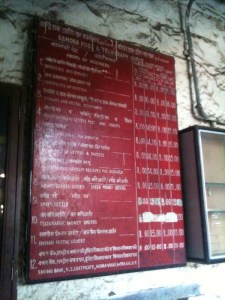
The very useful sign

I looked over to my right at a large red sign that indeed had a whole listing of times for different services. Of course, you wouldn’t know these times unless you were standing in this particular post office. And, of course, it also made no sense. Why couldn’t they process their own mail system after 2pm? I decided to not ask these kinds of questions to a man sitting with a ledger instead of a computer. In fact, when I looked behind him stack upon stack of dusty old ledgers sat haphazardly as if they’d been there a lifetime.

“Hand me the packages, I’ll weigh them to determine the cost.”

I did this and he started opening and looking through them- and not in a gentle way that indicated his love for artisanal wrapping paper (I know, I’m lame), but in a way that one would normally handle trash.
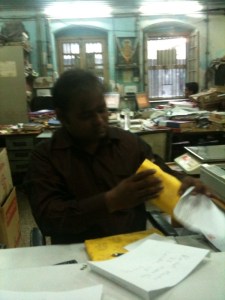
He actually opened them...

“Oh… sir… I… those are wrapped. They’re presents!”
“So?”
“So…. You’re ripping the paper.”
“I just want to see what they are.”
“For customs?”
“No, I’m just interested. What ”

I stood there, dumbfounded. He looked up and me and saw that I wasn’t amused so, as a gesture, he started to tape it all back together. With packing tape. I gave up trying to salvage my paper.

“Ok,” I responded, “So how much is it to send two packages to the UK?”
“Well if you send separate it is 900 rupees for each. If you send together it is 1,000 rupees. It is based on weight, you see.”

I didn’t really see. It made no sense. But I made the executive decision to send them together (the packages are going to two friends anyway, so I figured they’d see each other). My new friend told me to go outside and deal with a guy who would help me with my customs form.
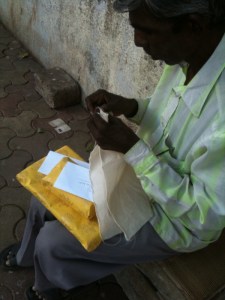
What could he possibly be making?

Baffled as to why this would take place outside, a new man gestured for me to come towards him on the sidewalk, so I just went with it. I tried to explain that I’d need bubble wrap or paper or something to keep everything from breaking. But he wasn’t’ really listening.

I started to stare intently at what he was doing – what was he doing? He had taken what looked like a piece of burlap and was sewing it with a large needle and a piece of string. I couldn’t make out what he was creating. So I just stood there, in the street, where homeless people were sleeping and one child was urinating while a man from the post office sewed something together that apparently was needed for international packages. No one else seemed to think this was weird. To them, I was what was weird.

Finally it came together – he was sewing a sack to put everything in. Was this intended as my bubble wrap or buffer?

Yes, my presents are inside

No, no it was not. This was my package. There’s no “International Mail Box” I was being given or even a padded envelope. I was required to send my packages via burlap-sack. Then handed me a customs form to fill out and I wrote in all the details and gave it back to him. He started sewing the customs form onto the parcel. I had to stifle a laugh. It was just too absurd. Really? Really? I’m standing on the street while a man sews a customs form onto my burlap parcel?

He handed it back to me and told me to go inside to pay. I went back to my original friend and gave him the package.

“It’ll be ok, right?” I said, hoping he might tell me about the greatness of ‘Speed Mail’.
“Ma’am, only God will tell.”

I guess in three to five business days I’ll know how the sack held up.

My customs form being sewn on
4 Little Words

They were four little words you definitely do not want to hear while living in India:

You. Might. Need Surgery.

It’s bad enough to be lying in a fetal position after spending your day taking tests. It’s another to contemplate having your body chopped into while living in a foreign country. I was not a happy camper.

It probably started with me boasting that I hadn’t gotten ‘India sick’ yet. I like to say this to people a lot – to be fair, it’s mostly to try and comfort people who are visiting. Such as, “Oh, you won’t get sick from the food. I’ve lived here six months and I haven’t gotten the notorious ‘Bombay Belly’ yet!’ I think I do better than my friend D who just likes to declare that she has a stomach of steel.

But I think there was a little bit of karma involved when I started to feel ill. It was as though the India gods were saying, “ok, you don’t need to get sick from food. We’ll give you a good-old-fashioned-regular-illness instead.”

I felt a bit ill on Friday but I only started to worry in the evening, when I took my temperature and it was above 100. I called my friend A.

“I have a weird question to ask you,” I began. “I have a fever. And Daniel is out of town. If this was America, I wouldn’t be nervous…”
“But it’s India.” she responded, clearly understanding where I was going.
“Right, so maybe you could spend the night over here in case something happens in the middle of the night?”

She, of course, said yes. You see, there’s an interesting thing that happens to all expats who live here: you get paranoid. And it’s justified. You hear too many tales that begin with, “Oh I thought I had a cold. But really it was dysentery” Or malaria. Or dengue. Everyone has horror stories about eating the wrong food or drinking the wrong juice. And these horror stories are much worse than your average food poisoning tales. So even the smallest hiccup or cough suddenly starts your brain ticking. What did I eat yesterday? Did I see a new mosquito bite on my ankle? Did I really wash that apple enough? You could go crazy worrying about getting sick – which is why most people stop obsessing over the small things after they’ve been here awhile. We start brushing our teeth with tap water and accepting ice from places that say they use mineral water. But it always lives in the back of your mind, the fear that India’s many health scares are coming your way.

I thought about all of this as I tossed and turned throughout the night. I couldn’t get comfortable no matter which position I picked. At 2am I looked at WebMd’s symptom checker. Bad idea. Once you say you’ve travelled to a third world country it starts giving you even more ideas. At 4am I wikipedia’ed dengue. That was comforting – apparently I would have had a rash, so it couldn’t be that. At 6am I took my temperature for the 20th time and was nervous to see it had gone up to its highest point so far. By 8am I woke up A.

“I think it’s time to call a doctor.”

My symptoms sounded bad- pain in the abdominal area on the right side of a female usually means appendix or ovaries, neither of which should be left unchecked. So we headed over to a clinic the doctor had recommended in order to get an ultrasound.

As I waited my turn in the plush waiting room I thought to myself, “This isn’t so bad.” It looked nicer than any clinic I’d seen at home. I was able to stretch out on a leather chair while a flat-screen tv showed the day’s cricket match (not my cup of tea, but interesting enough). Even with the nice setting the whole ultrasound only cost 1,200 rupees, or roughly $26. That’s before I even submit it to my insurance. For all the things to complain about the on the potential-diseases-you-could-get spectrum, I also had to be impressed by the low cost of everything. It’s not a low cost relative to the average income in Mumbai (where a large percentage of people only make a few thousand rupees a month), but compared to American health care, it’s a steal.

However my initial optimism soured a bit with the results of my ultrasound. I had “edematous gall ballder walls with sludge’ and ‘enlarged lymph nodes with fatty hila’. How was I to know what that meant? Sludge certainly didn’t sound good. Most annoyingly, they unfortunately they couldn’t get a close enough shot of my appendix to tell if it was bursting. So it was off to a CT (which, just as an FYI, cost around $120).

I’ve never had a CT before, but I can assure you that it is all the more unpleasant when 5 out of 6 techs in the room do not speak your language. They didn’t really understand that I was in a lot of pain, and therefore was having difficulty lying in one position. I couldn’t explain that my elevated fever was giving me the chills, which was also making it hard for me to not shake a bit. Finally a woman came in who spoke English and put a few blankets on me. I thought she might be my savior until she informed me that I would need an IV that would pump warm contrast into my veins as well as a tube going into another area (which I won’t go into depth describing here, since this blog aims to remain family friendly!). Needless to say, by the end of the CT I was feeling worse for wear.

That didn’t compare to my doctor’s visit after it all, where the idea of surgery was finally raised. As I lay curled up, exhausted from tests and fever and an unflinching pain, I listened to what the doctor had to say. You see, my appendix was fine. But that darn gallbladder was indeed inflamed and it would either need to respond to multiple medications or it would have to come out. A surgeon was lined up and at the ready in case I needed him. I suppose that was supposed to be comforting. We would just have to wait and see whether the inflammation and infection could go down before surgery became necessary.

Luckily the combination of the largest antibiotics I’ve ever seen, anti-inflammatories, pain medication, and an anti-nasuea medication normally reserved for chemo patients (the antibiotics apparently can be too strong to handle without some other medication) has made me start to feel like a new person (and all the medications together cost around $5). Within a day my fever went from almost 103 to almost normal. I’m certainly not at my best (those antibiotics are really not making it too easy on me), but at least it’s looking like I can keep my gallbladder.

So what have I taken from my few days of true illness in India? Well, firstly I will never make the silly claim of not having been ‘India sick’ again (although technically, lets be honest, 6 months of no food poisoning is pretty amazing in here. Knock on wood). I’ll also appreciate the cost of medicine here; it’s really something we Americans forget when we have insurance and something we decry when we don’t. If India can do it this cheaply why on earth can’t we even lower our costs a bit? I alternately appreciate being able to see a reliable doctor here and having the means to pay for it. I couldn’t help thinking of all the women I’ve met in Dharavi who clearly can’t afford to even get the kinds of tests I was able to get. It’s scary to think of how much pain I was in and the idea that someone couldn’t get the right diagnosis to lead them to the proper medication. It’s certainly something to be reminded of.

Mostly though, I’ll just appreciate (almost) having my health back. I’ve been lying around thinking of writing and being sad that I have no stories to tell other than the woes of a nauseous person with an enlarged gallbladder. It’s time for me to get better and back to everything I enjoy about living in India. Other than, of course, its predisposition for making us foreigners ill.

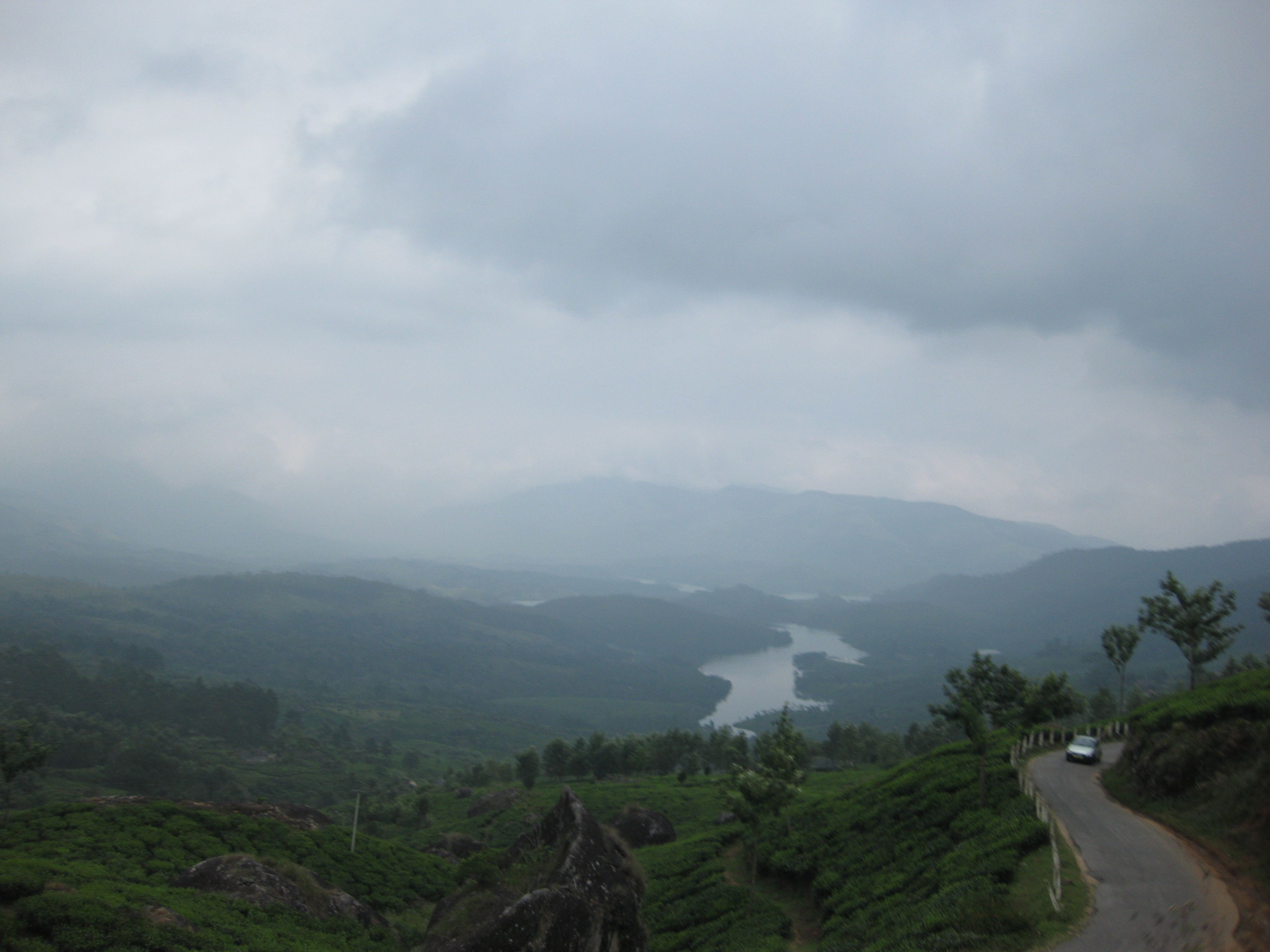
Atop Munnar

“Can we possibly order three cups of chai, one order of onion pakoras and some firewood?”

That was certainly a phrase I didn’t know I would ever utter.

The road driving up to Munnar

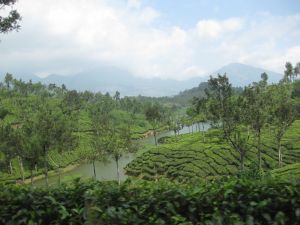
Everything changed after we drove off the red dusty roads of Tamil Nadu and up into the lush mountains of Munnar in Kerala. As we drove, it seemed like the world we had just been in was slowly disappearing – the air started to clear; the language subtly changed from Tamil to Malayalam; the cows and dogs and goats that populated the streets started to look healthier; tropical plants were replaced with tea plantations and rugged trees; and of course, we lost all cell phone service.

The altitude, the dramatic scenery and the windy roads felt like a new world.  Munnar was like no place I’d seen in India – it is truly off the grid in every sense imaginable. In a weird way, the trees and mountains and lakes kind of reminded me of a bizarre version New Hampshire – except it wasn’t snowing in January and everyone was Indian. Except us, of course.

Our hotel

We arrived after a long drive up into the mountains, and then onto a rocky dirt road that we could only get up with the help of an ancient 4-wheel-drive Jeep. Our hotel was in the middle of nowhere- a few houses and farms spotted the area, but otherwise it was just the hotel. Breathing in the clean, crisp air it was hard to remember we were in the same country we’d just come from.

After a night’s rest and the inevitable ordering of firewood (yes, our cabin got quite cold at night!), K and I decided that the only activity for the day could be a hike. So we set off with a guide from the hotel, who instilled a bit of initial fear when he told us to watch out for leeches.

taking a picture half-way up

We climbed and of course I lagged behind – I always love a good reminder of how completely out of shape I am. I was a little bit embarrassed when I saw a chatty group of older women sauntering up the mountain as though it was nothing at all. We had stopped halfway up and I was watching them as they climbed. When they saw us, they giggled and took a moment to gawk at the funny white girls trying to climb up their mountain. One of them offered us a piece of fruit – it was yellow on the outside and looked like a passion-fruit. Our guide said it was okay to eat and I thanked the woman. I stood, catching my breath and eating a piece of delicious fruit- that certainly wasn’t a bad way to spend a day.

As we continued to climb we eventually saw the same group of women heading down – but this time, they weren’t quite as chatty. As they came towards us I noticed they were all carrying huge, long stacks of wood on their heads. Their arms balanced the wood while their bare feet balanced their bodies down the narrowly demarcated path. They were hardly breaking a sweat. I caught the eye of the woman who had given us the fruit, and nodded. She smiled back, completely unfazed by the poundage bearing down on her head.

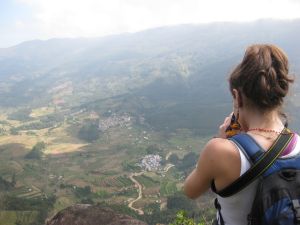
A view of Munnar

Since moving to India I’ve been endlessly enjoying watching the ways in which people go about their days.  And as I continued to pathetically huff and wheeze my way up the mountain, I couldn’t help but hope that this would be what I’d remember when I’m back in New York and totally caught up in the day-to-day pressures and expectations of my life. It’s amazing how much it feels like none of that matters when you’re so far away from it.

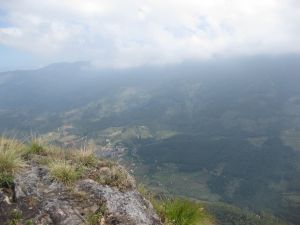
View from the top

But these thoughts dissipated as soon as we reached the top because all I could think of was sky and mountains and clouds. It was really something to see.

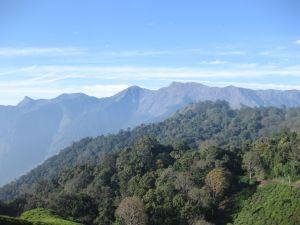
I hate to invoke the old cliche that a picture is worth a thousand words, but in this instance I don’t even think a thousand words could do justice to the breathtaking views. So I’ll end this post with some photos – and a true appreciation for the little slice of India called Munnar.

The mountain we climbed (in the background)

Southern Hospitality

I sometimes forget that only a few months ago India was a complete unknown to me – I think and behave now as though I belong or that I have a deeper understanding of my adopted country. I haggle and head-bobble to the point of surprising (and maybe even disturbing) friends who aren’t accustomed to my adopted Indian ways.

But of course, every time I think I’ve got it all figured out, India reminds me that I know nothing.

Coming to Tamil Nadu was like a kick in the gut – my Hindi means nothing here in a Tamil-speaking stronghold. After being assured by everyone up and down that there was no possible chance of rain post-monsoon, we encountered an afternoon storm. Familiar food staples have been upended by a world of thalis and dhosas. Despite having spent time in South India in Kerala, Tamil Nadu seems like an entire world away from safe familiar Bandra – and every Tamil I meet is happy and eager to explain to me how different they are from ‘northerners’. I have to say, it feels amazing to be reminded that whatever Indians might call me-  white person, foreigner, gora or ‘Canadian,’ (what one Tamil person seemed to think the Tamil word was for Caucasian) – as a perpetual outsider I will always have quite a lot to learn and be surprised by.

Sri Rangan temple

Our time in Tamil Nadu has centered around seeing temples- another thing I thought I could no longer be surprised by. After Angkor Wat and Borobudur and Prambhanan and Ranakpur I sort of thought I’d run the gamut. But because I’m traveling with two friends who hadn’t been to India before I thought that temples were a pretty important stop – and I’m lucky they let me come along with them, because South Indian temples are unique and powerful unto themselves. Over the last four days we explored temples in Trichy, Tanjore and, today, the epic Meenakshi temple of Madurai.

All of us on a roof facing one of the Vimana's of Sri Rangan

In Trichy we saw the Sri Ranganthaswamy Temple (Or Sri Rangan for short, thankfully). Dedicated to the god Vishnu, it’s a massive temple within walls within other walls over 156 acres that has been continuously built over the last 1,000 years. The most recent tower was only completed in 1987, but others date back to what is believed to be the 11th century. We got all of this information from a guide named ‘Bruce Lee,’ who insisted on telling us serious stories about Hinduism interspersed with showing us his favorite Karma Sutra carvings.  He also showed us how to be blessed by an elephant representing the god Ganesh – I told M and K they’re probably going to have to fib on their customs forms when asked whether they’ve been near livestock (see video below to watch the elephant in action!).

Brihadeeswarar Temple in Thanjore

Our next temple was the Brihadeeswara Temple in Thanjur, dedicated to Shiva. Built in 1010 during the Chola Empire, this UNESCO World Heritage site boasts India’s tallest Vimana, or temple tower. Standing under the sandy-colored intricately carved granite stone, I couldn’t help but be overwhelmed by the structure – how could anyone reach those heights and carve stones so finely without scaffolding or machinery? These thoughts kept getting distracted by the dozens of tourists hounding us to take our picture – I was once again reminded of how bizarre we must seem. Two white women and a white man wandering around their temple, snapping photos and laughing amongst ourselves. One man wanted to try on M’s sunglasses while children crowded to look at the magical photos popping up on the back of K’s camera. It was a funny sensation to be among the familiar- two of my oldest friends – while being treated like the most interesting oddities around.

Exterior of Meenakshi Temple

But we certainly saved the best for last.

Interior of Meenakshi Temple

In Madurai we got to see Tamil Nadu’s most renowned and beloved place of worship – the Meenakshi Temple. We were delighted to learn this was the only Indian Hindu temple devoted to a woman, Meenakshi (or Parvati), the wife of Shiva. It is one of the largest Hindu temples in the world and certainly one of the most elaborate. While the structure was built in the 17th century, it is believed a temple has stood in this spot since at least the 7th century – and today it represents the center of the sprawling, dusty, decidedly non-colonial city of Madurai.

Getting a bracelet knotted

It was hard for me to ever imagine a city crazier than Bombay, but I think Madurai is it. It is loud and bumpy and often incredibly over-run with advertising and run-down buildings – but it has also proven to be a place where M, K and myself have all relished in meeting and interacting with a population that wants to display their (self-described) southern hospitality.  Everyone we meet – even the people blatantly trying to sell us something – has wanted to convey to us that their portion of India has as much to offer as the more heavily-trafficked north. And our guide, Natarajan, at the Meenakshi Temple, made it a point of pride to try and make sure no one took advantage of us or sold us anything too expensive. It was wonderful to take in the beauty of the temple, but I think the highlight by the end was the jokes we could share with the tailors we were haggling with or the bracelet tied on our hands (for no money! no money!) by a shop-keeper.

Tomorrow we are leaving Tamil Nadu to go into the mountains of Kerala. It will be a sharp departure from the crazy city into the lush plantations, but I feel glad just to have gotten this taste of the south. And if I forget, I’ll be able to look down at the bracelet securely knotted on my arm and remember the place that helped jolt me out of my own India bubble.

Landing back in Mumbai, after a blizzard took over the American Northeast, I thought I would have another round of culture shock. Surely after two weeks in the comforts of home India would seem once again like a strange foreign land.

But after hours of delays I blearily stepped out into warm weather and felt right as though I had never left. Instead of being shocked by India, I was mostly shocked at how much this place could feel like home mere hours after feeling at ease in the comforts of my real home. And I liked the feeling that both places could somehow simultaneously be normal for me.

This of course only lasted until I had visitors, who were given the ‘Indian experience’ in full force before they’d even left New York. K and M had been planning for months to join me in Bombay for New Years before a trip to South  India. I’d been jealous of their simple direct flight straight from New York into Mumbai.  I should have known that for their initiation they’d need to feel frustration, Indian style.

When they arrived at the Air India counter (a full four hours before their flight) they were told that their seats had been nonsensically given away to passengers who’d previously been stranded by the blizzard, despite having confirmed reservations. After a lot of haggling and cajoling they finally convinced the agents to put them on a flight to London, with a connection to Mumbai. But they missed the connection and instead had to re-route to Delhi. On arrival in Delhi they were told their bags were lost- and so more haggling led to missing their flight to Mumbai. They would have to pick their bags up later whenever they were found.

A full 17 hours later than they were supposed to, and 31 hours after they’d left their homes I finally was able to give them a hug at the arrivals gate in Mumbai’s domestic terminal. Welcome to India.

I often write about the frustrations that can come hand-in-hand with the joys and amazing experiences that happen when you live here. But to experience it so soon seemed a little cruel. I looked at my friends, who after showering and napping were now fully decked out in my and Daniel’s clothes, and wished that they’d been allotted an easier introduction.

It wasn’t going to get easier – every time we called Air India’s baggage center either no one would answer the phone or the line would be busy. And after a late-afternoon trip to the domestic airport terminal we learned that to go through international customs the bags would have to be transferred to the international terminal. No one was getting clothes that day. The next morning we arrived and tried to argue our way in. No one at baggage claim was answering the phone and we needed the bags. M and K both braved talking to the Air India representative who told them that all the baggage personnel were ‘too busy, and they’d have to wait 30 minutes.’ I’d lived here long enough to know that 30 minutes means never, so I began an argument Indian style – I knew I’d need to make it a personal affront to my honor. After accusing the representative of insulting my guests and having a long back and forth about Indian standards of hospitality, the man relented and got a baggage claim representative to take us to the bags. There they sat, in a pile of hundreds of lost bags. I looked over and noticed that only one woman was answering a single phone, a small help in a sea of lost personal items.

But with bags in hand and a sunny day to explore the city, India once again gave more than she took. Standing at the Gateway of India and watching women selling fans made of peacock feathers and Indian tourists snapping pictures it was easy to get caught back up in my love for this place. A woman tied a bracelet to my wrist intertwined with jasmine, and despite my protests I really admired her persistance to just tie it in a knot and then just hoped I would pay her something. Driving through South Mumbai I found myself still staring in awe at the grand colonial buildings that I’ve now seen dozens of times. And eating lunch in my favorite Parsi restaurant, chatting to the dotty 90 year old owner made me giggle while I stuffed myself with berry pulav. It’s these moments and not the moments of frustration that make me happy to be back, despite having enjoyed the brief respite of home.

Tomorrow we’re off to Tamil Nadu to explore even more – and thankfully, we won’t be flying Air India!

Happy Holidays

It’s very bizarre, after months of living in India, to land in the Brussels airport and see a sign that says: “Brussels: Welcoming. European. Efficient.” I walked through the bright, crisp, orderly terminal until I found a cafe and ordered a tomato, mozzarella and parma ham sandwhich. In my groggy, jet-lagged state I felt a little bit like I was in some weird dream alternate universe – I knew these things existed but they barely seem real. Can I really eat that tomato without knowing how they washed it? Is it really possible that there is good baguette and mozerrella in the world? Where is the trash? Why is no one pushing me?  But also: why does it seem so sterile and colorless?

Yes, after my hazy and jarring layover in Brussels I landed back in New York for 2 weeks to see family and friends. There’s so much to love about being back and yet so much to miss about India (let’s start with the weather…). I’m not going to blog while I’m here, so I hope everyone enjoys their holidays and I will write again once I return to India for New Years!

Keep Up the Good Work

In India, there are times when you can get frustrated, and others when you just have to laugh at the constant absurdity of life here.

About a month and a half ago I wrote about how a leakage from our terrace had caused our downstairs neighbors’ ceiling to collapse. One would assume by now that this entire ordeal would be over, right? Au contraire.

The first round of porch construction

The original work included ripping up the entire side of our porch to get into the piping system. What had been quoted to us as taking a week instead took three. And it wasn’t hard to see why: the workmen would show up two hours late every day; they would then take a two or three hour lunch; in the afternoon one guy would work while the others sat around. And then every night we got the icing on the cake: they would declare that they needed to stay late, because they weren’t finished. I’m sure they saw this as the perfect overtime scam. Unfortunately for them, we would always kick them out.

But after weeks of cement dust in the house and an unusable terrace and cranky workers and shouts about overtime, they were finished. They just had to replace the wooden siding.

Except that the siding they used originally was no longer available. They, of course, hadn’t checked to see whether this was the case prior to finishing. So it took another week to find a solution (they ended up painting siding to try and closely match the original).

I couldn’t have cared less about whether the wood matched the original. I was just happy to have my house back. And I was happy that my neighbors would finally get to replace their ceiling.

So you can imagine my joy when Nigel, the supervisor, knocked on my door a few weeks ago.

“Ma’am, there has been a problem with the construction,” he said, pretending to be nonchalant.
“What kind of problem?”
“Well, there is still some leakage.”

I liked the phrase ‘still some leakage’, as though it implied that something had been done and there was only a little bit left to be fixed. It turned out that they hadn’t really known anything about where the leak was coming from – they had just made a guess and hoped for the best. The guess, shockingly, was wrong.

I made them wait three weeks while Daniel’s parents were here – I wasn’t going to have them come all the way to India and then have to live with construction!

After they pulled up some of the tiles

But now the time had come again. This time, I made them bring an engineer with blueprints of the building to try and prove to me that they suddenly understood the problem. They started by pulling up a few tiles to see where the crack in the ceiling really was. Eventually it led to tearing out the whole left side of the terrace.

This time around, I wasn’t going to agree so readily. I tried to ask as many questions as I could to understand the whole process. But the response to every question always somehow included ‘but ma’am, you’re foreign, so you don’t understand the way Indians do things.’

Our newly destructed terrace and the many workers

But the joke is on them: we’ve lived here now for almost six months and at least we know how to make a few more demands, Indian-style – we called the head boss and made him come over and speak to his workers; we got a written work plan detailing what needs to be done every day; we’re having someone come from the head office to supervise every day to make sure work gets done; Daniel even got the company to give half the workers wages to him so they have an incentive to finish in time.

And most importantly: I made sure they already had purchased the tiles before they started. For me, that’s progress. A sign that maybe we’re adapting to India a little better than perhaps the construction supervisors would have liked us too.

But of course, I’ve lived here long enough to also know that all of those assurances still will probably mean it will all take much longer than they’ve quoted. Luckily, I’m taking my new Indian self back to America for the holidays – so I luckily won’t be around to see! It’s the best of both my worlds.

Your Level Best

I saw a mouse run by and I jumped up – then almost as quickly I froze, trying to stop every instinct in me from screaming and running out of the room. I am like a child when it comes to mice; they cause me to act in a completely embarrassing irrational manner. But here, in R’s small one-room home in Dharavi, I knew I had to keep my cool. I knew how much R fretted over what we would think of her home. I knew that it was generous of her to allow me – a foreign, white person who clearly did not live in a 5 foot by 5 foot room – to watch and film her life.

So I sat down. I sat back down on the floor. The same floor and corner where I’d just seen a mouse run from. I could not embarrass this person who had been so open with me. So the interview began again, and I tried, with every fiber of my shaken being, to not look around for the mouse.

As I sat there, listening to the Hindi that I couldn’t understand (we were on our second round of the interview, since the first had been lost with the hard drive), I started to wonder: how on earth can I evaluate my standards for this film?

I’ve always tried to have every piece I’ve ever worked on look as professional as possible. I remember I one time got in a fight with an anchor who told me that for one shot in my piece my tripod wasn’t level – I’d tried to argue that I was constantly shifting to try and get a moving shot and I was standing on ground that was sloped. I was so angry that anyone would assume I hadn’t tried my best.

The thought now just makes me laugh. There will barely be one shot in this film that is level. We’re working with a camcorder because nothing bigger will fit in the room. Our tripod probably cost $20 at most and so any panning shots are usually done by hand, since the tripod is too jerky. We have only one light, and it conks out after an hour.

Not to mention that I can barely get a clear shot of anything – if we’re in a small room, even if I press my body up against the wall, I’m still not going to be able to get a full picture of the room. There’s just not enough space.

And everything is a distraction – During R’s interview we’d had to constantly stop and start over because her children would speak or laugh, or bang into something. Two of her three children were at home and they had a very difficult time keeping quiet. There wasn’t a place for them to sit, since R was being interviewed sitting on the bed. There wasn’t anything for them to do since there was no other room to go in and they obviously didn’t own anything to read or play with quietly.

I’d tried to keep R’s son quiet by playing a silent version of peek-a-boo but he kept laughing too loudly. So finally I pulled him onto my lap, where he fidgeted and tried to put chewing gum in my hair. He also kept declaring that he wanted chewing gum, which he said in such a cute way that I could barely contain my own giggle. It’s safe to say that some of that might come across in the background of these interviews. Oh well.

I’ve been really lucky to work in some great newsrooms with amazing equipment. So to say that shooting this film is a challenge is an understatement.

But somehow I am starting to get the feeling that this might be the best thing I’ve ever done. There will be children, and banging pots, and shouting neighbors and crows and shouts of ‘chewing gum’ in the background of a large portion of my interviews. A lot of the shots might be dark and grainy because we don’t have enough light. Nothing will be level (sorry to the anchor who doesn’t approve). Every time I had to walk with someone it will be shaky. Yet the content will be unique and interesting and honest.

Mouse be damned. Somehow, it’s all going to work.

Enjoying Joining

I really thought that I was being brave – darting around traffic for 2 hours in 90-degree heat in Dharavi to try and film from every angle; walking backwards to get the image of the women walking forward; holding the camera up without a tripod while my arms started to get sore. It was pretty daring for me – normally in Dharavi when I walk anywhere I spend most of my time watching my feet so that I don’t step in something unsavory or trip over a broken tile.

But I’ve got nothing on these women. They are truly something.

At the back of the rally

Today we were filming a rally – the workers and volunteers from the domestic violence prevention center were going to march through the streets in Dharavi with signs and banners while handing out leaflets and putting up signs about preventing abuse. That alone should be considered brave in the place and culture they inhabit.

But around the moment when the rally stopped right in front of a mosque, and women began talking on a bullhorn about rights while others taped signs to walls detailing how to report abuse I thought to myself: these women have chutzpah.

There’s nothing like the look on the faces of conservatively dressed Indian men watching women in saris and hijabs tell them how to act (and educating their wives on what they’re legally entitled to). It’s priceless.

I love watching the camaraderie of these women. They all come from different castes, they’re ethnically different, religiously different; many speak different native languages from each other. Two Tamil women – whom I had previously gone to a meeting with – grasped my hand when they saw me; Dharavi is practically a foreign country to where they grew up and yet here they were, marching in a rally with signs in Hindi (a language they can’t read), and welcoming a random white person who is filming them. They walked away holding hands with each other – even as they marched they still held hands, stronger together than they would be as individuals.

And for me that theme pervaded the whole march – in Dharavi, women’s rights are so tenuous; without a group behind them to remind them that they deserve better, it would be hard to go so strongly against the grain.

I don’t know if people really read or take seriously the pamphlets that they’re handing out – maybe no one does – but I think it’s worth it even if it just makes these women feel like they’re in it together. And I’m happy to be there with them – even if my arms certainly hurt the next day!

What Doesn’t Kill You…

One time I broke my foot and I called my mother to tell her I needed to go to the hospital. She asked me how I could possibly know that it was broken without seeing an x-ray – I replied that I had heard it happen, and so I just knew.

This is how I felt when I heard my hard drive tip over and give a little whir indicating its demise. I knew there wasn’t anything I could do to save it. I watched as my Mac went from editing video files to the colorful ‘spinning ball of death,’ as it tried to recognize the disappearance of the attached drive.

I sat in shock – everything I had filmed was on the drive. But it was gone. Everyone kept telling me that there was no way something couldn’t be recovered; but like my foot, I knew that the hard drive was broken.

This happened a few weeks ago, before the trip to Sri Lanka and Kerala. It’s only now that I’ve started filming again that I’ve felt like I could write about it.

Every single appliance we’ve owned in India (other than, inexplicably, our microwave) has broken and needed to be fixed: our washing machine, our juicer, our tv satellite, our oven, our hot water heater, our router, our toaster, our toilet (appliance?), the building’s elevator. Our porch is leaking. Walls are cracked.

This has been frustrating, for sure. There are days I want to throw the proverbial toaster out the window. There are other days where Nisha implores me not to hate India based on its inability to create working appliances.

But the hard drive was really too much. I mean, really? I had to lose the work I labored over in Dharavi? It’s safe to say I was pretty upset about it for a few days. We went and filmed a few times while technicians tried to fix the drive, but I knew they weren’t going to get anything and I felt heavy with the weight of starting over. I wanted to write about it, but I didn’t even know how to articulate my frustration at all the loss of all the footage I loved so much – even if we had only shot for a few days.

But yesterday, we finally re-did one of the interviews for the first time.

We were interviewing S, one of the three women we are following for the film. S is a 25-year-old mother of three children who is a volunteer at the domestic violence center. She became active after her in-laws abused her; she and her husband had a ‘love-marriage,’ and his parents were not too happy about it. So she had found solace in counseling and decided to volunteer for the organization that helped her get through her early years in her marriage.

The first time we had filmed her, the day was hectic. S was trying to get all of her children ready, and they were still on Diwali holiday so they had all been in her hair. When we interviewed her she was nervous about the camera and unsure of her answers. I hadn’t spent as much time with S as I had with B and R (the other two women) so she wasn’t as comfortable with me.

Yesterday though, it was like a second chance. S was excited because it was her daughter’s 10th birthday. Balloons and streamers made from lined writing paper adorned her one-room home. She seemed more comfortable because she already knew what the drill was – she understood that I would be filming her housework; she knew what the questions would be. When the interview was over my translator remarked that this interview was so much better than the first.

So there it was: my silver lining. I had been dreading doing the interviews again. After all, it’s not an easy set-up. We have to turn off the fans so the noise won’t seep into the interview – in a windowless small room, you can imagine how hot it gets. I have to stand, since no one has chairs in their crowded homes. And most importantly, I don’t know really what’s happening – I don’t want my translator to interrupt the subject’s train of thought by telling me what she’s saying, so for most of the time I stand and stare, listening to a language that I can’t understand and mostly just making sure that the audio is working and that the interviewee stays in the shot. Other than that, I’m shifting my weight in a hot room listening to jibberish trying to ignore how much I’m sweating for an hour-and-a-half interview.

But despite these discomforts, doing the interview over had only been a positive. The interview was better. The film will be better. In a weird way, that makes the loss of the hard drive okay. Once again, India has pushed my buttons and led me to a breaking point only to remind me that I’m stronger than I sometimes think I am.

But for now I think I’ll be buying a new hard drive once I get back to the US. I’m still not sold on Indian appliances.