Feeds:
Posts
Comments

Archive for the ‘India outside of Mumbai’ Category

I sometimes forget that only a few months ago India was a complete unknown to me – I think and behave now as though I belong or that I have a deeper understanding of my adopted country. I haggle and head-bobble to the point of surprising (and maybe even disturbing) friends who aren’t accustomed to my adopted Indian ways.

But of course, every time I think I’ve got it all figured out, India reminds me that I know nothing.

Coming to Tamil Nadu was like a kick in the gut – my Hindi means nothing here in a Tamil-speaking stronghold. After being assured by everyone up and down that there was no possible chance of rain post-monsoon, we encountered an afternoon storm. Familiar food staples have been upended by a world of thalis and dhosas. Despite having spent time in South India in Kerala, Tamil Nadu seems like an entire world away from safe familiar Bandra – and every Tamil I meet is happy and eager to explain to me how different they are from ‘northerners’. I have to say, it feels amazing to be reminded that whatever Indians might call me-  white person, foreigner, gora or ‘Canadian,’ (what one Tamil person seemed to think the Tamil word was for Caucasian) – as a perpetual outsider I will always have quite a lot to learn and be surprised by.

Sri Rangan temple

Our time in Tamil Nadu has centered around seeing temples- another thing I thought I could no longer be surprised by. After Angkor Wat and Borobudur and Prambhanan and Ranakpur I sort of thought I’d run the gamut. But because I’m traveling with two friends who hadn’t been to India before I thought that temples were a pretty important stop – and I’m lucky they let me come along with them, because South Indian temples are unique and powerful unto themselves. Over the last four days we explored temples in Trichy, Tanjore and, today, the epic Meenakshi temple of Madurai.

All of us on a roof facing one of the Vimana's of Sri Rangan

In Trichy we saw the Sri Ranganthaswamy Temple (Or Sri Rangan for short, thankfully). Dedicated to the god Vishnu, it’s a massive temple within walls within other walls over 156 acres that has been continuously built over the last 1,000 years. The most recent tower was only completed in 1987, but others date back to what is believed to be the 11th century. We got all of this information from a guide named ‘Bruce Lee,’ who insisted on telling us serious stories about Hinduism interspersed with showing us his favorite Karma Sutra carvings.  He also showed us how to be blessed by an elephant representing the god Ganesh – I told M and K they’re probably going to have to fib on their customs forms when asked whether they’ve been near livestock (see video below to watch the elephant in action!).

Brihadeeswarar Temple in Thanjore

Our next temple was the Brihadeeswara Temple in Thanjur, dedicated to Shiva. Built in 1010 during the Chola Empire, this UNESCO World Heritage site boasts India’s tallest Vimana, or temple tower. Standing under the sandy-colored intricately carved granite stone, I couldn’t help but be overwhelmed by the structure – how could anyone reach those heights and carve stones so finely without scaffolding or machinery? These thoughts kept getting distracted by the dozens of tourists hounding us to take our picture – I was once again reminded of how bizarre we must seem. Two white women and a white man wandering around their temple, snapping photos and laughing amongst ourselves. One man wanted to try on M’s sunglasses while children crowded to look at the magical photos popping up on the back of K’s camera. It was a funny sensation to be among the familiar- two of my oldest friends – while being treated like the most interesting oddities around.

Exterior of Meenakshi Temple

But we certainly saved the best for last.
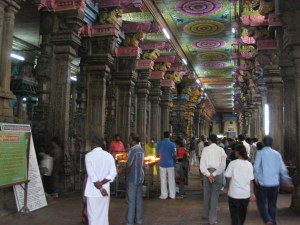
Interior of Meenakshi Temple

In Madurai we got to see Tamil Nadu’s most renowned and beloved place of worship – the Meenakshi Temple. We were delighted to learn this was the only Indian Hindu temple devoted to a woman, Meenakshi (or Parvati), the wife of Shiva. It is one of the largest Hindu temples in the world and certainly one of the most elaborate. While the structure was built in the 17th century, it is believed a temple has stood in this spot since at least the 7th century – and today it represents the center of the sprawling, dusty, decidedly non-colonial city of Madurai.

Getting a bracelet knotted

It was hard for me to ever imagine a city crazier than Bombay, but I think Madurai is it. It is loud and bumpy and often incredibly over-run with advertising and run-down buildings – but it has also proven to be a place where M, K and myself have all relished in meeting and interacting with a population that wants to display their (self-described) southern hospitality.  Everyone we meet – even the people blatantly trying to sell us something – has wanted to convey to us that their portion of India has as much to offer as the more heavily-trafficked north. And our guide, Natarajan, at the Meenakshi Temple, made it a point of pride to try and make sure no one took advantage of us or sold us anything too expensive. It was wonderful to take in the beauty of the temple, but I think the highlight by the end was the jokes we could share with the tailors we were haggling with or the bracelet tied on our hands (for no money! no money!) by a shop-keeper.

Tomorrow we are leaving Tamil Nadu to go into the mountains of Kerala. It will be a sharp departure from the crazy city into the lush plantations, but I feel glad just to have gotten this taste of the south. And if I forget, I’ll be able to look down at the bracelet securely knotted on my arm and remember the place that helped jolt me out of my own India bubble.

Read Full Post »

Kerala

In Kerala you can almost feel the world creaking to a halt and demanding that you stop along with it. Whether standing to watch waves crash against a cliff or gazing into the hazy distance of the backwaters, all you can do is just stand still and watch as the beauty of the world happens right in front you, slowly but deliberately.

The view from our hotel in Varkala

After running around Sri Lanka, arriving on the beach in Varkala was a welcome change. I’m not normally a person who likes vacationing on beaches, but Varkala was a little moment of perfection.

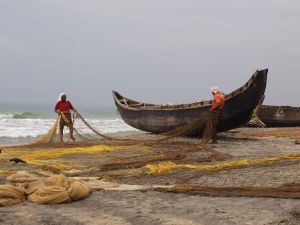
Fishermen with their nets in Varkala

We were staying on Odayam beach, away from the tourist-hub on the cliff and a place where fisherman outnumbered tourists.  I found myself watching them, wondering what they must think of this recent foreign infiltration of their beaches. They didn’t seem fazed – some fisherman sat carefully carving and piecing together oars, while others tied up fishing line.  The small bungalows and boutique hotels that had started to pop up around them didn’t change the work they had clearly been doing for generations.

We spent the day in the most relaxing of fashions – staring at the sea, swimming in the sea, and eating.

Incredible huge prawns

The fisherman certainly weren’t for show – at night when you stroll along Kerala’s cliff-front hub (if you walk a little bit off course you’ll find yourself in a straight long drop down into the sea), you can survey the wares at each restaurant because they keep the seafood right out front. You can make a decision based on what you see – does that marlin look fresh to you? How about this barracuda at the restaurant over here? Or how about the huge tiger prawns that look more like lobsters? You pick your food after looking at it up close and then the price haggling begins. It’s quite a way to start a dining experience before you’ve even sat down.

It was a much-needed respite from reality. Swimming in the waves and having a cup of tea looking out at the horizon it felt a little bit like we had found our own secret place in the world. I would have been sorry to go except that I was even more intrigued by Kerala’s more famous attraction: the backwaters.

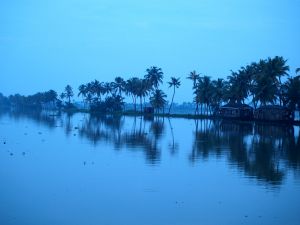
View of the backwaters from the tip of our boat

Having read Arundhati Roy’s the God of Small things many years ago, I’ve always been intrigued by the depth and beauty of her descriptions of the Keralan backwaters. I had always wanted to languidly cruise through the canals and jungles I’d pictured in my mind. I worried that the proliferation of backwater tours and houseboats might ruin the experience – but I was ready to take the chance.

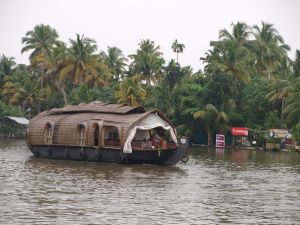
We boarded our very own houseboat early in the day and began slowly making our way along the backwaters. The beauty of this experience is that there is literally nothing to do but sit and gawk at the beauty of it all. As the boat cruised along we attempted to read or have conversations, but they continually got interrupted by someone saying, “Oh wait, but look at THAT”. And the ‘that’ they were usually pointing at was a far-reaching landscape.

A view of the backwaters as the sun goes down

The backwaters look like something you’d only see in a movie that has an other-worldly setting. Small plants grow up in the middle of each canal or lake, as though they are rooted only in water. We found ourselves first in an expansive lake with palm trees and bird-filled paddies in the distances and then later in smaller canals, bordered on either side by a jungle of trees growing straight from the water.

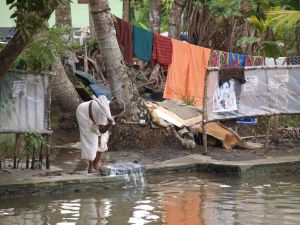
A woman doing laundry in her backwater-adjacent home

In many of these canals entire villages flourished, their pace of life dictated by the narrow strips of land they lived on and the water-buses that ferried them and their neighbors around. Like the Varkala fishermen, I wondered how odd it must be for these people living this rural, water-logged existence to see the ever-growing stream of boats with white people staring back at the beauty of their lives. But our captain seemed to think (however biased he must have been) that the growth in the industry was positive, since many of these people now were able to get higher-paying jobs in tourism.

A typical houseboat on the water

It was a bizarre experience, sleeping on a boat while mostly trying to avoid the onslaught of mosquitos that had come as night fell. But enjoying breakfast and a cup of tea in the morning light was really priceless. I could understand why the place had inspired such vivid prose from Roy.

We left the boat and headed for our last stop – Kochi, an old Portuguese colony at Kerala’s northern end. It was a sudden change from the rural waters, but it was made all the more easy after being welcomed at Sui House, a 3-room bed-and-breakfast run by a wonderful family who also specializes in selling antiques (so you can imagine how beautiful the furniture was). After an explanation of the sights to see we went exploring.

The beautiful Sui House

The main attraction, for us at least, in Kochi was the city’s 16th century Paradesi synagogue (The oldest in the ‘Commonwealth,’).

Inside the synagogue, courtesy of Creative Commons since no photos were allowed

It was a strange sight seeing a colonial-era Jewish house of worship in the middle of an Indian town, but it was beautiful. It was made funny by the fact that everyone calls the area where the synagogue is located, “Jew Town.” I guess that would explain why the owner of the hotel had no problem asking, “Are you Jew?” The population has dwindled (it’s estimated less than 20 Jews still live in Kochi) but enough people have stayed along to make sure the synagogue remains – and it was really beautiful. Kochi is the kind of city you imagine colonial India to be – still as crazy as ever, but with the architectural and culinary flourishes left over from a past era. It was a fitting way to end our trip.

As we left Kerala behind to go back to Mumbai I couldn’t help but try to spend my last moments soaking it all in, because that to me was the best of Kerala: taking the beauty from the beaches to the city and enjoying it at the pace Keralans seem to demand from its visitors. I hope I can someday make my way back to stand still and enjoy once again.

(Also – there are a few new signs added from this trip to the Amazing Signage tab at the top, if anyone was hoping for more!)

Read Full Post »

I always assumed that Sri Lanka was like an extra Indian state, an island country with its own charm but one that would ultimately be reminiscent of the country I now live in.

How naïve I was.

A beautiful Sri Lankan rainbow

Daniel’s parents are here visiting, and for many months now we had planned to go away for a week to Sri Lanka and Kerala. I planned the Kerala portion and they planned Sri Lanka – so I really had no idea what to expect.
Sri Lanka was such a surprise to me – it’s a country that has spent so many years at war and yet from the moment you land it looks so peaceful and tropical that you couldn’t imagine anyone wanting to upset that balance. And it is so unlike India in so many ways – the language, the Buddhist people, and (I hate the say it) the cleanliness that pervades. It reminded me more of South-East Asia than its most immediate neighbor.


A temple at Polonnaruwa

But the best part was that even in a few short days you can see an incredible array of varying cultures and sights and history. Sri Lanka is one of the more multi-dimensional places you can imagine.
This was certainly true even on our first day. We spent the morning at Polonnaruwa – an 11th century Buddhist capital that now lies in well-preserved ruins – and the afternoon spotting elephants at a national park. To go from roaming a lost city to riding in a jeep through the jungle was a whirlwind juxtaposition. Luckily, we had success in our elephant adventures- about an hour into the journey, we came across a whole troop of elephants standing at a watering hole. It’s amazing to watch these huge animals as they roamed free and enjoyed their afternoon as much as we did.


A slew of elephants

Sigiriya from afar

The next day we ‘conquered’ one of the true highlights of Sri Lanka – Sigiriya. Sigiriya is a rock that formed as the molten core of a volcano. The volcano has eroded but the core remained, and a civilization flourished in the fifth century. It’s an imposing sight – a huge rock with a plateau top – and it’s hard to imagine how anyone was able to scale it so many years ago.
But for this era, we were up to the challenge. You can walk into the fortified area that once was a royal garden and then you climb your way up and up until you reach the top. It’s a combination of original stairs and newly imposed spiral staircases – all frightening but all with an incredible view. Halfway up you can see frescoes that have remained in tact for at least 1,000 years. When we reached the top I think we were all exhausted, but it was victorious. Looking out, we could see across Sri Lanka and no amount of aches could take away from the moment.


Cave temples in Dambulla

There is just so much diverse history to take in when you’re visiting Sri Lanka – in Damublla we spent time in the Rock Cave Temples, a series of caves that have dozens of Buddha statues carved starting in the 3rd century BC, and then in the 18th century every inch, from the walls to the ceilings, were painted so that no matter where you look you see a Buddha. In Kandy we went to the home of Buddha’s ‘Tooth Relic,’ where Buddhists come to pray at the resting place of one of Buddha’s teeth (though it’s hidden away view).


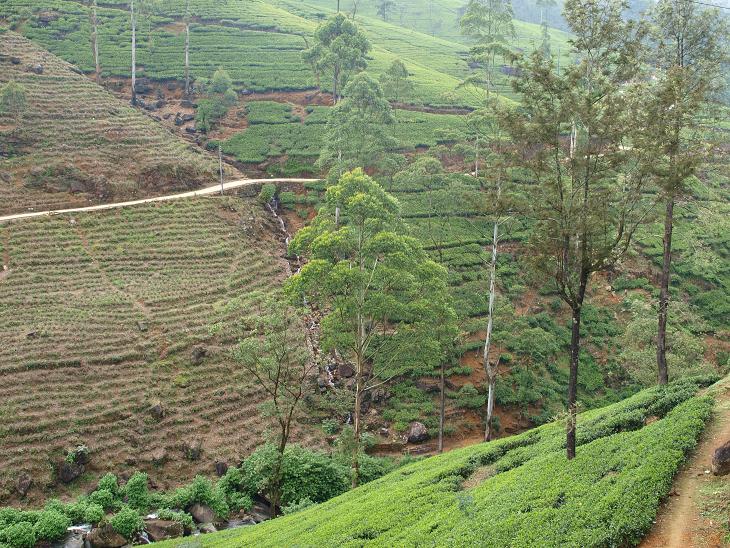
The winding road up into Hill County - covered with tea

I loved getting immersed in the history – but the real highlight (among highlights!) was when we switched gears, climbed altitudes and indulged my love of tea.
I think its safe to say that I am an avid tea drinker. I can’t remember a day in which I didn’t consume and enjoy at least one cup. So I was quite excited to go to the tea plantations in the world’s second-largest tea-producing country. I just didn’t realize how beautiful the view would be alongside my cup of tea.


Tea pickers in the fields

As we drove around the winding roads up into the hill country of Sri Lanka I was reminded of the phrase many use when describing Kerala: “Gods country.” It seemed apt for Sri Lanka as well. Up and up we went and with each turn we saw a better view – short tea plants covering the entire sides of mountains that led down into valleys and up into the sky. We got up so high eventually that we were in the clouds – if a cloud was passing through we could barely see more than a few feet in front of us.
Of course, we had to stop at one of the plantations so I could understand how they took the lush green leaves and somehow turned them into the loose tea I am so familiar with. It’s amazing- tea pickers (mostly woeful underpaid Tamils) go through the fields each day plucking the top leaves from each branch of the tea bush. They are dried, rolled and then fermented. The tips of the leaves are made into a special tea, called ‘silver tips,’ and the size of the remaining leaves determines the lightness or strength of the ‘regular’ tea. It was thrilling for me to see my favorite beverage created from start to finish. It was even more thrilling to sit outside with a cup of the finished tea and a chocolate cake while looking out onto the mountains continuing to grow more and more tea leaves. It was certainly a moment of perfection for me.


Inside the drying area of the tea factory

Less thrilling for me was Daniel’s suggestion that we wake up at 4:30am the next day in order to go hiking. I am not a hiker – I am a person who describes perfection as sitting, drinking tea, eating cake and looking out at a nice view. But I wanted to be a sport and go along with the plan – so I hiked.
There was, admittedly, a good reason for the early rise- Daniel wanted to hike to a point known as ‘World’s End’ in Horton Plains national park. It gets its name from its stunning view and 800 meter drop. But starting at about 9am the clouds come in and the view is obscured. So in order to drive to the park and then get to World’s End in time, we needed a brutal start-time.
So we woke up and went on the way – my outfit consisted of skinny jeans (the only long pants I’d brought) and three sweaters to try and keep out the early morning cold. I looked ridiculous and I felt like a hiker fraud – on the rough and wet terrain I stumbled and bumbled my way up the mountain.


Me and Daniel at 'Worlds End'

But we got to World’s End just in time – as I stood panting and completely winded I started to understand the place’s dramatic name. Huge mountains led down to lakes and waterfalls and a valley. And just as quickly as we had arrived, so did the clouds- it was incredible, they came up from below the mountain, like a rising force and soon the entire view was completely obscured. It would have been breathtaking if I had any breath left.


It was a lot to take in in five days – a lot of history, a lot of culture and a lot of changing altitudes. But Sri Lanka is a place one should go if you want to find yourself marveling at the world. It’s incredible to me that cave sculptures and structures and frescos have survived for hundreds and even thousands of years here. It’s jaw-dropping to see an animal whose weight is in tonnage sauntering around and kicking up grass right in front of you. And it’s hard to tear your eyes away from stunning views, whether from the top of a molten core, out the window of a car on a winding road or on the vista of a conquered mountain.
But hopefully Kerala can give us a run for our money.

Read Full Post »

I’m probably a bad patriot for deliberately wanting to leave my new city because my President was coming for a visit. But amidst road closures, traffic and increased security – along with a 2 day vacation for Daniel because of Diwali – we decided to high-tail it out of Mumbai for a relaxing weekend in Goa.

I had heard a lot of different things about Goa, all seemingly contradictory: Some derided it as a crowded over-hyped place for hippies and backpackers; others gleefully declared it Mumbai’s Hamptons. I was pleasantly surprised to find that if you stayed in the right places, Goa could be neither. Instead for me it was a relaxing blend of tropical paradise and historical oddity.

One of the Siolim House rooms

On the advice of numerous friends we stayed at Siolim House – a 17th century Portuguese mansion that had been restored as a labor of love by an Indian private equity manager. Siolim House is off the beaten track – it’s situated on a small lane in a tiny village that’s a ways away from the beach, but it means no other tourists are around. You sort of feel like you’re staying at a friend’s very nice country house (shouldn’t we all have friends like that?).

I’m ususally a sucker for historical houses anyway, but this one really was something to see. Our room made me feel like we could really get a sense of what it must have been like to live in colonial India – except we still were able to have running water and the use of a fan.

Siolim House lounge

We spent the next few days driving between the various beaches and the sights of Goa. It’s a funny place to tourist-watch – I’ve never seen so many people trying to embody the Goa fantasy life. White people with dreadlocks and kurtas made their way around on scooters along treacherous windy paths while getting honked at for going too slowly. European tourists happily paid 50 rupees for a fresh coconut without negotiating and apparently without considering that the coconuts grew on trees right in front of them and therefore shouldn’t be that expensive. A lot of the people we spoke with were spending up to two weeks in Goa – deciding that the rest of India would have to wait, since they were only in the mood for their tropical plans. I kept wondering what the local people must think of this specific type of tourist that wants to live the ‘chill’ life in India. Then again, what must they have thought of us? I think sometimes we’re naive to assume that we embarrass ourselves less just because we happen to have lived in Mumbai for a few months.

But Goa does live up to its hype. We went to one of the quieter beaches, in Mandrem, and it really was a new view of India I hadn’t been privy to in all my time on Mumbai’s sullied and crowded beaches. Hills gave way to white sandy beaches and palm trees. Locals made use of the tourists by selling us fresh-caught fish and prawns. It was hard to think of a better place to spend a day.

Inside of Bom Jesus church

As a history buff I also enjoyed Old Goa – which apparently a lot of beach travelers give a miss. It was striking to see 17th century grand churches in India. I watched an Indian Christian wedding- white dress and all – and I was struck by how odd it seemed in a country that seemed to promote every color but white in their average wedding. I certainly felt like I was in some remote part of forgotten Europe. The whole setting reminded me of some of the churches I’d gone to in Amalfi – a bit forgotten with the paint peeling off, but still glorious in their size and decorations.

I was also amused to see the ‘remains’ of St Francis Xavier. It was a bit of an inside joke for me – I was born in a hospital called St Francis Xavier hospital, and oddly enough I am the only person in my family who was born there. So I thought it was sort of fitting that I got to witness his bizarre mummified self (I would say I got to see him in the flesh, but that might be too terrible a pun).

At any rate, when it was time to board our plane Sunday night, I couldn’t help but wish I was able to spend more time in the slow-moving Indian state that seemed to belong to many cultures at once. And for a moment, the wish was granted: our flight out was delayed – a result of President Obama’s closure of the Mumbai airport for a full forty-five minutes. I guess we couldn’t avoid America even in Goa. But it certainly had been nice to try for a little while.

(I also found some great signs in Goa, so I’ve added a few to the slide show on the signs tab)

Read Full Post »

I’ve been here long enough that I take a lot of India’s quirkiness for granted at this point. I hate that I’ve become a bit used to some of the things that used to wow me. But it was nothing that a horse-drawn amphibious carriage couldn’t fix.

Daniel’s week had consisted of bouncing from one city across India to the next for work without getting much sleep. Mine had continued to go downhill: Bank of America forgot I lived in India and shut off my card; my internet stopped working again; my driver and housekeeper decided they hated each other for a little while and wanted to yell about it (long story…). So on Friday Daniel announced that we both needed some time to ourselves to just relax. I couldn’t have agreed more.

We decided to go to Alibaug, which is a beach town about two and a half hours outside of Mumbai. I loved driving out – its calming to watch as the crazy dirty chaos of Mumbai turns into quiet high-rises and then morphs into craggy hills, as though one of the world’s major cities wasn’t just a stones throw away. We got to the hotel and spent the first day just zoning out- reading, eating and sitting were the main criteria.

But for the second day in Alibaug we wanted to experience the beach and the Kolaba fort, an 18th century fort on an island about a kilometer from the beach. It was a gray and misty day but, as always, it was still plenty hot. And as we walked up towards the pier, I noticed there was something a little different about this particular beach.

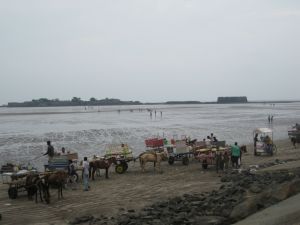
Alibaug Beach with Kolaba Fort in the distance

The tide was out so far that half of the beach was just wet sand. The fort stood in the distance with water surrounding it, but we watched as people waded their way up to it. The water was so low that all you needed to do was hike your pants up and start walking for about half an hour from the beach and you’d reach it – no swimming required

But there was an even more curious spectacle to take in as we got to the beach’s edge. Strangely rigged horse-drawn carriages were at the ready to take tourists across the shallow shores. Instead of regular wheels they had the kinds you would normally see on a dune buggy. They were equipped for sand, water and the weight of whatever number of people wanted to cram into their chariot.

We came up to one and asked the driver how much. “Teen-saw”, he responded. 300 rupees, or a little less than $7. This was not going to be like the $50 carriages in Central Park. I still had to haggle, just to save myself a little respect.

The view from our horse

“Doe-saw?” I replied (200). The man nodded and waved us in. I realized that while our carriage ride was going to be less than $5, based on his easy acceptance of my offer, I probably was overpaying by at least half.

With that, we trotted off. It seemed like we were in some weird dream sequence. We looked out onto gray skies and black sand on our way to an eroding imposing structure in the distance – I felt like a character in a fairy tale. The horse hit the water and kept going. The carriage – all wood and metal, with paint flaking off every plank – teetered and tottered but we got there eventually. Our transport waited and we went for a stroll around the abandoned fort.

Kolaba Fort

Daniel commented that it was easy to imagine this place as it must have been. It was true – there weren’t a lot of people around and perhaps it was the clouds that darkened everything but it seemed like we were in some sort of abandoned piece of history.

Daniel and our chariot

We made our way back and I watched as ‘land’ started coming closer and closer. Our horses decided to make a sprint for it at the end. The whole thing was fun and weird all at the same time. And it had cost us around $4.50. Only in India. I’m glad we got away to be reminded that there’s so much more we can continue to be amazed by.

Read Full Post »

Today I spent the entire day sitting inside, waiting. But I guess that days worth of killing time is nothing compared to the 60 years many people have waited for what transpired.

It was a big day in India, as you may or may not have heard. After decades of waiting, demolitions, murders, riots, religious furor and constant delays the Allahabad High Court declared a verdict on who controls 2.7 acres of land in Ayodhya.

You might wonder why so much drama and history was needed over a small piece of land. I would ask the same thing about certain parts of Jerusalem. But, as with many epics, it came down to religion. Is the alleged birthplace of Ram (a king who, in the legend of Ramayana, served as the human ‘avatar’ for the god Vishnu) as well as the site of a 16th century mosque that was demolished by Hindu nationalists in 1992. The demolition caused widespread riots and over 2,000 people were killed (riots 10 years later after a related train bombing saw another 1,000 people killed).

It is a long and complicated story as to how this tale that started with a mosque in 1528 and a court case beginning in 1949 ended up in a courtroom today. If you’re interested in a full timeline of events, I suggest you look at this helpful timeline, and if you want a full accounting of the ruling today read this.

For me this is not interesting just because of the outcome – the ruling stated that the land should be divided between 2 Hindu groups and one Muslim group, but all sides said they would appeal – but because it is just another fascinating display of what happens when religions collide.

How can a court even begin to decide whose religion deserves or has right to land? But they certainly tackled it head on here. To me the most befuddling part of the ruling is this: One of the justices, Dharam Veer Sharma actually wrote in his opinion, “The disputed site is the birth place of Lord Ram.”

As an American it is fascinating to see how religion can be woven into a court decision as though it is fact. And perhaps for many it is. But that’s hardly consolation to Muslims who think that their almost-500-year-old mosque was destroyed. And the land for the Muslims is no consolation to those who would swear that the mosque was built only after an original Hindu temple was destroyed.

The thing that gives me faith is this: as of now (knock on wood), there have been no major instances of violence. After a week of delays and waiting with bated breath to see what would happen, there’s a collective sigh that nothing has happened.

Has India moved beyond its religious tensions? Of course not. But in a country that is reeling from its embarrassment over the Commonwealth Games, maybe this is a moment to stand proud. It’s not over yet, but perhaps the long-running suit can now hope for closure, instead of fearing more bodies will be added to the count of this saga.

And birthplace or no birthplace, mosque or no mosque, that is something to celebrate – especially now that I feel safe enough to leave my house.

Read Full Post »

Ranakpur

I have seen some pretty unbelievable man-made structures in my life. Versailles. Ankor Wat. The Hagia Sophia. The Chrysler Building. So I suppose by now I shouldn’t be surprised by human ingenuity and skill. But it still would never have occurred to me that you could make an entire giant structure – inside and out- out of marble.

Wide interior view of Ranakpur

But that is Ranakpur a Jain temple about two hours drive outside of Udaipur. And it is a work of art, a true example of man’s devotion to his god (or gods).

For a bit of context, its important to note that (according to our guide the day before) 95% of the marble in India comes from the environs of Udaipur. It explains why the Lake Palace and the City Palace are adorned throughout with beautiful white marble. But they have nothing on. Ranikpur.

One of the many, many marble sellers outside Udaipur

Just the drive is worth taking- you drive out of the city of lakes, drive past dozens and dozens of marble dealers (your first clue of what’s to come), and into a mountainous world that seems like a cross between the Scottish Highlands and Lord of the Rings. Rajasthan in the monsoon is very different to the desert most people associate with the region- it is a lush grouping of craggy mountains with monkeys and goat herders co-existing with the cars and motorbikes making their way along a road reminiscent of Amalfi’s perilous drives.

When you pull up to Ranakpur’s main temple you start to get the sense you’re seeing something unique. Every piece of the structure is marble- the steps you climb, the wall you lean against, the ceiling you walk under. And when you finally step into the entranceway you are greeted by an imposing labyrinth of a space, with 1,444 pillars holding it up- all are intricately carved top to bottom and no one pillar has the same design.

One of the ceiling designs in Ranakpur

The temple dates back to the 15th century and the same group of families have looked after it since that time. Our guide’s entire family had devoted their lives to its upkeep- he spent every morning cleaning and ‘feeding’ the temple with a bath of milk. Tourists are allowed to visit between noon and five every day, although certain areas are off limits to non-Jains.

A close of some of Ranakpur's columns

For those unfamiliar, Jainism is a religion focused primarily on non-violence. It has been explained to me as a cross between Hinduism and Buddhism (pardon the complete oversimplification). A Jain friend of mine and I joke that the Jains are like the Jews- small in number, powerful in business, but very focused on family and education. And like the Jews who often give significant contributions to Jewish causes, so have the Jains, across the centuries, donated funding for some extraordinary temples.

Everywhere you look in Ranakpur you see some new intricate design- on walls, on pillars, on statues and most especially on the ceiling. Some of the designs are so finely carved that they appear translucent.

Carving of a snake made from a single stone

When you walk out you’re supposed to look up and make a wish on one of the more staggering ceiling designs. Our guide insisted that there is a 100% success rate here. Perhaps that belief comes from 600 years of wishing to maintain the beauty if the temple. That wish certainly has stayed true.

Another interior view

Read Full Post »

“Excuse me sir… sir… SIR!”

The car swerved out of the way, just narrowly missing a group of cows lying casually in the middle of the highway. The driver looked back at me in his rearview mirror as though I was completely insane for being perturbed at his proximity to the animals. This was just everyday life here – cows lie with abandon and drivers go around them at the last moment possible. This was Udaipur, Rajasthan.

Daniel had suggested we do something to get out of Bombay and relax while it was still the low season throughout India. He had found a great monsoon deal at the Lake Palace, which is one of the most famous and unique hotels in India- he had rightfully convinced me that despite still having a bit of jetlag, it would be worth the trip.

India for me had only been Maharastra (the state where Mumbai is located). It was Mumbai and a bit of its environs. I was curious to see my new adopted country in a different light (For a sense of the streets of Udaipur, I’ve attached this video of my ride in a rickshaw, below).


And Rajasthan brings to light the classic India that many imagine. The cow element was something I had come to believe was a myth – while Mumbai has cows tethered to the side of the road I had certainly never experienced the famed cows wandering through the streets. Here it is inescapable – on the side of the road, in the road, crossing paths with trucks and motorbikes, cows just stare at the people who regard them with such awe and piety.

Lake Palace entrance (from a boat)

But beyond that curious Indian stereotype, Udaipur itself is a dream. It is said to be one of the most romantic cities in the world and it’s easy to see why. It’s as though Venice and India from the Raj times collided to create a city on water surrounded by hills and beautiful architecture.

And the Lake Palace is the epicenter – built in the early 18th century for Rajasthan’s King (the Maharana), it is only accessible by boat and once inside it is breathtakingly beautiful. Ceilings and columns with glass mosaics lead down to marble floors. A lily pond and views of the lake come at you from every direction. It is a true testament to the beauty of Indian design and skill.

We spent today wandering the city and its sights. The most notable is the Maharana’s other home – The City Palace. In present times the Royal Family rents out the Lake Palace to the Taj Hotel Chain and they have turned the majority of their City Palace into a museum. They still live in one (very, very large) section of the palace. They have also turned another lake structure, Jagmandir, into a place for dinners and weddings. It must be good to be Rajasthani royalty.

Jagmandir lit up at night

In the City Palace

The City Palace is also incredible – Indian marble columns are intricately carved and walls are inlaid with Venetian glass mosaics or Chinese tiles, all from the 18th century. The Palace is so large it was completed over 400 years, beginning in the 16th century and only completed in the 20th century. Elephant fights used to take place in the courtyards, and this practice was only discontinued in the 1950’s.

Lake Palace courtyard

Being in Udaipur is like getting to experience another world in another time. Unlike Mumbai, which is struggling to keep pace and prove its modernity, Udaipur seems to be happily frozen in its glory days (and profiting handsomely from them). It is romantic and tranquil and calming, as though each moment we’ve sat on the boat coming out to our hotel on a lake is something you can capture in time.

This feeling, of course, is a far cry from the moment of terror where we almost hit the cow. It’s almost incongruous. But maybe it all fits – while we were rushing to enter the city perhaps the cow was laying there thinking, “slow down, relax, take in the sights. No one will hit you. Just enjoy Udaipur.”
And we will take that advice – after all, we’re not leaving ‘till Tuesday!

Daniel and Ali with the Lake Palace behind

Read Full Post »

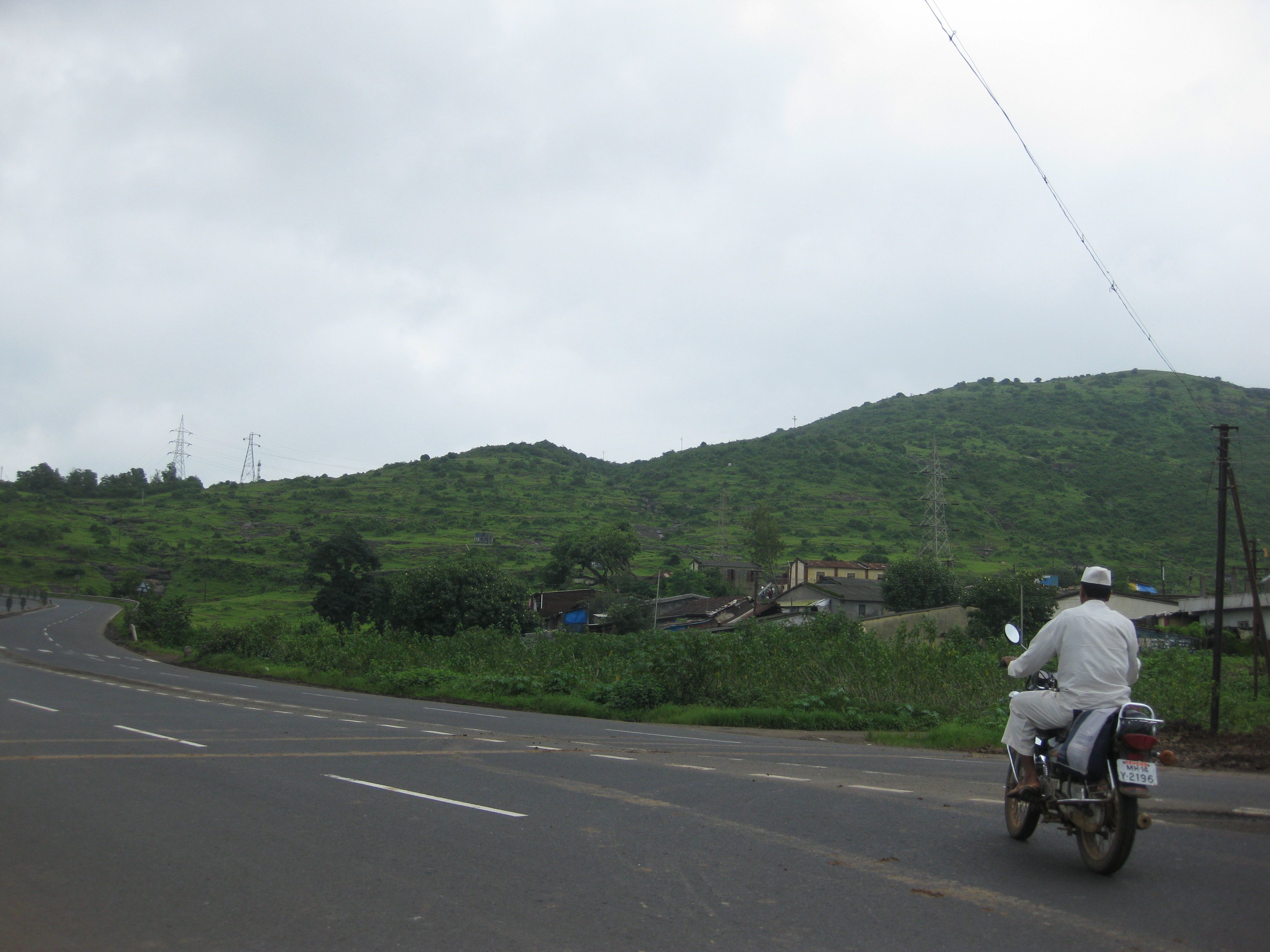
Driving out of Bombay was a shock to my senses — could we really be this close to lush green mountains? Apparently it had been here all this time while I was living in my little city cocoon.

I took a bit of small break from writing for the last few days because Daniel and I took a long weekend to Pune and I wanted no computer distracting me from my first moment away from Bombay.

On the highway driving out of Mumbai

And it was those first moments that truly stuck out – the feeling of traffic fading away, of noise and honking dissipating, of seeing rolling hills and no crowds of people. This was a piece of India I hadn’t seen yet, and it struck me that while I felt at home in ‘India’, my whole notion of India was based on Bombay.

We had decided to break up the four-hour drive by stopping at the Karla Caves. The literature I’d read about these caves was oddly imbalanced – the caves are beautiful, but not a major site. It’s an important historical landmark but certainly something you could skip. The caves are hard to believe, but not if you’ve been to any of the more major caves in India. So I didn’t really know what to expect.

We drove up to the base of a hill and started hiking up. On the way Daniel and I ate some roasted corn while we looked out onto a spectacular vista. I was already convinced this was a good stop. We made our way past sellers jockeying to play their Bollywood music the loudest while women weaved garlands together. But none of the usual attempts to sell us items came our way – they were mostly baffled to see white tourists.

When we’d hiked up and paid our 100 rupee entrance ($2 compared to the 5 rupee entrance for Indians) we entered the main cave. And it was magnificent. In the 2nd century Buddhists had carved out the interior of the cave to create a hall with grand pillars lining the walls. At the entrance and above each pillar were intricate carvings.

I am the tiny person...

The Karla caves interior

I stood there and took in the site, marvelling mostly at the fact that this is a site considered “off-the-beaten-track”. In a country so large and so full of rich history it’s amazing how much goes unseen. And I’m sure that if I had gone to the Ejanta and Allora caves (something I’m hoping to do while I’m here) before coming to Karla, I would also have been fairly unimpressed. But here was a cave that more than 2,000 years ago people had dug into (with no modern tools or explosives) and created a pillared hall out of the stone. And it still stands today in pristine condition. How is that not something to shout from the rooftops about?

It mostly just gave me a big reality check that I cannot get too settled into Bombay – I have to see this incredible country.

Of course, after feeling that, the rest of Pune was ironically slightly underwhelming. It certainly is a vibrant city – it’s three or four hours south of Mumbai, a hub for colleges and universities with a thriving cultural scene. I’ve heard it described, for all these reasons, as the Boston of India.

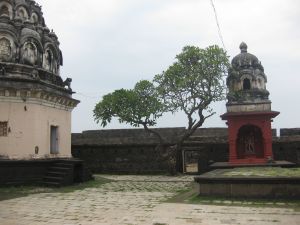
View from a fort in Pune

But we were mostly there to see some of our friends who were in town from the US – and as such the few forts and temples we went to took a backseat to the enjoyment of seeing familiar faces (especially since these forts and temples were not as nice as other temples and forts we had already seen. I’d already forgotten my earlier reminder that we shouldn’t stop appreciating the seemingly less-impressive-by-comparison sites).

One other thing that did strike me about Pune was the presence of Marathi, Maharastra’s main language. I know a lot of people speak Marathi in Bombay (in fact, many native Bombayiites try to argue that everyone here should place more emphasis on Marathi), but Hindi and English rule outside of residential areas. But in Pune, Marathi is king.

Of our two friends (both American second-generation Indians), one spoke Marathi and the other Hindi. And our Hindi-speaking friend (and Hindi-speaking driver from Bombay!) had quite the difficult time. I had heard so much about India’s multi-lingual idiosyncracies, but since in Bombay I am always the foreign one, it amazed me that even a few hours away, Hindi speakers also were lost.

On our last day in Pune we ventured up to a temple on the top of a hill that overlooked all of Pune. It was beautiful to see the whole city laid out in front of is. It was large and sprawling and just another reminder of how small we are in this country with so many people, cities, languages and cultures.

And so we drove back to Bombay, but with a newfound determination to see the rest of India – not just the small India that I know.

Read Full Post »

« Newer Posts