Feeds:
Posts
Comments

Archive for the ‘Mumbai’ Category

Rain Be Gone

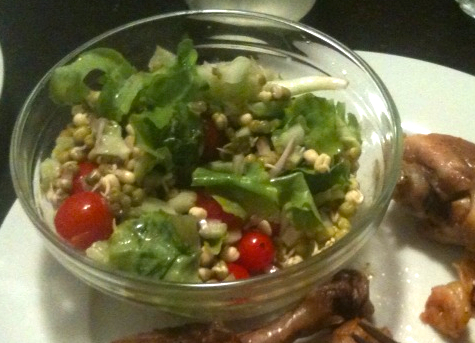
My extraordinary salad

It was a very weird, unsettling milestone: we ate a salad at home.

This might seem bizarre as a momentous occasion, but as India newbies amidst a monsoon we had steered clear of the most likely route to sickness – raw vegetables. Every vegetable was meticulously cleaned and then cooked. Every fruit was peeled. Hands were washed before eating anything we were about to touch.

Yet in the past few weeks a drastic change has settled into the Mumbai we’ve come to know and love. The rain has steadily stopped. It started with a few days of clouds peeking through the storms. Then longer periods without precipitation. Then full days of the sun declaring its presence. And now, just like that, there’s no more rain. The monsoon has taken its bow and retreated until June rolls around again.

For most who live here its a blessing and a curse. The rains are over but now they settle in for a hot month before it cools down again in November. However for us, its just unfamiliar territory. I am so used to carrying around my small umbrella and stepping out in my waterproof shoes. I am so accustomed to knowing that no matter what the sky looks like, it will absolutely rain today. I am in the habit of not solidifying plans until I can tell whether or not we’ll get a full dose of monsoon or whether there will just be a drizzle.

I had never lived in a world where it rained every single day. And now I must oddly accustom myself to a world where I will not see a drop of rain again for nine months (unless we have one or two surprise rains left to break this spell).

Which brings me back to salad: I (knock on wood) have not had any food-related illness since I have been in India. This is obviously a trend I hope to continue (although now that I’ve put it in writing I’m sure I’m doomed). I think part of it is luck, but part of it has been having a very conditioned approach to food – I avoid anything suspicious, even if I really really want to eat it.

But the rains (and the dirt and disease that comes with the rains) are over and so vegetables are less of a danger. Nisha suggested to me the other day that it was safe to eat a salad.

“I know you are missing salad, so I will clean it really well and make one.”
“Are you sure that I won’t get sick?”
“Ha,” (yes) she said, “I promise you will not get sick. Monsoon is over, lettuce is not bad anymore”

I wanted a salad, so I decided to go for it. That night, I sat down at the table and stared at the freshness in front of me. Cherry tomatoes. Lettuce. Onions. All former enemies now claiming to come in peace. I stuck my fork in. It was so delicious – it felt like the antithesis to every heavy curry spicy meal I’d eaten over the last three months. And I didn’t get sick.

It may be unsettling. But rains, I’m glad you are gone.

Read Full Post »

So a Jew, a Christian and a Muslim stood around talking about Hindus…

That sounds like the start of a joke, but it was just a regular day in our household. On this occasion, Nisha and our driver (who are Muslim and Christian, respectively) were trying to explain to me why I should not participate in Ganesh Visarjan, the end of the Ganpati celebrations where millions of people crowd Mumbai’s beaches to immerse their statues of the god Ganesh into the water.

The Ganpati crowd at Juhu beach

“You will not want to go there ma’am,” our driver said, “It will be all crowds and drunk people.”
Nisha concurred, “People there are crazy, you don’t know what can happen.”

I didn’t want to mention to Nisha that this was what the driver had said to me about going to Muhammad Ali Rd during her holiday of Ramzan.

I spoke to my friend D (who is a Jain Indian raised in America but has a lot of family in Bombay) — she said everyone was telling her not to go as well. “They all think unless we have a rooftop to watch from we shouldn’t go – it’ll be too crazy and dirty.”

This is the funny thing about Bombay – everyone lives in harmony until you start talking about people of a different caste or religion. Then suddenly everyone of the opposing caste or religion is a drunk dirty lout.

I, however, was not going to miss Ganesh Visarjan. It’s one of the most exciting days in Mumbai and I wanted to see it for myself. Six million people take 200,000 statues of the god Ganesh to Mumbai’s various beaches and immerse him in the water – setting him on a journey and supposedly taking the misfortunes of his followers away with him. All week I’d seen the Ganesh statues, large and small, with people dancing throughout the streets. And I wanted to watch as the festival came to its glorious end.

Rolling Ganesh towards the sea

So after a bit of planning we decided to go to Juhu beach – it’s not too far from Bandra and its one of the less crowded areas. When I say less crowded this just means there were probably tens of thousands of people crowding the beach instead of potentially hundreds of thousands. There are 27 immersion spots throughout Mumbai, but the ones in South Bombay are the most crowded. We figured it would be best to stay close to home and out of the massive crowds.

A few friends and I went to a bar on the beach and grabbed a table early. The real festivities start at night so by 3pm when we arrived there were just a smattering of people with their idols. But as the sun got lower more and more and more people began to show up with increasingly large Ganesh statues.

The Ganesh that we followed

Imagine looking out and seeing a sea of people going from the end of the beach all the way up to the water. Everyone is excited, many people are singing, and every so often you start to see a large portion of the crowd begin to move like one, with a big Ganesh in the middle as they all head towards the sea. You can watch the people and the Ganesh until it suddenly sinks and cheers go out. But when you look somewhere else the same thing is happening all over again.

D and I decided we wanted to follow a Ganesh from beginning to end. So we spotted a big one, left our table, and went out to join in. The crowd surrounding it was huge. The Ganesh was taller than any man and everyone was surrounding it, singing, and celebrating. They then lifted our Ganesh onto a cart (slowly but surely) and began to wheel it toward the sea with everyone still singing and celebrating. We ran with it, joining in and letting ourselves get caught up in the moment.

Our Ganesh going out to sea

I was so caught up I didn’t realize I’d gone right into the water up to my thigh. I turned around and saw D had not followed me – Mumbai’s beaches are notoriously dirty. Oil and other unpleasantries mix to create a blackened version of the sea. With the many Ganesh statues the water becomes an even more dangerous place (There are many people here who are understandably against Ganpati because of the horrible implications of thousands of plaster and chemically painted statues being left at the sea floor). I stepped back, ignored my dirty legs and watched as our Ganesh was taken out to sea. And then, in and instant, he was gone. He had gone to the bottom of the ocean and everyone was cheering. We’d been allowed to share in this one group’s moment of their Ganpati and we felt it was ours too (To watch a video of ‘our’ Ganesh and his journey, see below).

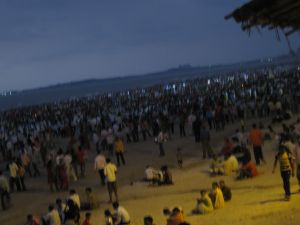
The crowd growing as night falls on Juhu beach

We went back to the bar, exhilarated and excited. We stayed awhile longer, watching the crowd swell more and more as time went on. We left after it got dark, but for most real celebrants the night was just beginning. As we drove home, one side of the road was closed as thousands of people were in their own processions with their own Ganesh, making their way towards the sea.

I asked our driver how his night was. “I hadn’t seen the Ganesh immersion since I was a boy. I always avoid it now. But you know, it was really fun to see it.” Yes it truly was.

Read Full Post »

The Choices We Make

When I was in high school we took a class called ‘life issues’, which was essentially meant to be a sex-ed class coupled with self-esteem and health issues. Everyone joked about it and laughed off the content (what teenager isn’t uncomfortable in a glorified sexual health class?) but the school made it very clear that these were important issues that we needed to understand.

I mention this now because I was thinking about ‘life issues’ quite a lot as I sat in a small room with no windows in Dharavi, sweating through my long sleeved cotton kurta and long linen pants, watching a field worker explain sexual education and health to a group of Muslim teenagers – most of whom were married and many of whom already had children.

At this particular meeting (I’ve now been to so many I’m starting to get the hang of it), the field worker was fearless. Here was a Hindu woman in a sari trying to explain female anatomy to a group of women whose only visible anatomy was their face and hands. She had started on the topic of periods. Did anyone in the room want to open the discussion by relaying when they got their first period?

Silence.

My translator piped up, telling her story to try and break the ice. It seemed to make the girls less uncomfortable as they laughed and giggled at her trials and tribulations. They started sharing more about themselves.

But then the conversation took a more somber tone: “How many of you feel that your periods make you dirty?” they were all asked. Everyone raised their hands. I was really surprised – how can you have given birth to a child and still feel ashamed about your body’s natural reproductive cycles?

But the field worker was not at all surprised by this response. She began a very stern tirade – she explained that this was a beautiful and natural part of our humanity. She was adamant that they not let their religious views lead to unsanitary practices.

Apparently, in their religion (or their practice of their religion within their particular culture), when a woman has her period she is considered unclean. Anything that she touches becomes impure and she cannot go near her mosque. I had seen similar signs relating to Hindu temples in Indonesia, instructing menstruating women to stay away, but it was amazing to me that this practice is so widespread across varying religions.

Most of these women could not afford sanitary pads (and tampons don’t even exist here for anyone) so they used rags. And when the rags were dirty they would often clean them and then hide them away for drying. This apparently can lead to infections when the rag is used the next time, because without sufficient space to dry, the wet rag can become a hotbed for bacteria.

I’m going to pause here for a moment to acknowledge that this is a very uncomfortable and graphic blog post. But it is astounding the things we take for granted – I rarely consider my period because the modern marvel of tampons makes it as insignificant as possible. These women are getting infections in large numbers because they do not have access to something as simple and cheap as sanitary pads, and their shame about having their period stops them from drying their rags in the sun or out above a flame or even on a drying rack. It’s just astounding to me the number of hardships these women face every day.

I watched as the field worker continued to encourage and explain sanitary habits. The women listened, uncomfortably but attentively. Some of the women began to open up and ask questions.

One woman, who is 15 and has been married for 6 months, had not yet gotten her period. She had not met her husband because apparently in her tradition you don’t meet for one full year. She was worried that if she didn’t get her period soon that she wouldn’t be able to continue being married.

The field worker kindly explained that if she never got her period it would not mean she couldn’t stay married, but it would unfortunately mean that she could not have children. The woman looked stricken – apparently she wasn’t confident that she could stay married without the ability to have children.

Again, as with most of the other meetings I have been to with this particular group, the discussion had nothing to do with it’s stated goal of reducing domestic violence – it was just another way to bring people into the organization. Little by little, person by person, they just try to help in the many many places where help is needed.

As the discussion came to a close and most of the women (girls? How do your characterize young teenagers with such adult responsibilities?) said goodbye, we were left with the girl who had hosted us in her home. She was 15 and her mother had ‘chaperoned’ the discussion.

She had stayed behind to ask the field worker about computer classes- she wanted learn but she only could read and write in Urdu, and all of the classes were in Hindi or English.

I asked why she had chosen to go to an Urdu-only school.

She laughed and started talking. My translator said she was explaining that it wasn’t a choice. The only school she could go to was a madrassa, and the only thing they learned was the Koran.

“You mean that’s what you learn most of the time?” I asked.
“No,” my translator translated. “It’s the only thing we ever study.”
“Can’t you go to another school?”
“There is no other school available. And the men in my family wouldn’t let me go to another school anyway.”

This is the point at which I started to get angry. She and her mother and I then began a thirty-minute discussion where I kept asking why and they kept laughing at me and answering that, “This is just the way it is.”

She couldn’t go to a different school because there wasn’t one that would take her.
She couldn’t take lessons in English because she wouldn’t have time for that and the men in the family wouldn’t allow it.
She couldn’t wait to get married because that would bring shame to her family.
Her school couldn’t teach anything other than Urdu because they could only spend time reading the Koran.
She couldn’t get a job because the men wouldn’t allow it.

I just kept sitting there stunned, trying to find some alternative. Could these women really just allow themselves to be subjugated in this way when they understood what was happening? I asked what kept them from just leaving.

“This is our home. This is our life. Would you want to start completely over and never be allowed to see your family or anyone in your community again?”

I answered that no, I would not want that. That seemed to settle it for them. I was starting to wonder if I had overstepped, so I apologized for asking so many questions. They, again, just laughed at me.

“It’s ok. We understand that you live your life differently.”

I nodded, thinking we were having a moment. But then the mother started saying something that my translator wasn’t translating. I asked her what they were saying.

“You don’t want me to tell you – now they’re asking if you can help them in any way. They want you to maybe help the men in their family find better jobs or for you to give them some money.”

I guess our moment was over. I tried to respond that I was going to be helping by making the film about the organization. They didn’t seem moved.

I walked out still feeling angry. It’s one thing to not understand that there was another world out there. It was another to know that other people are free and to just calculate that it’s not worth it for you.

The meeting and my conversation swam in my mind as I walked out. These women can’t even stand up for themselves by demanding that their rags dry out in the open, let alone demand for education or the ability to work. It was the first time I had left a meeting where I didn’t feel inspired or empowered. So now they knew about their reproductive systems and proper menstrual hygiene – so what? Would they even use the information they would be given? Or would they just continue to be under-educated child brides with no ability to break their own cycle?

I said this to the field worker. I asked her how she keeps going every single day when there are so many battles to fight and change comes in such small incremental steps?

“Because it needs to be done,” she replied. Yes it most certainly does.

Read Full Post »
My motto in Mumbai is to say yes to anything I’m invited to because you just never know what to expect in this city – and it’s almost always a good story.

So in that vein, last night and today I found myself in two scenarios that anyone who knows me would have thought were highly unlikely: at a packed club dancing to a trance techno DJ (I really don’t know the difference between ‘trance’ and ‘techno’, let’s be honest) and at Mumbai’s Fashion Week.

Both were cases of just saying yes: our broker, with whom we’ve kept in touch, mentioned to me that one of her favorite DJs was going to be in town Saturday night. She said it was going to be a really fun night and we should come. So I said yes. Why not? Separately, I was at a drinks event and I met a guy who runs a non-profit that tries to bring the arts into impoverished schools. His organization was partnering with one of the designers at Fashion Week and he had extra tickets – so he invited me to go. Who knew what on earth this event would be? But I said yes.

So last night I found myself in a room full of elegant high-heeled Mumbaikers sipping their overpriced drinks waiting in breathless anticipation for ‘Dash Berlin’, a Dutch DJ who everyone kept reminding me was “rated as the 14th best DJ in the world.” I kept wondering what a DJ would have to do to make it to 13.

When he came out the crowd went absolutely wild. And this guy was working for it- he jumped around, smiled widely while waving his hands in the air, played ‘air drums’, and intermittently held up an iPad with scrolling words saying things such as “Hello Mumbai” or “Make Some Noise”. One time he just held it up with hearts going by. Each time the crowd roared. (See video below – it’s not something I shot, but it gives you the idea!)


I didn’t know whether to enjoy it or laugh at it. My boring old self had the instant reaction of: why is everyone in this room staring at a guy fiddling with a Mac and some turntables? He’s not playing anything. The guy must be on some kind of drug to have that much energy and some members of the crowd were also channeling the same energy source that allowed them to dance with complete abandon.

Models strutting their stuff at Lakme Fashion Week

I had a similar reaction to the Fashion Week show. Was it really fun? Or taking itself too seriously for my taste?

We walked in and it was certainly larger than I had expected. Mumbai Fashion Week (also known as Lakme Fashion Week) had been advertised around town but I didn’t know how big it was. When we walked in it certainly looked like a fashion show (or at least the photos of fashion shows I had seen). It looked professional and I was standing in line to get in behind Fern Mallis, the head of New York Fashion Week, so I supposed this must have some credibility.

But it was just so funny to me – everyone scrambling and haggling to get the best seat they could (a very Indian spin on the concept of a Fashion Week). A hundred photographers stood at the end waiting. But when the lights went down and the music came on, models strutted out it was certainly a bit thrilling – who doesn’t enjoying getting a glimpse of the fashionable life that seems to exist outside of my world? It looked like a New York fashion show but with slightly less impressive models and some very fancy saris mixed into the more traditional fashion. And there I sat, in my Old Navy skinny jeans and H&M top thinking I was an imposter.

In both the club and the fashion show I had the reaction of: this is fun, but is it me?

But that’s a stupid question here – the whole point of coming to Mumbai was to test those boundaries. It’s to walk through the streets of Dharavi one day and then watch an absurd fashion show the next. It’s to breathe in all the wonders and incongruities Mumbai has to offer.

So at the fashion show I just took it all in. And at the club I just let myself dance. I cheered for Dash Berlin, I closed my eyes and let the strobe lighting and bass music carry me for just a little bit. I’m ok with getting swept up in Mumbai. I’m going to keep saying yes.

Read Full Post »

Of all the many things I love about Indians, one thing I particularly adore is their love of celebration. There are so many holidays, so many festivals, so many excuses to dance and party and sing. And with numerous religions and cultures and languages smashed into a city like Mumbai, we certainly see all of them in full swing.

We are now in full force of one of my new favorite festivals- Ganesha Cahturthi, or known more commonly as Ganpati (Don’t know how it’s spelled, but that’s what everyone calls it!).

It’s an 11 day Hindu festival to celebrate the birthday of the Elephant God Ganesh, who is the god of wisdom and prosperity.  It’s sort of reminiscent for me of Christmas in some ways – it’s a birthday celebration where people put up lights EVERYWHERE and everyone is constantly singing. Like Christmas you could not escape the joy of Ganpati – people are swept up in the spirit everywhere.

And that spirit has come out every night since Ganpati started last weekend – people come out into the streets, sing, play instruments, and push statues of Ganesh around on a cart. This will all culminate next Wednesday (the 11th and final day) when people will push their Ganesh statues into the sea for reasons on which I am still unclear. I am determined to find out though, and certainly I will blog about it.

But just to give you a sense: Below is a compilation of celebrations on my 15 minute drive home tonight. There was not a moment where you couldn’t see a crowd gathered around their community’s Ganesh statue. You couldn’t help but be happy. You couldn’t help but want to join in and thank Ganesh for bringing everyone a bit of joy and laughter.

Read Full Post »

I’ve always gotten a kick out of seeing young girls hanging out of a rickshaw on their way to school with Hannah Montana backpacks over their uniforms, or watching a family strolling down Carter Road with small pink spoons dipping into a Baskin Robbins cup. The Indian interactions with American products and companies are often jarring and comforting all at once. In a foreign setting it can make you start humming “one of these things is not like the other…”

But it’s often even more interesting how lower-end American brands can become upscale here. McDonalds and KFC are ubiquitous and are often seen as a sit-down restaurant (and yes, you can get a McCurry but no beef burgers here).
So when everyone started talking about the new California Pizza Kitchen coming to town, I wanted to take a seat and watch the action. Who could resist seeing what happened when an American pizza chain decided to plant itself into a city that has it’s own odd love affair with our cheese, bread and tomato concoction?  Watching cultures collide, and having at least a small understanding of both sides of the coin, is part of the fun of being an expat.

The crowd waiting to get a table

And the collision was massive – we went for a weekend lunch day and it was packed. Every table was full and by the time we left there was a line out the door. But the most jarring piece of the puzzle, was that this American chain had an oddly wealthy clientele. The pizzas were on average around 400 to 500 rupees (or a bit more than $8 – $10). That might not sound crazy, but considering most other sit-down pizza places sell for 100 to 200 rupees, it’s a bit steep.  So it shouldn’t have been surprising to see well dressed grandmothers in pearls doting over pizza-hungry grandchildren or teenagers toting their Louis Vuitton bags – but it was such a weird disconnect. We were in California Pizza Kitchen! This just wasn’t normal.

We got to talking with one of the ‘Franchise Management Specialists,” who basically spends his life overseeing the openings of California Pizza Kitchen’s across the world (who knew that was a job?). Due to India’s heavy import taxes, they’d had to find a way to make every element in the restaurant feel authentic while being purchased locally- except the oven. Apparently no CPK pizza could be complete without its specific oven.

The team on hand had come from their California headquarters to train the Indian servers. It apparently had been tough to instill their values: don’t bring appetizers and entrees all at once. Assume people aren’t sharing all their food. Service with a smile. Could Indians really emulate Californians?

It was all such an odd pairing – sure, you could get guacamole, but it was made with the less fleshy Indian avocados that don’t taste quite right. You could certainly order a classic pizza, but there was also an option for curry pizza (really?).
I was happy when my pizza came – for just a moment it was good to step out of ‘learning and exploring’ mode and just allow myself to enjoy the familar. It’s always nice to find small oases of home in a unfamiliar place. But I like my Indian things to be Indian. The cultural collision isn’t quite as interesting as the actual culture, although it seems like the Mumbaikers around me would disagree- they want that piece of California.

Read Full Post »

Chaos. Vibrancy. Overstimulation. I’d missed that potent Mumbai blend. I wanted to be thrown right back into it.

So on our way home tonight I asked our driver if we could stop at Muhammed Ali Road. Most people only see it from above the flyover (or raised highway) on the way from South Bombay heading toward Mahalaxmi. It’s one of the Muslim areas of Mumbai and normally not particularly notable. But at night during Ramazan (the way Indian Muslims pronounce what we know as Ramadan) it comes alive.

A view of all the action on the road in the dark

Because Muslims fast all day during Ramazan, at night it’s time to celebrate. And Muhammed Ali Road is the center of Bombay’s Ramazan action. And tonight was the last night before Eid (the celebration of the end of Ramazan) so I knew we’d have to make it a priority today (jetlag be damned!).

Nisha, who is Muslim, had told us this would be a great place for us to go. She thought we would have a lot of fun. Our (Christian) driver was not so convinced.

“Ma’am, they are all gangsters here. They all get together to beat people. Look at the drivers in this area – no discipline. Why do you want to come here?”

“I don’t think it’s that bad in the main areas,” I said, trying to be tactful. I knew plenty of people who had ventured out perfectly safely to eat and celebrate. I had a sense that while there may have been some grain of truth to parts of what he said, it struck me as probably one of the many stereotypes fellow Bombayiites had about other castes and neighborhoods that they probably knew very little about.

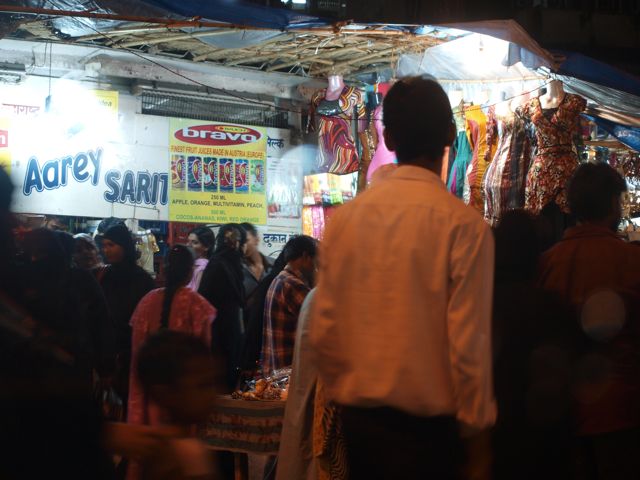
People crowding into stalls

Besides, there was nothing but excitement and food and salesmanship surrounding us. Everywhere you looked, food was cooking on indoor and outdoor stoves, men sold bangles and kufis, stilettos and hijabs. Sellers negotiated animatedly with potential buyers. The scene goes on and on like that for miles. You can stay on the main road or venture down side streets where the food can range from typical rice dishes to the more adventurous (brains and tongues and any other animal part you can name). And if you’re driving in, don’t be in a rush. It’s wall to wall traffic as everyone tries to push their way through the crowd.

It’s hard to describe the feeling that was in the air but I guess as a Jewish person I could relate to it somewhat – after all day of fasting on Yom Kippur I’m usually giddy with excitement to eat. If I could multiply that by an entire month of fasting each day I can’t imagine how elated I would be every night just to eat and soak in the energy. It seemed sort of fitting that we were going to see Ramazan’s end right after Rosh Hashanah, the Jewish New year. For us and everyone around us tomorrow is a new beginning.

It was a good welcome back.

One stall with one tiny light

Read Full Post »

(This post is dedicated to my grandmother – who reads this blog every day and loves seeing the world.)

In India, ‘the right to education’ has become a catch phrase. In a country with startling levels of illiteracy and poverty it’s hard to think of something more imperative than giving every child some kind of education. The UN Population Fund estimates that only 77% of men and 54% of women in India are literate (let’s not get started on that gender gap…).   But youth literacy is the key to the future; and UNICEF estimates that 87% of 15-24 year olds are literate – a better start than their parents and grandparents.

So when India’s ‘Right to Education Act’ came into force this past April, requiring compulsory education for every child ages 6-14, you’d think most people would jump for joy. But like ‘No Child Left Behind’, it seems that results are more difficult than just passing a law.

If you ask most people in India about education you’ll hear the same stories – the schools are crumbling, kids in poorer areas can’t even get in to a school. But it doesn’t matter if kids get into a ‘Municipal School’ because the teachers are so poorly trained they barely learn anything (ie: becoming literate may be the only thing they achieve in many years of schooling). There are no resources.

It’s not a pretty picture I’ve been painted.

So when I was asked to help out with InspirED, the innovation in education conference, I was interested to see what all the talk was about. How can you possibly even begin to solve these problems with a conference? I didn’t know – I still don’t know. But at least now I’ve seen some positives of Indian schooling.

One thing I wanted to do before the conference was go into schools, shoot some video, talk to teachers that were attending the conference.  And in this vein, I was inspired by what I saw.

A classroom wall

I went to the class of a teacher who is doing ‘Teach for India’ (the same basic model as Teach for America). And when I walked into the school, all the negatives I’d heard rang in my ear – the building was falling apart. Paint came off the walls in chunks. Children played in a courtyard made of cement. They were sharing desks and books.

But when I went into the class (a 3rd grade equivalent), the children were listening. They were writing letters to pen pals in London (adorable) –  they were supposed to be practicing proper grammar.  There were 35 kids in the class and they all wanted desperately to get their teacher’s attention. They were raising hands, participating, writing silently when asked to and (somewhat most astonishingly) not distracted by the large camera filming them.

It was one bright glimmer in a sea of classrooms I had clearly never seen or experienced. I haven’t been to the schools where the children are supposed to learn in English from a teacher who barely speaks English themselves. I haven’t been to the classrooms with no paper or pencils to write with. I certainly have seen, from my time in Dharavi, a lot of young people (women especially) who are taken out of school early or prevented from going altogether so they can work.

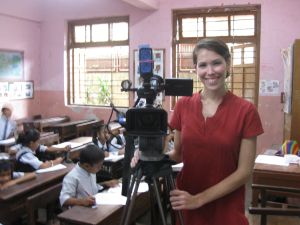
A photo of me in the class - now up on the 'Wall of Professional Visitors' for the kids to see!

So maybe it was naive to think that the solution is just good teachers. But (and this is a gross generalization), from everything I’ve heard, India doesn’t have our difficulties with unruly students and no desire to learn. The kids here are starving to learn. They behave in class. They just need a teacher who engages them even if the room is crumbling and even if their books look so worn you can barely the read the covers. Perhaps the right to education act can only come true when India gets serious about having teachers that live up to the quality of the student’s desires, even if the infrastructure isn’t there yet.

And that’s why having the conference is a good start- hopefully it can inspire a few more teachers to bring about change little by little in a country that wants to badly to make education a right that people actually receive.

I’m clearly talking about an issue where I know very little and have barely even begun to skim the surface.  But I wanted to share that moment because it gave me a bit of hope after hearing all the bad. I’m hoping for India’s sake that there can be more classes like that.

Read Full Post »

Film City

It’s not very often a person gets invited to go inside the heart of Bollywood. It’s probably even less often that the person doesn’t know where they’re getting invited to.

I, of course, am that silly person in this scenario.

To be fair, no one ever told me what Film City was. I was mostly just happy that someone was willing to lend me equipment.

You see, the biggest challenge for any person hoping to volunteer their time to Mumbai NGO’s as a journalist/documentarian (or, filmstress, as one friend recently dubbed me) is that to be productive you need the help of some very expensive equipment.

I’m used to working for organizations that own innumerable cameras, have all the editing space you need and technical support whenever you want. Here, I’m like a jockey without a horse.  NGO’s don’t have a budget for even the most basic resources, let alone thousands of dollars worth of camera and editing equipment.  So for the projects I’m working on, every scenario has been a bit of a scramble.

Luckily for one, we got a little bit of help.

I’m doing all the documentation for a large education conference taking place next weekend called InspirED (www.InspiredIndia.in if anyone is interested). The aim of the conference is to bring teachers and educators in from across the country to discuss ways to improve innovation in India’s classrooms.

One of the conference’s partners happened to be connected to someone at a major film school – and as such they were able to convince the film school to become a sponsor of the conference and donate equipment. It was a huge relief.

Our contact at the film school told me that I should come out to see the equipment and facilities I would be using. We set a time to meet and then he told me the school was located within Film City. The words flew over my head.

When I got in the car the next day I confused my driver: “Can we go to the film school in Film City. Do you know where Film City is?”

“You want to go to Film City?”

“Yes, it’s in Goregaon.”

“Yes, ma’am. I know where it is. Everyone knows where it is. Are you sure you have permission?”

“What do you mean?”

“You can’t go in without permission.”

“I… I have permission.” I said, still a bit confused by what he meant.

“Why would I need special permission?”

“Ma’am, Film City is where all the Bollywood movies are made.  You have to have authorization to go in.”

I assured him that we had permission, and he began to drive. But I was still quite curious- I asked him to tell me more.

Apparently, the land for Film City was given to the film industry by the Indian government and it’s been home to thousands of Bollywood movies since the first film was shot there in 1911. It’s on the edge of Sanjay Gandhi National Park (the largest urban park in the world) and it is a sprawling place- forests are next to large sets next to various sound-stages. While films are created across India, Film City is known as the hub. It’s as though half the studios in Hollywood were located in one place. And in an industry that puts out  over 900 films a year (more than Hollywood), that’s really saying something.

We drove up to the gate. A glowering guard stared at me as I rolled the window down. I gave him my name and he checked his list. Apparently, I was good to go.

An unused elaborate film set

We drove in and it was as though someone had turned the city on its head – the noise and dirt and pollution instantly disappeared. It was like we were driving down a remote dirt lane – hills stood tall in the distance as a lush forest came right up to the road.  It was hard to remember we were two minutes from the insanity of Bombay.

At every turn there was something else hidden in the space– an elaborate set, a soundstage, a group filming some movie or tv show. I know that hundreds of extras must see this every day but I couldn’t help but feel like I’d entered some secret compound. It just didn’t feel like the city anymore – and I suppose that’s what movies are supposed to do best. This was the perfect hidden space to make a film about anything.

We pulled into the film school and I was greeted at the door. I was shown the equipment and everything looked perfect- they were giving us great cameras and unlimited time in an edit room. It was fitting that they could give me everything we required for filming the conference – we were in need of a bit of magic and they, apparently, were in the right place to make it happen.

Read Full Post »

Drawing the Line

Today in Dharavi I got the giggles. And perhaps that seems strange on a day where the heavy monsoon forced me to wade through ankle-deep puddles consisting of rainwater, dirt, garbage and inevitably sewage. I felt as wet and as dirty as the huge rats that scurried through the small moats dug in the side of the narrow residential pathways.

But I couldn’t help but get the giggles.

The staircase up to the house

It started with a meeting and a ladder. A field worker brought me and my translator to the building where we would be attending a discussion on ration cards. When we arrived the field worker pointed up at a steep metal ladder. To get into the home of the woman hosting the discussion, we would have to climb a nearly vertical incline in the pouring rain. I said a little prayer and climbed up – this was, after all, the climb that every member of this family undertook multiple times every day.

Safely inside I washed my feet off and sat on the cold stone ground. My whole body was wet and a fan was humming right above my head – it was my first time since arriving in India that I’d actually been cold. I almost relished the feeling.

I looked around at the home. It was larger than some others I had been to, but more sparsely furnished. There were no beds or refrigerators or televisions. A teenage boy slept on a mat on the ground, oblivious to the meeting going on around him. Our host explained that he was her son. I blinked back at her, unsure of how to respond. This woman looked about 30 years old.

“He’s your son?” my translator asked in Hindi. The woman laughed.

“I know, we don’t look too far apart in age. But he is 18 and I am 33. I got married to my husband when I was 14.”

This sparked a discussion about everyone’s children – I found out that the 26-year-old field worker had an 11-year-old son. She passed around her mobile phone to show photos of her 11, 5 and 3 year old children. I guess at 25 I’m practically a spinster in Dharavi.

After this small-talk, the meeting began.  As with most of these meetings, the topic was not domestic violence (the non-profit’s stated purpose). Instead, today it was ration cards.

ration 'card', more like a book!

It’s hard to even delve into the statistics on ration cards in India without feeling a bit overwhelmed. In India, if you are ‘BPL’ (or Below the Poverty line) you qualify for a ration card.  The ration card entitles you to subsidized wheat, rice, dal, gas, oil and sugar.

But it’s shocking to hear what BPL actually is. While the exact number depends on the state you live in, to quality for BPL you have to earn less than 30,000 rupees annually for a family (approx $640). That works out to about $50 a month for an entire family to survive – and the average family in India is 5 or 6 people, which means each person is living on less than $10 a month.  330 million people qualify as BPL and theoretically receive ration cards. (Just FYI, these stats come from Indian government websites, which may or may not be totally accurate).

If you put this in perspective, our normal ‘Western’ heuristic of extreme poverty looks at individuals living on below $1 a day. However, about 45% of Indians fit into that category. If you expand the criteria to $2 a day 80% of India is included. By contrast, to qualify as BPL you would have to live on around 30 cents a day.

You would think that existing on 30 cents a day would be enough to go through, but apparently the Public Distribution System (which runs the ration cards scheme) is infected with corruption from the top down. And as such many (if not most) families have difficulties getting their rations.

The women we were speaking with faced all kinds of problems: The proprietor of one woman’s Fair Price Shop (where rations can be purchased) insisted that each purchase came with a 50 rupee (approx $1) surcharge. Another claimed he had run out of oil and had not supplied it for months. Another claimed that if the women complained he could take away their ration cards. And almost all received much less than their allotted rations for the month. It seemed to be widely known and accepted that the shopkeepers stole the remaining rations and sold them on the black market.

So the field worker began to explain to the women their rights – they could demand to see the price list, they could demand to write in the shop’s government-issued complaints booklet, their ration cards could not be taken away by anyone.  She said she was going to take them all to their Fair Price Shops to show them where all the items were located and to make sure the owners understood that they now knew their rights.

And so off we all went, down the treacherous staircase, and further into the streets. We were the most colorful and spirited mob of women you could find – 15 Indian women and one white woman in saris and kurtas, all soaked, still trying to avoid the rain – but with spirits bolstered by the newfound knowledge.

Some of the women in front of one shop

And it was on this trip that I got the giggles – because try to imagine a large group of women approaching one man who has systematically screwed them over time and again.  And then imagine his face once he realizes what’s happening.

I watched as the field worker stood in front of him and started explaining to the women what their rights were. She demanded to see his complaint book, she demanded to see his price list – and all he could do was watch and cooperate, looking angry and sheepish all at once.

“His face is damn priceless!” my translator whispered to me as we watched. She apparently also found the situation highly amusing.

And clearly this wasn’t going to solve the problems that existed on the state and national level – politicians and government workers are still going to steal rations and the money for rations. Our one day wouldn’t solve that.

But it was hard not to feel empowered by the scenario. These shopkeepers at the ground level had been put on notice. People who deserved to get food subsidies were closer to getting what they needed.  And all it took was a little bit of education – these women just needed to know that the shopkeepers couldn’t hurt them. They needed to know what they were entitled to.

How could I not feel good watching that? The problem wasn’t fixed, but these women had certainly taken a large step.

And so I just stood back, let the rain soak me through, and laughed while watching the tiny victory taking place in front of me.

Read Full Post »

« Newer Posts - Older Posts »